
Collaborative Robot Market Witnesses Strong Growth in Automation
How AI-powered automation, human-machine collaboration, and smart manufacturing initiatives are accelerating productivity, flexibility, and operational efficiency in the collaborative robot market.

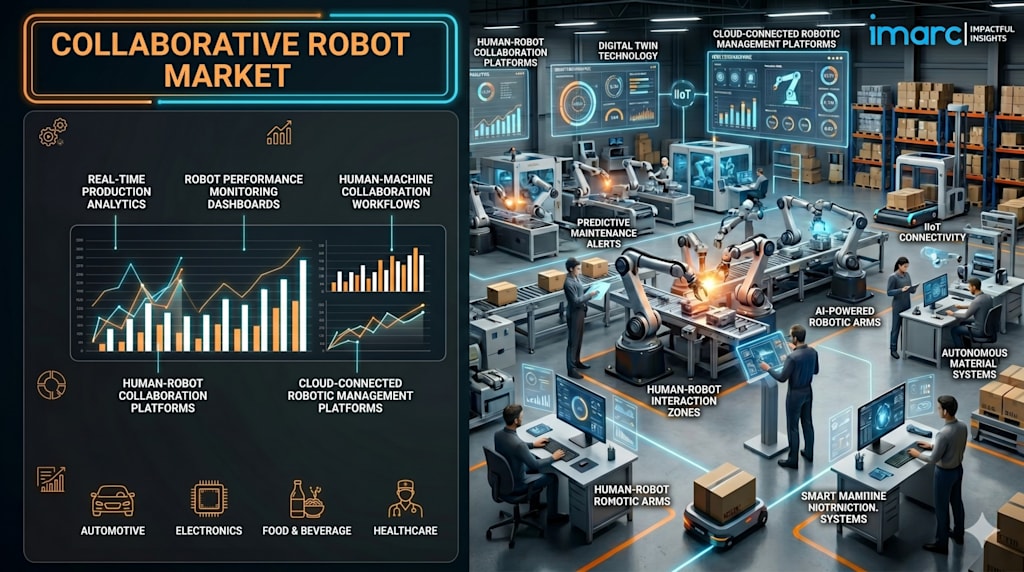
According to IMARC Group's latest research publication, "Collaborative Robot Market: Global Industry Trends, Share, Size, Growth, Opportunity and Forecast 2026-2034", The global collaborative robot market size reached USD 5.0 Billion in 2025. Looking forward, the market is expected to reach USD 80.3 Billion by 2034, exhibiting a growth rate (CAGR) of 35.02% during 2026-2034.
This detailed analysis primarily encompasses industry size, business trends, market share, key growth factors, and regional forecasts. The report offers a comprehensive overview and integrates research findings, market assessments, and data from different sources. It also includes pivotal market dynamics like drivers and challenges, while also highlighting growth opportunities, financial insights, technological improvements, emerging trends, and innovations. Besides this, the report provides regional market evaluation, along with a competitive landscape analysis.
How AI is Reshaping the Future of the Collaborative Robot Market
- E-Commerce Boom Driving Cobot Adoption in Warehouses: The rapid expansion of online retail and consumer preference for digital shopping has placed immense pressure on fulfillment operations. Collaborative robots are being deployed extensively in warehouses and distribution centers to automate repetitive tasks including picking, packing, sorting, and palletizing. In February 2024, OMRON Automation launched its TM S Series Collaborative Robots in India specifically to improve factory productivity in shared human-robot workspaces, with enhanced speed and performance across machine tending, assembling, and packaging tasks.
- Industrial Automation Creating New Efficiency Benchmarks: Collaborative robots are transforming production environments by operating safely alongside human workers without requiring physical barriers. Their ability to perform with continuous precision and repeatability reduces cycle times, minimizes errors, and lowers production costs. In October 2023, Schneider Electric introduced the Lexium Cobot, an advanced collaborative machine incorporating next-generation automation and industrial robotics technology designed specifically to boost both industrial productivity and workplace safety.
- Advanced Sensor Integration Expanding Cobot Capabilities: Modern cobots are increasingly equipped with sophisticated vision systems and multi-axis force-torque sensors that enable highly accurate environmental perception and delicate manipulation. In March 2024, Bota Systems AG launched the SenseONE T5, a highly sensitive multi-axis force-torque sensor with a sensitivity level of 0.05 N / 0.002 Nm, which is three to five times higher than its predecessor, opening new possibilities for small-payload cobots performing sensitive applications.
- AI and Machine Learning Elevating Cobot Decision-Making: Artificial intelligence and machine learning algorithms are being integrated into collaborative robot platforms to enhance path planning, autonomous decision-making, and adaptive task execution. In March 2024, Teradyne Robotics partnered with NVIDIA to embed AI capabilities into its industrial robots, with NVIDIA's computing infrastructure accelerating the path-planning process for cobots by up to 50 to 80 times.
- Industry 4.0 Policies Accelerating Regional Cobot Deployment: Government-backed Industry 4.0 initiatives across Asia-Pacific, Europe, and North America are creating structured demand for intelligent automation solutions. These frameworks encourage manufacturers to integrate smart robotics into production lines, directly benefiting the collaborative robot market by lowering adoption barriers and expanding the addressable base of mid-sized manufacturers and SMEs seeking cost-effective automation.
Collaborative Robot Industry Overview:
The global collaborative robot industry is undergoing rapid transformation and scale-up, underpinned by converging forces of labor shortages, rising wage costs, and the accelerating push toward flexible, intelligent manufacturing. Unlike traditional industrial robots that require protective caging and extensive floor space, cobots are designed from the ground up to work directly alongside human operators, making them accessible to a far wider range of production environments including electronics assembly, food processing, pharmaceutical packaging, and automotive component handling.
The logistics sector has emerged as one of the most significant demand drivers, with the exponential growth of e-commerce creating sustained pressure on warehouse operations to process higher order volumes with greater accuracy and speed. Nearly 50% of global consumers surveyed cited greater convenience as their primary reason for preferring online shopping over physical stores, a behavioral shift that directly translates into sustained cobot demand for fulfillment automation. Beyond logistics, the integration of torque and force-sensing technologies is enabling cobots to take on increasingly sophisticated tasks that were previously restricted to skilled human labor, further expanding the market's application scope across precision-dependent industries.
Collaborative Robot Market Trends and Drivers
Labor Shortages Compelling Manufacturers to Automate: Persistent shortages of skilled and semi-skilled manufacturing labor across major industrial economies are accelerating the adoption of collaborative robots as a practical operational solution. Cobots allow manufacturers to maintain and expand production capacity without dependence on a growing workforce, while simultaneously improving output consistency, reducing human error, and enabling workers to focus on higher-value tasks that require judgment and dexterity.
User-Friendly Design Lowering the Skills Barrier: The rising demand for cobots that do not require highly specialized programming expertise is reshaping the competitive dynamics of the market. Modern collaborative robots feature intuitive interfaces, hand-guided teaching functions, and drag-and-drop programming environments that allow operators with minimal technical backgrounds to deploy and reprogram systems quickly. This democratization of automation is opening the market to small and medium-sized enterprises that previously found automation inaccessible.
Assembly Line Integration Becoming Standard Practice: The growing employment of collaborative robots on manufacturing assembly lines for tasks including screwing, riveting, gluing, welding, and component placement is acting as a major growth-inducing factor. In June 2024, Delta introduced six variants of its six-axis D-Bot series of collaborative industrial robots, specifically engineered for precision in pick and place, welding, and palletizing applications across diverse manufacturing environments.
Innovative 7-Axis Cobot Architecture Expanding Flexibility: The evolution of cobot hardware design is enabling more versatile and space-efficient deployments. In May 2024, Kassow Robots launched what it described as the world's first 7-axis cobots with the controller integrated directly into the robot base, a design innovation that reduces cable complexity, minimizes installation footprint, and dramatically increases the range of motion for demanding manufacturing and assembly tasks.
Laser Technology Integration Creating New Industrial Applications: The convergence of collaborative robotics with advanced manufacturing processes is generating entirely new application categories. In May 2024, IPG Photonics Corporation developed an automated cobot laser welding and cleaning system targeting fabrication and manufacturing industries, combining the precision of fiber laser technology with the flexibility and safety profile of collaborative robot platforms.
Leading Companies Operating in the Global Collaborative Robot Industry:
- ABB Ltd.
- AUBO (Beijing) Robotics Technology Co. Ltd.
- DENSO WAVE Incorporated (Denso Corporation)
- Doosan Robotics Inc. (Doosan Group)
- Fanuc Corporation
- Kawasaki Heavy Industries Ltd.
- KUKA AG (Midea Group)
- Omron Corporation
- Precise Automation Inc. (Brooks Automation Inc.)
- Rethink Robotics GmbH
- TechMan Robot Inc. (Quanta Storage Inc.)
- Universal Robots (Teradyne Inc.)
- Yaskawa Electric Corporation
- Collaborative Robot Market Report Segmentation:
- Breakup by Component:
- Hardware
- Software
Hardware accounts for the dominant share owing to the growing demand for lightweight, compact robotic arms with precise motion control capabilities that can be deployed across diverse factory floor environments with minimal space requirements.
Breakup by Payload:
- Upto 5 Kg
- 5-10 Kg
- Above 10 Kg
The upto 5 Kg segment is widely favored in electronics and pharmaceutical industries that require delicate handling and high-precision manipulation, while the above 10 Kg segment is gaining momentum in automotive and aerospace applications demanding robust load-bearing performance.
Breakup by Application:
- Material Handling
- Pick and Place
- Assembly
- Palletizing and De-Palletizing
- Others
Material handling represents a critical application segment driven by the need for efficient transportation and organization of goods within warehouses and manufacturing plants, while assembly applications benefit from cobots' ability to enhance productivity and consistency across high-volume production processes.
Breakup by End Use Industry:
- Automotive
- Electronics
- Manufacturing
- Food and Beverage
- Chemicals and Pharmaceutical
- Others
The automotive industry leads end-use adoption, with cobots deployed for assembling components including dashboard modules, seats, and engines, as well as performing screwing, riveting, and gluing tasks with high precision. The electronics sector is also a major contributor, with cobots supporting PCB assembly and surface-mount technology processes.
Breakup by Region:
- North America (United States, Canada)
- Asia Pacific (China, Japan, India, South Korea, Australia, Indonesia, Others)
- Europe (Germany, France, United Kingdom, Italy, Spain, Russia, Others)
- Latin America (Brazil, Mexico, Others)
- Middle East and Africa
Asia Pacific holds the largest regional share and represents the fastest-growing market, fueled by rapid industrialization, expanding manufacturing sectors, increasing labor costs, and strong government support for Industry 4.0 adoption across China, Japan, India, and South Korea. North America benefits from widespread industrial automation adoption and advanced technological infrastructure, while Europe's well-established automotive and manufacturing base continues to drive sustained cobot integration across the region.
Recent News and Developments in the Collaborative Robot Market
- June 2024: Delta introduced six variants in its six-axis D-Bot series of collaborative industrial robots, engineered for precision performance across pick and place, welding, and palletizing applications in shared human-robot manufacturing environments.
- May 2024: Kassow Robots launched the world's first 7-axis cobots featuring a controller integrated directly into the robot base, a design innovation that enhances range of motion, simplifies installation, and reduces the physical footprint required for demanding manufacturing deployments.
- May 2024: IPG Photonics Corporation, a fiber laser solutions provider, developed an automated cobot laser welding and cleaning system targeting fabrication and manufacturing industries, combining advanced fiber laser technology with the flexibility and safety characteristics of collaborative robot platforms.
- February 2024: OMRON Automation launched its TM S Series Collaborative Robots in India to improve factory productivity across shared workspaces, with the series offering greater speed and performance for machine tending, assembling, and packaging tasks across manufacturing facilities.
- March 2024: Bota Systems AG launched the SenseONE T5, a highly sensitive multi-axis force-torque sensor with a sensitivity level of 0.05 N / 0.002 Nm, three to five times more sensitive than its predecessor, enabling small-payload collaborative robots to perform highly delicate applications across precision manufacturing environments.
Note: If you require specific details, data, or insights that are not currently included in the scope of this report, we are happy to accommodate your request. As part of our customization service, we will gather and provide the additional information you need, tailored to your specific requirements. Please let us know your exact needs, and we will ensure the report is updated accordingly to meet your expectations.
About the Creator
Abhay Rajput
I am working in market research company that provides market and business research intelligence across the globe.
Enjoyed the story? Support the Creator.
Subscribe for free to receive all their stories in your feed.
Comments
There are no comments for this story
Be the first to respond and start the conversation.