
Coffee Bean Market Expected to Reach US$ 54.95 Billion by 2034 as Global Coffee Culture Continues to Expand
Rising coffee consumption, specialty brewing trends, premium café experiences, and growing urban lifestyles are fueling steady growth across the global coffee bean industry.

Introduction
Coffee has evolved far beyond being just a morning beverage. Across the world, it has become part of social culture, professional routines, urban lifestyles, and premium consumer experiences. From independent specialty cafés to global coffee chains, the coffee industry is witnessing continuous transformation driven by changing consumer behavior and increasing demand for high-quality products.
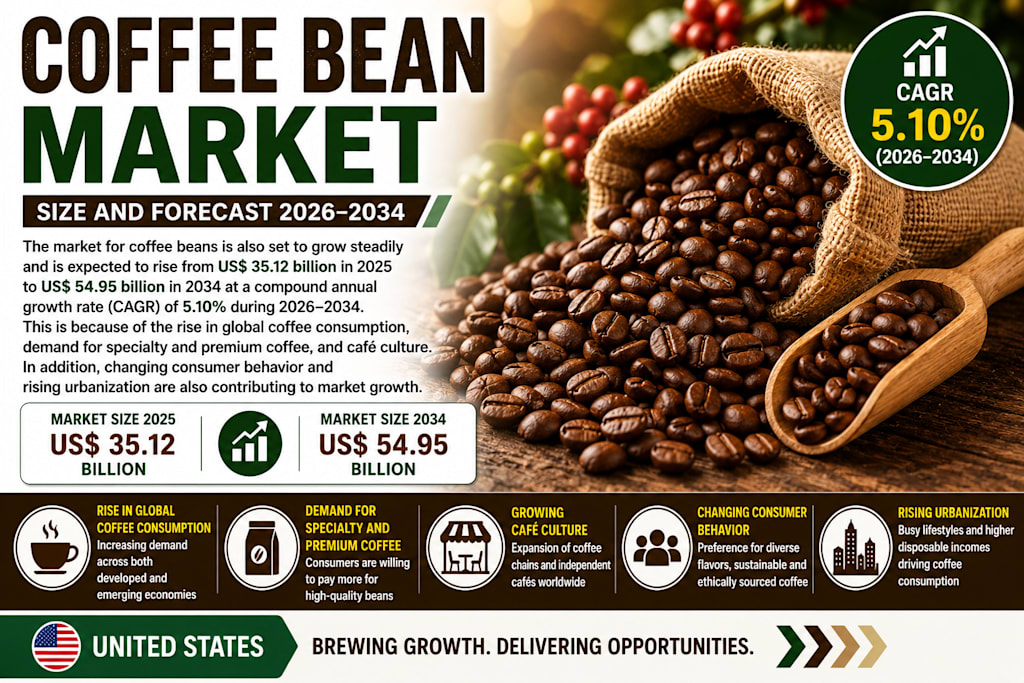
According to the provided Renub Research insights, the global coffee bean market is expected to grow from US$ 35.12 Billion in 2025 to US$ 54.95 Billion by 2034, expanding at a compound annual growth rate (CAGR) of 5.10% from 2026 to 2034. Rising coffee consumption, the expansion of café culture, increasing demand for premium and specialty coffee, and rapid urbanization are among the key drivers supporting market growth.
Coffee is no longer viewed only as a commodity. It has become a lifestyle-driven product shaped by flavor preferences, sustainability concerns, brewing innovation, and consumer identity. As global demand continues to rise, the coffee bean market is entering a new era defined by premiumization, specialty sourcing, and evolving consumption habits.
Understanding the Coffee Bean Industry
Coffee beans are the seeds found inside coffee cherries produced by coffee plants. After harvesting, the beans go through multiple stages including processing, drying, roasting, grinding, and brewing before becoming the beverage consumed globally.
The two primary varieties are Arabica and Robusta coffee beans. Arabica beans are generally known for their smoother flavor and lower acidity, while Robusta beans have a stronger taste and higher caffeine content.
Coffee quality and flavor depend heavily on factors such as origin, altitude, climate, farming methods, and roasting techniques. Because of these variables, coffee has become one of the most diverse and experience-driven products in the global food and beverage industry.
Over time, coffee culture has expanded from traditional consumption into specialty brewing, café experiences, premium retail products, and home-based brewing systems. This evolution continues to strengthen global demand for coffee beans.
Rising Global Coffee Consumption Is Fueling Demand
One of the strongest growth drivers for the market is the steady increase in global coffee consumption. Coffee has become a daily necessity for millions of people worldwide, especially in urban environments where fast-paced lifestyles encourage convenient beverage choices.
The report references data from the International Coffee Organization (ICO), which forecasts world coffee production for 2025/26 to reach a record 178.8 million bags, supported by production recovery in Vietnam and increased output from Indonesia and Ethiopia.
Coffee consumption continues expanding across both developed and emerging markets. Younger consumers are increasingly adopting coffee culture, while Western-style café experiences are becoming more popular globally.
Urbanization also plays a major role. As cities grow and professional lifestyles become more demanding, consumers increasingly rely on coffee for energy, convenience, and social interaction.
The growing popularity of takeaway coffee, ready-to-drink beverages, and premium café experiences further supports market expansion. As more people incorporate coffee into their daily routines, global demand for coffee beans continues to rise steadily.
Specialty Coffee Is Transforming the Industry
One of the most important developments in recent years is the rapid growth of specialty and premium coffee.
Modern consumers are becoming more knowledgeable about coffee origins, roasting techniques, flavor profiles, and brewing methods. Instead of focusing solely on price or convenience, many coffee drinkers now seek unique taste experiences and high-quality products.
Specialty coffee refers to coffee produced in unique growing conditions with carefully managed harvesting and processing methods. These products often emphasize traceability, sustainability, and distinctive flavor characteristics.
Specialty cafés have played a major role in driving this trend. Coffee shops now educate consumers about brewing methods, bean origins, and tasting notes, helping transform coffee into a premium lifestyle experience.
Premiumization also allows producers and coffee brands to improve profitability through higher-value offerings. The report highlights that in November 2025, Ethiopia officially launched the Specialty Coffee Association of Ethiopia (SCAE) to strengthen global recognition of Ethiopian specialty coffee and support new opportunities for producers and exporters.
As coffee enthusiasts increasingly prioritize quality over quantity, specialty coffee demand is expected to remain a major industry growth engine.
Café Culture Continues Expanding Worldwide
The rise of café culture has fundamentally changed global coffee consumption patterns. Cafés are no longer simply beverage outlets; they have become social hubs, workspaces, networking environments, and lifestyle destinations.
International coffee chains and local café brands continue expanding rapidly across urban markets worldwide. Consumers increasingly seek premium coffee experiences, comfortable environments, and personalized beverage options.
This trend is especially strong among younger urban consumers who view cafés as part of their daily social and professional routines.
The report highlights a major development from February 2026, when China-based Luckin Coffee introduced a premium flagship store concept aimed at competing directly with Starbucks’ high-end Roastery format.
This reflects a broader industry shift toward premium café experiences and high-quality coffee offerings, particularly in rapidly growing Asian markets.
The continued growth of café chains is expected to drive sustained demand for high-quality coffee beans globally.
Climate Change Is Creating Serious Industry Challenges
Despite strong market growth, the coffee industry faces major long-term challenges linked to climate change.
Coffee plants are highly sensitive to environmental conditions such as temperature, rainfall, and humidity. Changes in weather patterns can significantly impact crop quality and production levels.
Droughts, irregular rainfall, rising temperatures, and frost events increasingly threaten major coffee-producing regions. Climate-related challenges can reduce yields, damage crops, and increase vulnerability to pests and diseases.
Supply chain instability caused by climate disruption can also lead to price fluctuations and production uncertainty across global markets.
Brazil, one of the world’s largest coffee producers, has already experienced challenges related to drought and frost conditions affecting production stability. Similar risks exist across multiple coffee-growing countries.
As climate pressures intensify, the industry will likely require greater investment in sustainable farming methods, climate-resistant coffee varieties, and environmentally responsible agricultural practices.
Price Volatility Remains a Key Concern
Price volatility continues to be another major issue within the coffee bean market.
Coffee prices are influenced by numerous factors including weather conditions, production levels, geopolitical developments, supply chain disruptions, and changing consumer demand.
Economic instability in producing regions can also affect export performance and global pricing trends.
For producers, maintaining consistency in premium coffee production while managing unpredictable pricing conditions can be difficult. Specialty coffee producers especially face pressure to preserve quality standards despite market uncertainty.
Because coffee is traded globally, fluctuations in currency exchange rates and transportation costs can also impact profitability throughout the supply chain.
Managing these risks remains one of the industry’s most significant ongoing challenges.
The European Union Remains a Major Consumption Hub
The European Union continues to represent one of the world’s largest coffee consumption markets due to its deeply rooted coffee culture and high per-capita consumption rates.
Countries including Germany, Italy, France, and the Netherlands remain major coffee-consuming nations where coffee plays an important role in everyday life.
European consumers increasingly prefer high-quality, organic, fair-trade, and sustainably sourced coffee products. Specialty cafés and advanced brewing methods have further strengthened premium coffee demand across the region.
The European Union is also one of the world’s largest coffee importers, sourcing Arabica and Robusta beans from leading producing countries such as Brazil, Vietnam, and Colombia.
The report notes that the European Union imported 2.7 million metric tonnes of organic products in 2023, reflecting strong regional interest in sustainability and certified agricultural products.
This strong focus on sustainability continues shaping global coffee trade practices.
Brazil Continues Leading Global Coffee Production
Brazil remains the world’s largest producer and exporter of coffee beans, particularly Arabica coffee.
The country’s favorable climate, large agricultural areas, and advanced farming infrastructure allow Brazil to maintain a dominant position in global coffee supply.
Brazilian Arabica coffee is especially valued for its smooth flavor profile and relatively low acidity. The report highlights that Brazil exported more than 40 million bags of coffee in 2025, reinforcing its importance within the international market.
Despite environmental challenges and climate risks, Brazil continues investing in production efficiency and sustainable farming methods to maintain global competitiveness.
Its export performance heavily influences international coffee pricing and supply chain dynamics.
Vietnam Strengthens Its Position in Robusta Coffee
Vietnam remains the world’s largest producer of Robusta coffee, accounting for approximately 97% of its coffee production.
Robusta coffee is widely used in instant coffee, espresso blends, and high-caffeine products due to its strong flavor and affordability.
Government support, favorable climatic conditions, and export-oriented farming strategies have helped Vietnam become one of the most influential players in the global coffee industry.
The report estimates Vietnam’s coffee exports reached approximately 25 million 60-kilogram bags during the 2023–2024 period.
Vietnam’s role is particularly important as demand for affordable and mass-market coffee products continues to rise globally.
Convenience and Roast-and-Ground Products Are Growing
Changing lifestyles are increasing demand for convenient coffee formats such as roast-and-ground coffee, single-serve systems, and ready-to-use products.
The United States remains one of the largest markets for roast-and-ground coffee imports because of strong demand for packaged and convenient coffee solutions.
Single-serve brewing systems have also transformed consumer habits by making premium-style coffee more accessible at home and in workplaces.
According to the report, global consumption of roast-and-ground coffee exceeded 170 million 60-kilogram bags in 2024, representing more than 60% of the total coffee market.
Convenience-focused consumption patterns are expected to remain an important driver of market growth.
Competitive Landscape
The global coffee bean market includes several powerful international brands and beverage companies competing across retail, café, and specialty coffee segments.
Key players highlighted in the report include Starbucks, Nescafé, Keurig Dr Pepper, JDE Peet’s, J.M. Smucker, Coca-Cola, Dutch Bros, Kraft Heinz, and Luckin Coffee.
Competition increasingly focuses on premiumization, sustainability, café expansion, specialty offerings, product innovation, and consumer experience.
Companies capable of balancing convenience with premium quality are expected to maintain strong market positions as consumer expectations continue evolving.
Final Thoughts
The global coffee bean market is entering a period of sustained and dynamic growth fueled by rising consumption, evolving café culture, specialty coffee demand, and premium consumer experiences.
The market’s projected growth from US$ 35.12 Billion in 2025 to US$ 54.95 Billion by 2034 reflects coffee’s expanding role in modern global lifestyles.
At the same time, the industry faces major challenges related to climate change, supply chain stability, and pricing uncertainty.
As consumers increasingly seek quality, authenticity, convenience, and sustainability, coffee companies will need to innovate continuously while maintaining ethical sourcing and environmental responsibility.
Coffee is no longer simply a beverage commodity. It has become a global cultural and economic force shaping consumer behavior, retail experiences, and international trade across every region of the world.
About the Creator
Enjoyed the story? Support the Creator.
Subscribe for free to receive all their stories in your feed.
Comments
There are no comments for this story
Be the first to respond and start the conversation.