
Cloud Infrastructure Is Entering Its Most Resilient Era
Hybrid cloud networks are evolving beyond speed and scale, placing reliability, observability, and automation at the center of enterprise computing.
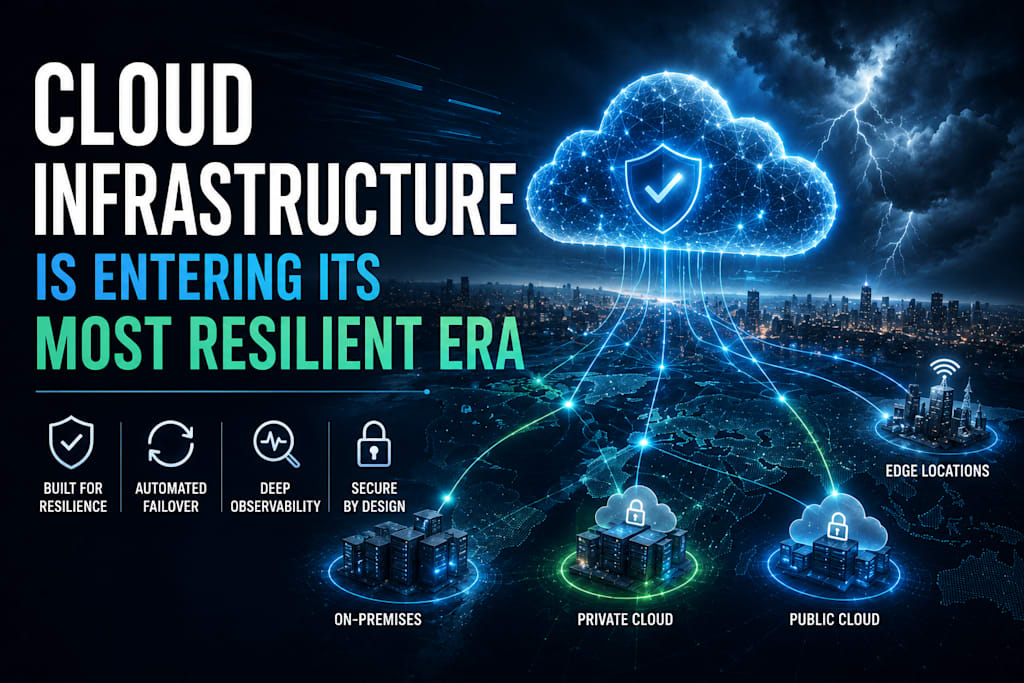
As AI, edge computing, and always connected applications become the norm, the next generation of cloud infrastructure will depend on networks that never stop adapting.
For years, the conversation around cloud computing has focused on speed, scalability, and cost. Organizations raced to move workloads into the cloud, adopt containers, and automate deployments. These changes transformed software development, but they also introduced a new challenge that is becoming impossible to ignore.
Modern applications can scale in seconds, but they are still vulnerable to something much simpler. Network failure.
As businesses become more dependent on cloud services, uninterrupted connectivity is no longer a technical luxury. It is becoming the foundation of digital operations. The future of cloud infrastructure will not belong to the fastest platforms. It will belong to the ones that continue operating even when parts of the network fail.
That shift is quietly changing the way infrastructure is designed.
The cloud is no longer a single destination
Most enterprises no longer operate from one data center or one cloud provider. Instead, applications are spread across public clouds, private environments, edge locations, and on premises infrastructure.
This hybrid approach offers flexibility, but it also creates complexity.
Every connection between these environments becomes another potential point of failure. A single outage, routing issue, or network disruption can affect customer experiences, business operations, and internal systems within seconds.
As organizations continue expanding their digital footprint, building resilient networks is becoming just as important as building better software.
Downtime is becoming more expensive than ever
A few years ago, temporary network interruptions were often viewed as operational inconveniences.
Today they can halt financial transactions, interrupt healthcare systems, disrupt manufacturing, or disconnect AI services that rely on constant communication between distributed infrastructure.
The cost of downtime is no longer measured only in lost revenue. It is measured in customer trust.
Users expect digital services to remain available regardless of what happens behind the scenes. They rarely care whether an outage was caused by a cloud provider, an internet service provider, or a routing problem.
They simply expect everything to work.
That expectation is forcing infrastructure teams to rethink how networks should behave when failure becomes inevitable.
Building infrastructure that expects failure
One of the biggest changes happening in cloud engineering is a philosophical one.
Instead of assuming networks will remain healthy, engineers are increasingly designing systems that assume failures will happen.
This mindset changes everything.
Rather than relying on manual intervention after an outage, modern infrastructure automatically detects unhealthy connections, reroutes traffic, and restores communication without interrupting users.
In many ways, resilience is becoming an active capability instead of a backup plan.
Technologies such as WireGuard, automated failover mechanisms, and continuous network monitoring are helping organizations build systems that recover almost immediately when disruptions occur.
Observability is becoming a competitive advantage
As infrastructure grows more distributed, visibility becomes just as important as connectivity.
A network cannot recover from problems it cannot detect.
Modern observability platforms provide engineers with continuous insight into latency, routing behavior, packet loss, and network health across multiple environments. Instead of reacting after customers report an issue, operations teams can identify abnormal behavior before it becomes a business problem.
This shift from reactive maintenance to proactive infrastructure management will define the next generation of enterprise networking.
Hybrid cloud is becoming the default future
The debate over public versus private cloud is gradually disappearing.
The future belongs to organizations that combine multiple environments and move workloads wherever they make the most operational sense.
That future requires networking technologies that remain secure, flexible, and resilient across every location.
This is one reason infrastructure engineering is receiving renewed attention. Companies are realizing that cloud strategy is no longer only about compute power or storage capacity. It is equally about how reliably those environments communicate with each other.
Engineering resilience into the future
Technology companies are increasingly sharing practical approaches for solving these infrastructure challenges. GeekyAnts, for example, recently explored how resilient hybrid cloud networking can be built using WireGuard, automated route based failover, and deep observability to maintain reliable connectivity across distributed environments. Rather than treating resilience as an afterthought, the approach places continuous availability at the center of infrastructure design.
This reflects a broader trend across the industry.
Future ready infrastructure is no longer defined by how quickly it scales during normal operations. It is defined by how gracefully it responds when unexpected failures occur.
The next era of cloud computing
Artificial intelligence, autonomous systems, edge computing, and real time analytics all depend on reliable networking. As these technologies become more deeply integrated into everyday business operations, resilient infrastructure will become one of the most valuable competitive advantages an organization can build.
The companies leading the next decade of digital transformation will not necessarily be the ones with the biggest cloud environments.
They will be the ones whose systems continue operating when everything around them becomes unpredictable.
Cloud computing has already transformed where software runs.
The next transformation will determine how reliably it survives.
About the Creator
Enjoyed the story? Support the Creator.
Subscribe for free to receive all their stories in your feed.
Comments
There are no comments for this story
Be the first to respond and start the conversation.