
Climate-Resilient Construction Materials Market Expands as Builders Prepare for a More Extreme Future
Rising climate risks, stricter regulations, and new low-carbon technologies are transforming how the world designs and constructs buildings.

The global construction industry is entering a new era where resilience is becoming just as important as cost and speed. Buildings are no longer expected merely to stand strong under normal conditions — they must also withstand heatwaves, floods, storms, wildfires, and rising energy pressures.
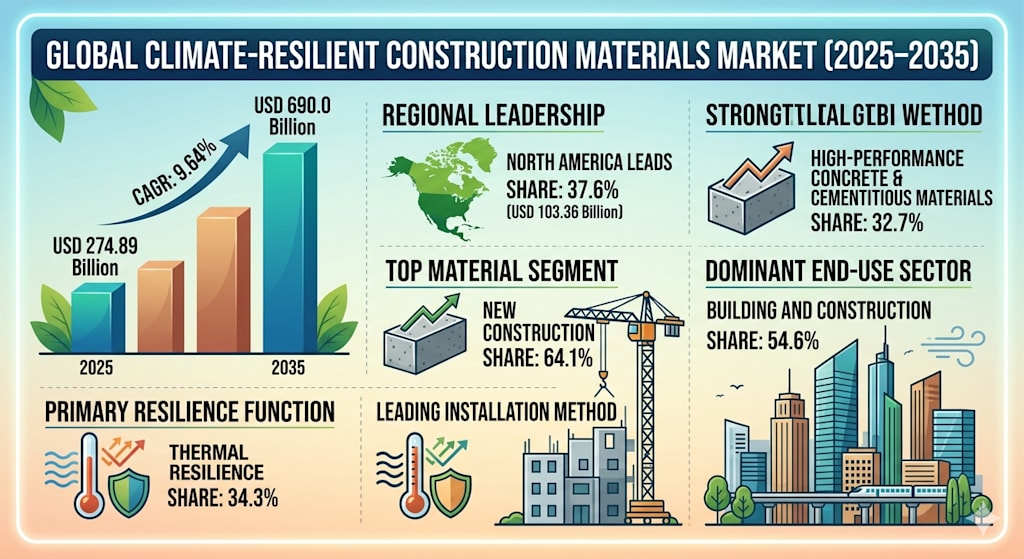
This shift is driving rapid growth in the Climate-Resilient Construction Materials Market, which is projected to increase from USD 274.89 billion in 2025 to approximately USD 690.0 billion by 2035, growing at a CAGR of 9.64%.
The market’s growth reflects a fundamental change in construction priorities. Governments are tightening environmental standards, infrastructure agencies are rewriting procurement rules, and enterprise buyers are increasingly choosing materials that offer both lower carbon emissions and higher durability.
From advanced cement systems and cool roofing technologies to bio-based insulation and moisture-resistant composites, resilient materials are becoming essential to modern building design rather than optional upgrades.
Market Highlights
- North America leads all regions with a 37.6% share, valued at USD 103.36 Billion.
- High-performance Concrete and Cementitious Materials holds the top material segment at 32.7%.
- New Construction leads by installation method with 64.1% of market share.
- Thermal Resilience is the leading resilience function segment at 34.3%.
- Building and Construction drives end-use demand with a 54.6% share.
Why Climate Resilience Is Reshaping Construction
Extreme weather events are becoming more frequent and more expensive. Heatwaves are straining energy systems, floods are damaging infrastructure, and wildfires are forcing insurers and developers to rethink building standards. As a result, resilience has become a financial and operational concern for governments, businesses, and property owners alike.
Construction materials now play a critical role in reducing these risks. Modern resilient materials are engineered to maintain structural performance under difficult environmental conditions while also improving energy efficiency and lowering lifecycle emissions. This dual benefit is one of the key reasons demand is accelerating so quickly.
Procurement policies are also changing rapidly. Public projects in many regions now require contractors to use certified low-carbon or climate-adaptive materials. This creates a competitive advantage for suppliers that can provide verified performance data and environmental product declarations, often referred to as EPDs.
Developers and investors are responding as well. Commercial real estate companies increasingly face pressure from lenders and tenants to prove that assets are durable, energy efficient, and aligned with long-term climate goals. In practice, this means climate-ready materials are becoming central to investment and construction decisions worldwide.
Advanced Concrete and Cement Systems Lead Demand
High-performance concrete and cementitious materials currently dominate the market, accounting for 32.7% of total demand. Their leadership is largely tied to the construction industry’s long-standing trust in concrete systems, which remain the backbone of infrastructure and large-scale building projects.
What is changing is the type of concrete being specified. New formulations using supplementary materials, recycled content, and lower-clinker blends are helping reduce emissions while improving resilience against heat, moisture, and structural stress. These products are gaining traction because they fit within existing engineering standards while delivering measurable environmental benefits.
Low-carbon cement technologies are becoming particularly important. Limestone calcined clay cement, commonly known as LC3, can reduce carbon emissions significantly while also lowering production costs compared to traditional Portland cement. This combination of affordability and performance is helping remove one of the industry’s biggest adoption barriers.
Alternative systems are advancing quickly as well. Bio-based materials, fly-ash concrete, and geopolymer binders are increasingly appearing in commercial and public-sector projects. Several new housing developments and infrastructure pilots have shown that these materials can deliver faster construction timelines and lower lifecycle costs without sacrificing structural integrity.
Cool roofing and reflective materials are also growing in popularity, especially in regions facing extreme summer temperatures. By reflecting more sunlight and absorbing less heat, these materials help lower indoor temperatures and reduce air-conditioning demand, creating immediate energy savings for building owners.
New Construction Remains the Primary Growth Engine
New construction currently accounts for the largest share of market demand, representing 64.1% of installation activity. The reason is straightforward: it is far easier and more cost-effective to integrate resilient materials during the design phase than to retrofit older structures later.
Governments are accelerating this trend through infrastructure spending and updated building standards. Public housing programs, transportation projects, and municipal developments increasingly require certified climate-adaptive materials from the start. In many markets, suppliers that fail to meet carbon or resilience standards are excluded from major tenders altogether.
Adaptive reuse projects are becoming especially attractive in urban areas. Rather than demolishing and rebuilding, developers are finding that upgrading existing structures can dramatically reduce embodied carbon while also lowering project expenses. This approach is increasingly viewed as both environmentally responsible and financially practical.
Thermal and Fire Resilience Are Becoming Essential Features
Among resilience categories, thermal resilience leads the market with a 34.3% share. This reflects the growing importance of controlling indoor temperatures as energy prices rise and climate conditions become more severe.
Thermal-performance materials improve insulation, reduce heat transfer, and stabilize indoor environments. In hot climates, cool roofs and reflective pavements can lower surface temperatures dramatically, helping reduce cooling loads and urban heat island effects. In colder regions, advanced insulation systems improve energy retention and reduce heating demand.
The business case for thermal resilience is especially strong because the savings are measurable. Lower energy consumption translates directly into reduced operating costs, making these materials attractive not only for environmental reasons but also for long-term financial performance.
Fire resilience is also emerging as a critical market driver. Wildfires across North America, southern Europe, and Australia have increased demand for fire-rated walls, structural assemblies, and roofing systems. Insurers are increasingly tying coverage terms and premiums to fire-resistant construction standards, creating additional financial incentives for adoption.
Seismic, flood, and wind resilience are similarly gaining attention in climate-vulnerable regions. Infrastructure agencies are beginning to specify materials capable of withstanding stronger storms, rising water exposure, and seismic stress as part of broader disaster-prevention strategies.
Regional Markets Are Expanding at Different Speeds
North America currently leads the global market with a 37.6% share valued at approximately USD 103.36 billion. Strong government procurement programs, mature environmental regulations, and major infrastructure investments have helped create stable demand for certified climate-resilient products.
The United States, in particular, has accelerated adoption through sustainability funding initiatives tied to embodied-carbon measurement and environmental disclosure standards. These policies are encouraging manufacturers to invest more aggressively in low-carbon production systems.
Europe remains one of the most regulation-driven regions. The EU Green Deal and national climate laws are embedding carbon limits directly into procurement frameworks and building codes. Countries such as Ireland and the United Kingdom are already implementing standards that favor lower-carbon cement systems and advanced concrete technologies.
Asia Pacific represents the highest-volume growth opportunity due to rapid urbanization and large-scale infrastructure expansion. China, India, and Southeast Asia are investing heavily in resilient construction systems as climate risks intensify across the region. Private-sector launches of low-carbon cement products and green building alliances are accelerating regional market maturity.
Challenges Still Limit Faster Expansion
Despite strong momentum, the market faces several important challenges. One of the biggest barriers is the slow pace of building-code updates. Many innovative materials already demonstrate strong technical performance but cannot yet be widely used because regulations have not formally approved them for standard construction categories.
Certification costs also remain high, especially for smaller suppliers. Producing environmental product declarations and obtaining third-party verification can be expensive, limiting market access for emerging companies.
Supply constraints represent another issue. Production capacity for ultra-low-carbon cement and advanced resilient materials remains limited compared to projected global demand. Scaling these technologies requires significant investment in manufacturing infrastructure, carbon-capture systems, and supply chains.
Conclusion
The Climate-Resilient Construction Materials Market is rapidly evolving from a specialized sustainability niche into a foundational part of global construction strategy. Rising climate risks, stricter regulations, and changing investor expectations are pushing builders to prioritize resilience and carbon performance together rather than treating them as separate goals.
Innovations in concrete technology, insulation systems, cool roofing, and bio-based materials are making climate-ready construction more practical and more cost-effective than ever before. Governments and large corporations are reinforcing this momentum through procurement mandates, infrastructure spending, and new performance standards.
About the Creator
Yash Mule
SEO Specialist with 10+ years of experience at Evolvance Market Research. Expert in technical SEO, content strategy, and data-driven optimization, with a proven track record of significantly increasing organic traffic and search rankings.
Enjoyed the story? Support the Creator.
Subscribe for free to receive all their stories in your feed.
Comments
There are no comments for this story
Be the first to respond and start the conversation.