
Claude Shannon: The Engineer Who Made the Digital World Possible
The little-known genius whose ideas about switches, binary numbers and information helped create computers, telecommunications and the Internet
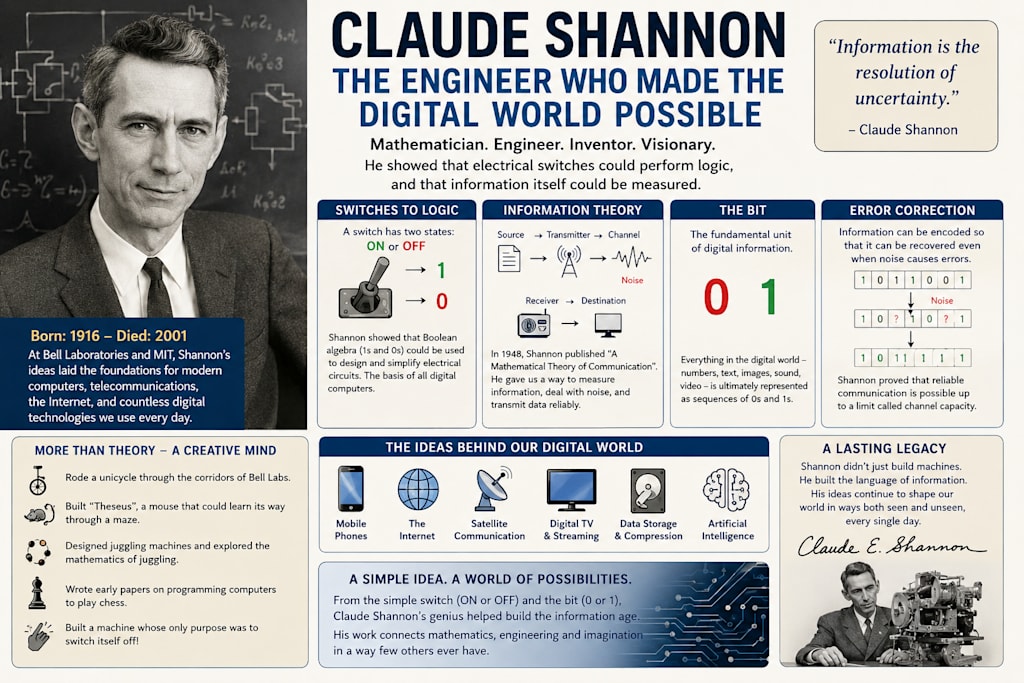
When we talk about the people who created the modern technological world, familiar names usually appear: Alan Turing, John von Neumann, Bill Gates, Steve Jobs and Tim Berners-Lee. Yet one of the most important people behind virtually every computer, mobile telephone and digital communication system remains comparatively unknown outside engineering and mathematics. His name was Claude Shannon.
Shannon was an American mathematician and electrical engineer whose work answered two extraordinarily important questions. First, could electrical switching circuits perform logic? Second, could information itself be measured mathematically? His answers helped establish the foundations of both digital electronics and information theory.
Every time we send an email, stream a film, make a digital telephone call, store a photograph, compress a file, or transmit information across the Internet, we live in a technological world that Shannon helped make possible.
From Switches to Logic
Claude Elwood Shannon was born in Michigan in 1916. As a boy, he was fascinated by mechanical and electrical devices. He constructed model aeroplanes and radio equipment and even built a telegraph system connecting his house with a friend's using nearby fencing.
He later studied electrical engineering and mathematics at the University of Michigan before moving to the Massachusetts Institute of Technology, MIT, and it was there that something remarkable happened.
Shannon worked with the differential analyser, an enormous mechanical analogue computer developed under Vannevar Bush. The machine contained complex networks of electrical relays that controlled its operation.
A relay is essentially an electrically operated switch. It can be open or closed. Shannon recognised something that seems obvious today but was revolutionary at the time. A switch has two states: ON or OFF, and these two states could be represented as 1 or 0. Shannon then connected this idea with a branch of mathematics developed almost a century earlier.
George Boole Had Already Invented the Mathematics
In the nineteenth century, the English mathematician George Boole had developed what became known as Boolean algebra. Boole was interested in logic rather than computers. His system dealt with propositions that could have two states, such as: TRUE or FALSE. Mathematical operations could then be performed upon those logical values using concepts such as AND, OR and NOT.
Nobody in Boole's time had a digital computer on which to use this mathematics. Then Shannon realised that Boole's logic corresponded almost perfectly with electrical switches. TRUE could be represented by a closed switch, and FALSE could be represented by an open switch, or, more generally:
1 = ON
0 = OFF
Networks of switches could therefore perform logical operations, and that idea changed engineering.
Perhaps the Most Important Master's Thesis Ever Written
In 1937, when Shannon was only 21, he produced his MIT master's thesis, A Symbolic Analysis of Relay and Switching Circuits. It demonstrated how Boolean algebra could be used to design and simplify electrical switching circuits. The significance was enormous.
Before Shannon, engineers could design relay systems, but complicated circuits were often developed through practical engineering methods rather than a comprehensive mathematical framework. Shannon showed that their operation could be expressed mathematically. A circuit was no longer simply a collection of wires and switches. It could represent logic. This principle became fundamental to digital circuit design.
The relays were eventually replaced by vacuum tubes, then transistors and finally microscopic transistors inside integrated circuits, but the underlying principle remained. The computer or smartphone you use today contains billions of electronic switches performing operations ultimately reducible to logical relationships between zeros and ones.
Shannon and Alan Turing
Shannon's career also crossed that of another great pioneer of computing. During the Second World War, Shannon worked at Bell Laboratories, where he became involved in cryptography and secure communications. Alan Turing visited Bell Labs in 1943 while working on wartime cryptographic matters, and Shannon and Turing met.
The two men approached computing from different directions. Turing had explored what a theoretical computing machine could calculate, and Shannon demonstrated how logical operations could be physically implemented using switching circuits. Their work became complementary foundations of computer science.
What Exactly Is Information?
Shannon's second great breakthrough was arguably even more profound. Engineers had always transmitted information. Telegraph operators transmitted messages. Telephones transmitted speech. Radio stations transmitted sound, but what exactly was information, and could it be measured? Shannon realised that it could.
In 1948, he published a landmark paper called A Mathematical Theory of Communication. It effectively created the modern field of information theory. Shannon stripped communication down to its essentials. There is an information source; a message; a transmitter; and a communication channel, but there may be noise interfering with the message. There is also a receiver, and finally a destination. That model applies equally well to a telegraph wire, telephone line, radio link, fibre-optic cable, satellite connection or Wi-Fi network.
The Bit
Shannon's theory helped establish the bit as the fundamental unit of digital information. The term "binary digit" had already been shortened to "bit" by mathematician John Tukey, but Shannon's work made the concept fundamental to information theory. A bit has two possible values: 0 or 1.
That sounds almost absurdly simple, yet combinations of bits can represent virtually anything. Eight bits traditionally form a byte, and patterns of bits can represent letters, while other patterns represent numbers. Millions of bits can represent photographs, and billions can represent films. Speech, music, documents, programs and entire libraries can ultimately be represented by sequences of zeros and ones. Shannon helped provide the mathematics explaining how much information those sequences contain and how efficiently they can be transmitted.
Noise Does Not Have to Destroy the Message
Another remarkable consequence of Shannon's theory concerned errors.
Communication channels contain noise. A radio signal experiences interference. Electrical signals suffer disturbances. Wireless signals weaken. Data transmitted over enormous distances can become corrupted. It might seem inevitable that sufficiently noisy communication must eventually become unreliable. Shannon demonstrated something much more surprising.
Provided that the information rate remains below a mathematical limit known as the channel capacity, it is theoretically possible to encode information so that it can be transmitted with an arbitrarily low probability of error. That result became a fundamental principle of modern communications engineering. Error-correcting codes, digital television, mobile communications, satellite systems, computer storage and deep-space communications all exist in a world shaped by Shannon's insight.
He Also Explained Data Compression
Shannon's mathematics also established theoretical limits on how much information could be compressed without losing its essential content. Suppose a message contains a great deal of predictable or repetitive information. We do not necessarily need to transmit every part of it independently, as we can encode it more efficiently. That basic principle lies behind modern data compression.
ZIP files, compressed images, digital audio and video all exploit redundancy and statistical structure, although today's compression systems employ techniques developed long after Shannon. Shannon established the mathematical framework showing that such limits exist.
Shannon Was Not a Conventional Academic Genius
Despite the seriousness of his work, Shannon had a playful personality. He was famous for riding a unicycle through the corridors of Bell Labs, sometimes while juggling, and he also built mechanical gadgets simply because they amused him. One was a machine whose sole purpose was to switch itself off. When somebody turned it on, a mechanical hand emerged and turned the switch off again.
He built juggling machines, experimented with mechanical mice, and even developed ideas connected with juggling theory. Shannon also became interested in chess-playing machines long before computers were powerful enough to challenge the best human players. In 1950, he published an influential paper discussing how a computer could be programmed to play chess. Decades before Deep Blue defeated Garry Kasparov, Shannon was already thinking about how machines could search possible moves intelligently.
The Mouse That Could Learn
One of Shannon's most entertaining inventions was Theseus, an electromechanical mouse that could navigate a maze. The mouse moved through the maze searching for a target. The underlying system could remember the successful route, allowing Theseus to complete the maze more efficiently on subsequent attempts. It was an early demonstration of a machine appearing to "learn" from experience. This was happening around 1950. Artificial intelligence was barely recognised as a field.
The Ultimate Machine
Shannon's famous self-switching-off machine reveals something important about him. He enjoyed ideas for their own sake. Many brilliant engineers concentrate upon making something commercially useful. Shannon was just as interested in whether something was intellectually amusing. That freedom probably contributed to his extraordinary creativity.
During its greatest period, Bell Labs provided an unusual environment in which exceptional scientists and engineers could pursue fundamental questions without being required to turn every idea immediately into a commercial product. The results included the transistor, major advances in telecommunications and Shannon's information theory.
The Man Behind Everything Digital
It is difficult to identify a modern technology that does not somehow depend upon Shannon's ideas. Mobile phones encode information digitally. The Internet transmits packets containing binary data. Satellites use error correction. Digital television compresses enormous quantities of information. Computer processors contain logic gates. Storage systems represent information using bits. Artificial intelligence runs on digital computers constructed from logical switching circuits, and even communication with spacecraft billions of kilometres from Earth depends upon extracting information from extremely weak, noisy signals.
Shannon did not personally invent all these technologies, as what he did was arguably more fundamental. He provided part of the mathematical language that made them possible.
Shannon's Extraordinary Combination
Claude Shannon occupied an unusual position between mathematics and engineering. George Boole had created a mathematics of logic. Electrical engineers had created switching circuits. Shannon connected them all together. Communication engineers transmitted signals, and mathematicians studied probability. Shannon also connected those too.
That ability to recognise that two apparently separate subjects were actually manifestations of the same underlying idea was perhaps his greatest talent. A relay was not merely a switch; it could represent a logical statement. A telephone signal was not merely electricity travelling down a wire; it contained measurable information. Noise was not simply an engineering nuisance; it could be analysed mathematically. Once those connections had been made, entirely new fields became possible.
The Engineer Who Deserves to Be Better Known
Claude Shannon died in 2001 at the age of 84, and by then, the world his ideas had helped create was everywhere. Personal computers had become commonplace. The Internet was expanding rapidly. Mobile telephones were spreading around the world. Digital photography and music were replacing analogue technologies. Yet relatively few of the people using these inventions knew his name.
Perhaps that is because Shannon did not create one famous consumer product. There is no Shannon computer, Shannon telephone or Shannon website sitting in our homes. Instead, his ideas lie underneath almost all of them.
Alan Turing helped answer the question: What can a computer calculate? Claude Shannon helped answer another: How can logical information be represented, processed and communicated? The modern digital world required answers to both.
Every email, photograph, telephone conversation, streamed film and web page eventually becomes information represented and transmitted electronically. Behind that enormous digital universe lies an astonishingly simple idea: ON or OFF, TRUE or FALSE, and 1 or 0. Claude Shannon recognised that from those two states, we could build an entire information age.
About the Creator
Alan Spencer
Have been an author and writer for over 20 years. Have been a journalist, editor, proofreader, and a designer and presenter of training courses. Have written over 100 articles, two books, and around 20 training courses.
Enjoyed the story? Support the Creator.
Subscribe for free to receive all their stories in your feed. You could also become a paid subscriber, letting them know you appreciate their work.
Comments
There are no comments for this story
Be the first to respond and start the conversation.