
Chrono Splice
When Time Fractures, Who Holds the Threads?

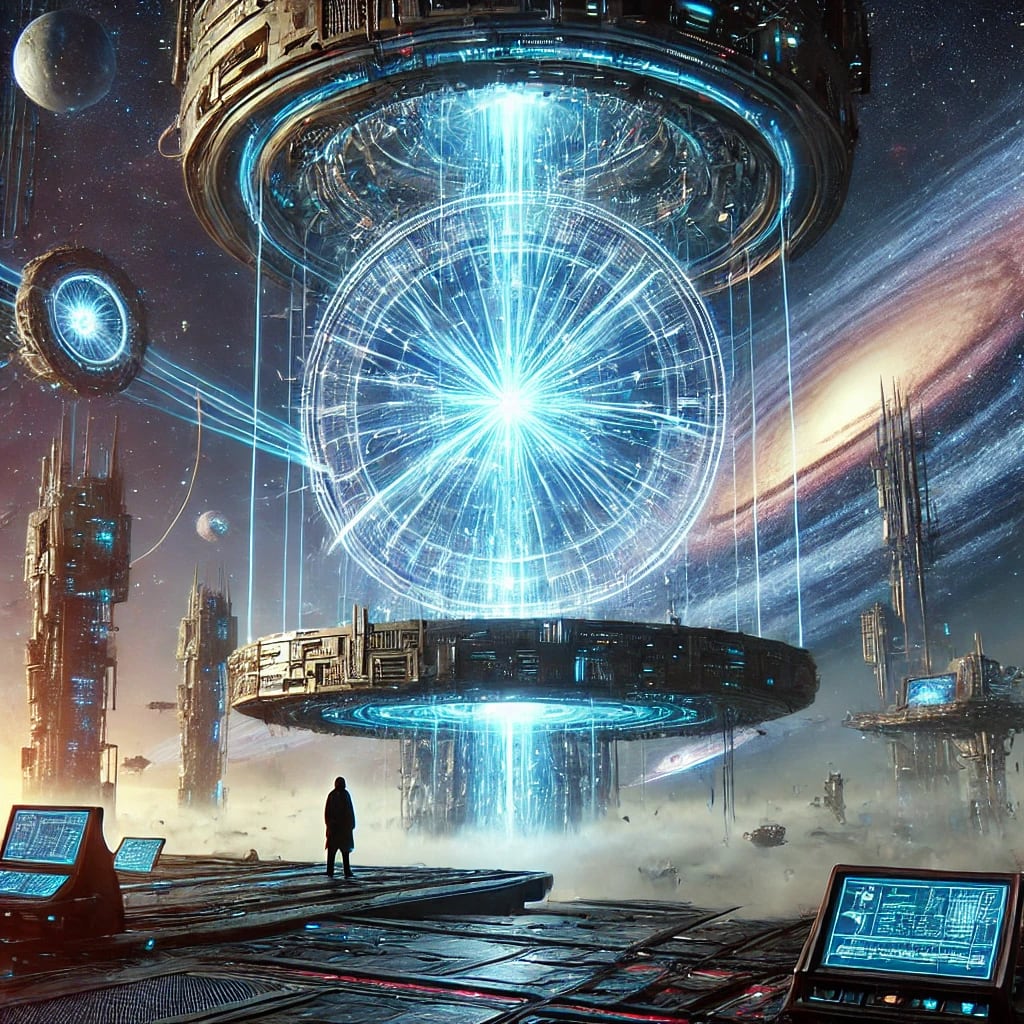
In the year 2267, Earth was no longer the isolated blue dot in the cosmos. Humanity had conquered the stars, ventured into the unknown, and established colonies on distant planets. Technological advancements had reached unimaginable heights, with one particular breakthrough surpassing all others—time manipulation.
The Chrono Splice Project, a secret endeavor spearheaded by the Unified Galactic Council, aimed to use this technology to rewrite the past, reshape the present, and influence the future. It wasn’t about traveling through time, but rather creating "splices"—small, controlled fractures in the timeline that could alter events without disturbing the fabric of reality. If done right, it could solve the most pressing issues of the galaxy: wars, famines, even the climate catastrophe on Earth. But no one fully understood the risks involved. Time, after all, was not something to be trifled with.
Leading the project was Dr. Maia Velasquez, a brilliant yet cautious quantum physicist. She had always harbored deep reservations about tampering with the timeline, but her superiors at the Galactic Council insisted the Chrono Splice was the future—literally and figuratively. It was to be used sparingly, they assured her, only for events of extreme importance.
And so, despite her concerns, Maia and her team completed the construction of the Chrono Nexus, a machine capable of creating and controlling time splices. It was housed deep within the Chrono Spire, a towering facility floating in the L4 Lagrange point between Earth and the Moon, away from prying eyes and external influences. Only a select few knew of its existence, let alone its purpose.
The first splice was to be a simple test: they would shift an insignificant event from 50 years prior—a failed launch of a space probe that had no significant impact on history. It was the perfect starting point. If something went wrong, the ripple effect would be minimal, and corrections could be made.
On the day of the first splice, Maia stood before the Chrono Nexus, her hands shaking slightly as the machine powered up. A cascade of lights illuminated the chamber as the machine hummed with raw quantum energy. She glanced at her assistant, Samir, who gave her a reassuring nod.
“Splice initiated,” Maia whispered, as she pressed the activation panel.
The room shuddered slightly, as if reality itself was adjusting to the new timeline. The display on the console in front of Maia blinked rapidly, recalibrating. The splice was clean. The launch from 50 years ago had succeeded. History had been altered without anyone noticing. No catastrophic changes. No paradoxes. The project was a success.
Over the following months, the Council authorized more splices. Minor tweaks at first—averting a failed diplomatic mission here, ensuring the discovery of a crucial medical breakthrough there. But with each successful splice, the Council grew bolder. Soon, they wanted to prevent wars, adjust political outcomes, and even alter the course of technological progress. What had started as minor interventions now became a tool to manipulate entire civilizations.
Maia, though still in charge of the project, began to feel increasingly uneasy. The timeline, once a delicate thread, was now a tangled web of splices and changes. The more they altered, the more unstable reality became. She noticed anomalies in the simulation models—unpredictable shifts in outcomes that hadn’t occurred in their original projections. It was as if time itself was rebelling.
One day, during a routine analysis, Maia detected a splice anomaly unlike anything they had seen before. An event—an unknown catastrophe—was looming in the future, a direct result of the splices they had made. The timeline, fragile and volatile, was on the verge of collapse.
She brought her findings to the Council, urging them to cease all further manipulations until the anomaly was fully understood. But they refused. The power of the Chrono Splice had become too alluring. They believed they could correct the future by making one final splice, erasing the anomaly from existence before it even occurred.
But time is not a puzzle to be reassembled at will. It is a living entity, unpredictable and relentless. Maia knew this, but she was just one voice against the ambition of an empire.
Left with no choice, Maia took drastic action. She deactivated the Nexus and, in a final act of defiance, locked herself inside the Chrono Spire. If the Council wanted to make more splices, they would have to go through her.
For days, Maia worked in isolation, pouring over every splice they had made, trying to find the exact moment when time began to fracture. She slept little, ate even less, consumed by the gravity of her task. The more she studied, the more she realized that the damage was far worse than she had imagined. The anomaly wasn’t just a future event—it was already here.
Reality itself had begun to warp. People reported seeing phantom versions of themselves, flickers of alternate lives that had never come to pass. Buildings shifted, as though parts of them belonged to different timelines. Entire sections of the colony ships that orbited nearby vanished and reappeared in different states of existence. The timeline was unraveling.
Desperate, Maia tried to reverse the splices, but the Nexus wasn’t designed for that. Each splice they had made had merged into a new, permanent version of reality. Undoing them was impossible. She needed a new solution, one that could stabilize the timeline and prevent the collapse of everything they had ever known.
That’s when she realized: the only way to save the future was to sacrifice the present.
She devised a plan—a final splice, not to the past or future, but to the very fabric of time itself. It would effectively reset the timeline, erasing every splice, every change they had made. But in doing so, it would erase everyone and everything in the present. Humanity would have to start again, without the burden of tampered time.
The Council, realizing the full extent of the catastrophe, relented. They gave Maia permission to enact the splice. It was the only way. But it came with a price. The splice had to be initiated from within the Nexus, and once it was activated, there would be no turning back. Maia would be the last person to exist in this timeline.
On the day of the final splice, Maia stood alone in the Nexus chamber. She had given the order for all personnel to evacuate the Spire. It was just her and the machine now. As she prepared to initiate the splice, she hesitated for a moment, looking at the reality she had known one last time.
With a deep breath, she pressed the panel.
“Splice initiated.”
The room trembled, and the world around her dissolved into light. For a brief moment, Maia felt everything—every timeline, every possibility, every life that had ever existed. And then, as quickly as it had begun, it was over.
The timeline reset. And with it, time itself was whole again.
About the Creator
Enjoyed the story? Support the Creator.
Subscribe for free to receive all their stories in your feed.
Comments
There are no comments for this story
Be the first to respond and start the conversation.