
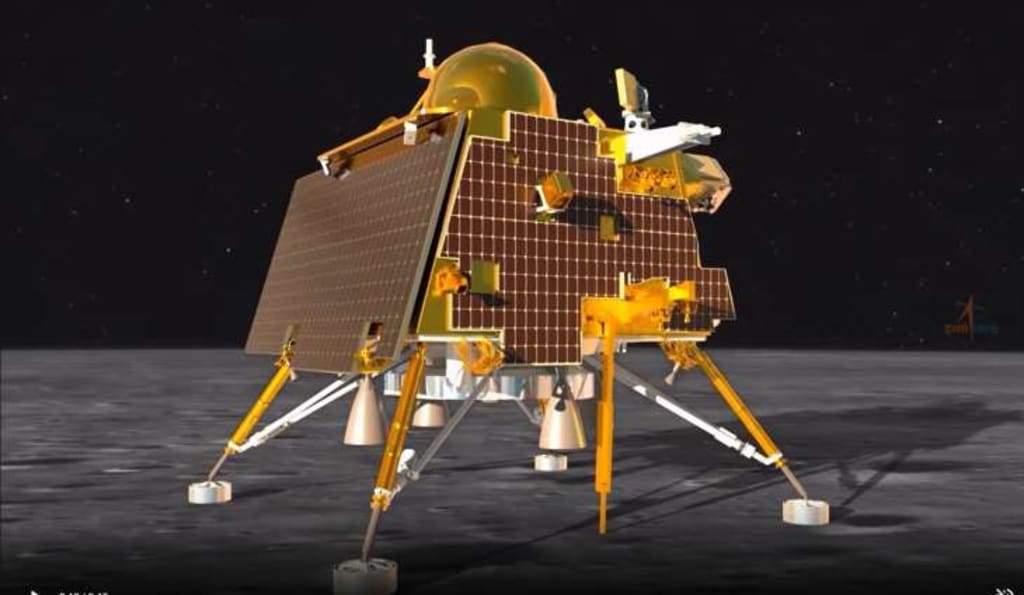
India has achieved a significant milestone in lunar exploration by successfully landing a spacecraft near the lunar South Pole for the first time in history. With this achievement, India joins the exclusive club of countries, including the USA, Russia, and China, that have accomplished a soft landing on the moon. However, India's feat is particularly notable because it marks the first time a country has landed near the lunar South Pole, a potential location for future moon bases.
This accomplishment is the primary objective of Chandrayaan-3, India's third lunar mission, which was launched on July 15th, 2023. The lunar South Pole is a unique and challenging region, with temperatures ranging from -10 degrees to 60 degrees Celsius, depending on the depth, and the possibility of water ice being trapped in permanently shadowed craters. Water ice is of great significance for future lunar missions, as it can serve as a source of drinking water, oxygen, and rocket fuel.
Chandrayaan-3 aims to study the lunar environment and resources around the South Pole. It intends to measure the temperature profile and chemical composition of the lunar soil.
India's space program began in 1962, and since then, it has launched numerous satellites, rockets, and probes into space, establishing itself as a leading spacefaring nation. Chandrayaan-1, India's first lunar mission in 2008, orbited the moon for almost a year and provided valuable data and images of the lunar surface. Chandrayaan-2, launched in 2019, included an orbiter, a lander called Vikram, and a rover called Pragyan. Although Vikram and Pragyan were intended to land near the South Pole, they lost contact with Earth during the final descent and crashed on the lunar surface. Undeterred, India launched Chandrayaan-3, essentially a replica of Chandrayaan-2's lander and rover with improvements and modifications.
Chandrayaan-3 embarked on its journey on July 15th, 2023, from India's Satish Dhawan Space Center. After about a month, it reached the moon's orbit and performed several maneuvers to adjust its trajectory and altitude. On August 20th, 2023, it initiated its final descent towards the South Pole, facing numerous challenges. The communication delay of about 3 seconds between Earth and the Moon required Chandrayaan-3 to rely on its onboard computer and sensors for navigation. Additionally, there was no detailed map of the landing site, making it necessary for Chandrayaan-3 to use its own camera and radar for terrain scanning. The South Pole region also had limited sunlight, necessitating the use of onboard batteries and solar panels for power. Despite these difficulties, Chandrayaan-3 successfully landed near the South Pole on August 28th, 2023, and promptly sent back its first image of the lunar far side area. The rover, Pragyan, was deployed an hour later, and both the lander and rover began their scientific mission on the moon.
Chandrayaan-3 has two main objectives: to demonstrate India's capability for soft landing and roving on the moon and to conduct scientific experiments to study the lunar environment and resources. It carries 14 onboard payloads on the lander and rover, designed to measure various aspects of the lunar surface and subsurface, including temperature, radiation, seismic activity, mineralogy, and chemistry. Notably, ChaSTE (Chandra's surface thermophysical experiment) is a crucial payload on the lander, capable of probing up to 10 centimeters into the lunar soil to measure its temperature profile. This data can help estimate the depth and availability of buried water ice. Another important payload, LRRA (Lunar Retro Reflector Array), has eight mirrors to reflect laser beams for precise measurements of the Earth-Moon distance and testing general relativity. It can also detect low-frequency radio signals from the lunar far side.
The rover, Pragyan, carries payloads such as APXS (Alpha Particle X-ray Spectrometer) to analyze the chemical composition of lunar rocks and soil and LIBS (Laser-Induced Breakdown Spectroscopy) to determine the abundance and isotopic ratios of different elements on the lunar surface.
Chandrayaan-3's scientific results have been shared with the public through the Indian space agency's official website and social media channels. These results provide valuable insights into the lunar surface and subsurface, contributing to our understanding of the Moon.
Looking ahead, Chandrayaan-3 has more plans and goals to achieve. The lander and rover are expected to operate for at least one lunar day, equivalent to 14 Earth days, during which they will conduct various experiments, including drilling into the soil, analyzing samples, and testing technologies. Communication between the lander, rover, and Earth will be facilitated through the Chandrayaan-3 Orbiter, which will continue to orbit the Moon. The orbiter has a lifespan of approximately seven years, ensuring a prolonged period of data collection and imaging of the lunar surface, especially the South Pole region, which remains largely unexplored.
Chandrayaan-3 is not only a significant milestone for India's space program but also an inspiration for those who dream of exploring the unknown. It underscores the importance of vision, passion, and determination in achieving seemingly impossible goals. Furthermore, it opens up possibilities for future lunar missions from India and collaboration with other space agencies, such as NASA and ESA, to explore the Moon comprehensively. The Moon holds not only scientific intrigue but also potential as a future habitat for humans and a gateway for deep space exploration, making its study vital for future exploration and utilization beyond Earth.
About the Creator
Enjoyed the story? Support the Creator.
Subscribe for free to receive all their stories in your feed.
Comments
There are no comments for this story
Be the first to respond and start the conversation.