
Challenger: The Small Seal That Exposed a Much Bigger Failure
How an O-ring failed in the cold, why engineers feared the launch, and how Richard Feynman helped the world understand what went wrong
Introduction
On 28th January 1986, the space shuttle Challenger rose from its launch pad in Florida. Seventy-three seconds later, the vehicle broke apart, and all seven people aboard lost their lives. Among them was Christa McAuliffe, a teacher whose planned lessons from space had brought particular attention to the flight.
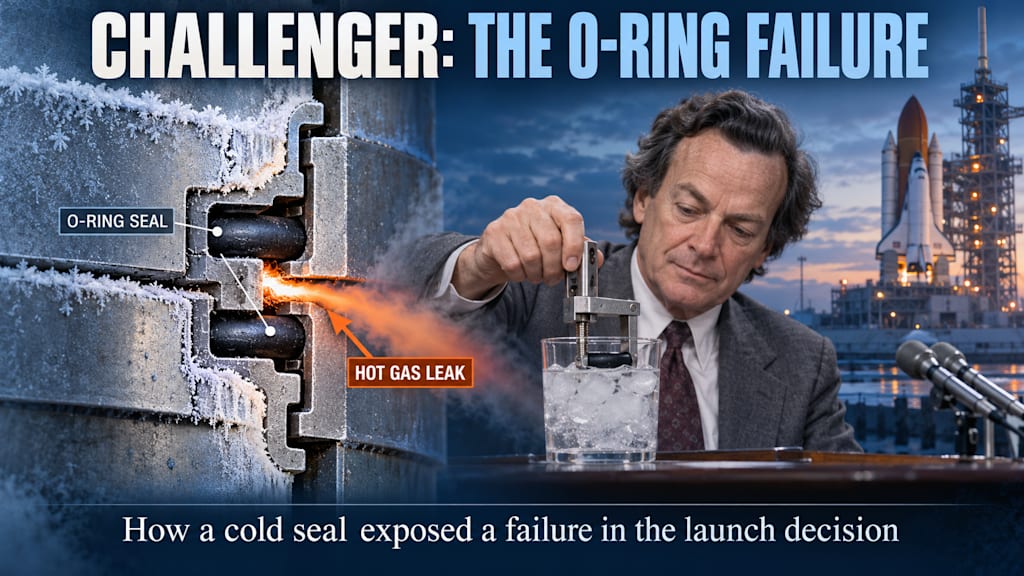
The investigation would focus on a rubber seal called an O-ring. Richard Feynman later made its weakness visible with a simple experiment involving a clamp and a glass of ice water. His demonstration became famous, but the deeper question was why the shuttle had launched when engineers had already raised concerns about the cold.
What Was the O-ring Supposed to Do?
Challenger had two large solid rocket boosters attached to its external tank. Each booster was assembled from sections, and the joints between those sections needed to stop extremely hot gas escaping during launch. Rubber O-rings sat inside the joints to provide that seal.
The joints moved slightly as pressure rose inside a firing booster. For the seal to work as intended, an O-ring needed to respond quickly and close any opening. Rubber that had become stiff in the cold might respond too slowly, allowing hot gas to pass before the seal was properly established.
This was no minor leak in an ordinary machine. The boosters burned with enormous force beside the external tank, which carried the propellants for the shuttle’s main engines. A failure at a booster joint could put the entire vehicle in danger.
Warnings Before the Launch
The morning of the launch was unusually cold for Florida. Engineers at Morton Thiokol, the company that made the boosters, had examined damage to O-rings after earlier flights. They were concerned about launching at temperatures below those for which they had relevant flight experience.
During a discussion with NASA on the evening before launch, Thiokol engineers initially recommended against flying if the O-ring temperature was below 53°F, about 12°C. That figure represented the lowest temperature associated with a previous shuttle launch, rather than a proven boundary between safe and unsafe operation. After NASA officials challenged the recommendation and Thiokol management reconsidered it, the company changed its position and recommended launch. Some of its engineers remained opposed.
The presidential commission that investigated the disaster later described the decision to launch as flawed. It found that key decision-makers had not been made fully aware of the O-ring problems, the contractor’s initial written recommendation, or the engineers’ continuing objections. The warnings existed, but they had not been handled in a way that gave safety the weight it required.
What Happened During the Flight?
Soon after liftoff, photographs showed smoke coming from a joint in the right-hand booster. A seal at that joint had failed to prevent hot gas escaping. Later in the flight, a flame emerged from the booster area and damaged the structure beside the external tank. At about 73 seconds, Challenger broke apart.
It is tempting to picture one little rubber ring suddenly snapping. The failure was more complicated. The joint’s design, its movement under pressure and the O-rings’ response in the cold all mattered. Earlier signs of damage had also been observed without a disaster, which made it easier for people to treat a dangerous condition as something the shuttle could survive.
That history made the accident especially troubling. A successful previous flight did not prove that a damaged seal was safe. It showed only that the seal had not failed completely on that occasion.
Feynman and the Glass of Ice Water
Richard Feynman, the physicist and Nobel Prize winner, served on the presidential commission investigating the accident. During a public hearing, he placed a sample of O-ring material in ice water and squeezed it with a clamp. When he released the pressure, the cold rubber did not immediately spring back to its original shape.
The demonstration took only moments, and it made a technical concern understandable to anyone watching. If the rubber could not recover its shape quickly, how could it be relied upon to seal a moving rocket joint during the first moments of launch? Feynman said the material had lost its resilience for several seconds at the temperature of the ice water.
Feynman did not discover the O-ring problem on his own. Engineers had been raising concerns before the launch, and the commission drew on extensive evidence from flight records, photographs, tests and testimony. His contribution was to give the public a clear view of the physical behaviour at the heart of the investigation.
The Failure Beyond the Seal
Feynman’s wider concern was how an organisation could keep flying after seeing evidence that an essential part was being damaged. In his appendix to the commission’s report, he challenged the reasoning that treated previous survival as proof of adequate safety. If a component was not meant to erode, finding erosion should prompt a serious investigation. It should not quietly become an accepted feature of normal operation.
The launch decision exposed a related failure in communication. Engineers closest to the problem expressed doubts, but those doubts lost force as the decision moved through management. The commission concluded that a safety system working properly would have highlighted the growing concern about the booster joint well before the launch.
Near the end of his appendix, Feynman wrote a sentence that has outlasted the investigation: “For a successful technology, reality must take precedence over public relations, for nature cannot be fooled.” His point was direct. Confidence, schedules and past success could not change how cold rubber behaved inside a rocket.
Conclusion
The Challenger disaster began with a failed seal, but it cannot be understood by looking at the O-ring alone. Engineers had noticed warning signs, the cold introduced a risk beyond previous flight experience, and the final decision did not properly reflect those concerns.
Feynman’s glass of ice water remains memorable because it reduced a complex engineering issue to something people could see. The lasting lesson is larger than the experiment: when evidence shows that a critical part may fail, the people making the decision must listen before the machine is put to the test.
About the Creator
Alan Spencer
Have been an author and writer for over 20 years. Have been a journalist, editor, proofreader, and a designer and presenter of training courses. Have written over 100 articles, two books, and around 20 training courses.
Enjoyed the story? Support the Creator.
Subscribe for free to receive all their stories in your feed. You could also become a paid subscriber, letting them know you appreciate their work.
Comments
There are no comments for this story
Be the first to respond and start the conversation.