
Cement Market Outlook: Infrastructure Development and Growth Opportunities
The Cement Market is experiencing strong growth driven by increasing infrastructure development and construction activities worldwide.

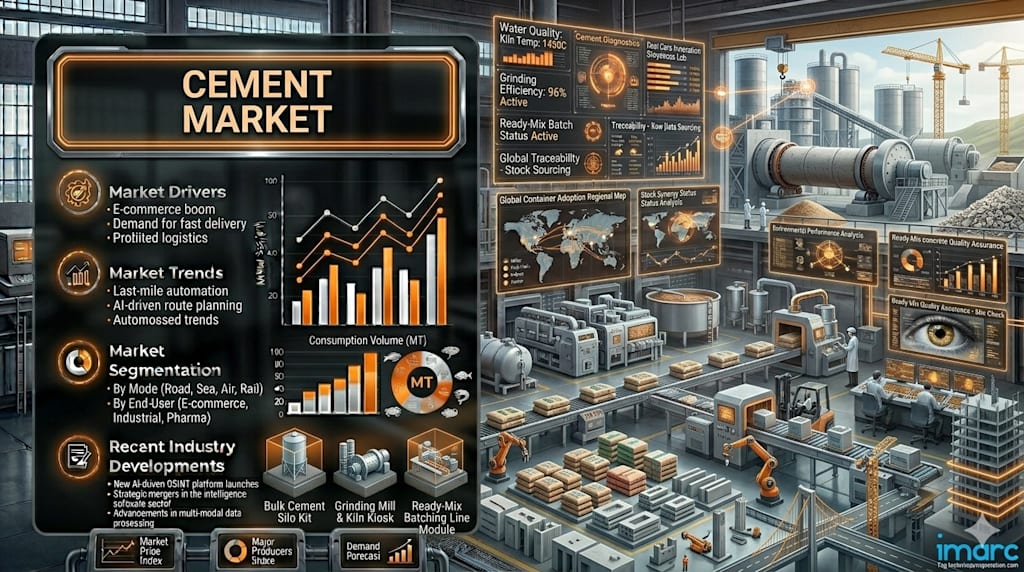
According to IMARC Group's latest research publication, The global cement market size was valued at USD 428.5 Billion in 2025, and is projected to reach USD 676.2 Billion by 2034, growing at a CAGR of 5.20% during 2026-2034.
How AI is Reshaping the Future of Cement Market
- Intelligent Kiln Optimization and Energy Management: AI-driven systems analyze live production data including feed rate, temperature, and pressure in rotary kilns, adjusting process settings in real-time. This reduces free lime variation by 10 percent, lowers coal consumption by additional 1 percent, and ensures consistent clinker quality through deep learning control methods.
- Predictive Maintenance and Equipment Reliability: Machine learning algorithms monitor 28 scenarios including roller abnormalities and belt tearing, enabling 24/7 equipment monitoring and early warning systems. This transforms inspection methods from human effort to AI-driven intelligence, reducing unplanned downtime and improving maintenance planning accuracy across global production networks.
- Concrete Mix Design and Material Discovery: Bayesian optimization platforms intelligently navigate vast spaces of possible concrete formulations, learning from existing data and historical mix designs. AI suggests high-potential candidates meeting target specifications while incorporating constraints upfront, accelerating discovery of lower-carbon, faster-curing formulations without compromising performance.

Cement Industry Overview:
The Infrastructure Investment and Jobs Act allocated USD 1.2 Trillion in total funding, with approximately USD 500 billion for roads, bridges, and major infrastructure projects. As of September, 40 percent of allocated funding has been spent, providing sustained cement demand for coming years. Data centers require nearly 1 million tons of cement through the next three years, with annual spending reaching USD 27.4 billion, representing 38.6 percent of office-related construction spending projected by 2027.
Cement Market Trends & Drivers
Urbanization and population growth are driving unprecedented construction activity across developing economies and established markets. The degree of urbanization worldwide reached 58 percent in 2025, with people migrating to cities demanding housing, urban infrastructure, and public facilities daily. India is projected to reach 441.9 million tons of cement consumption, accounting for over 60 percent of residential construction demand regionally. China remains the world's largest single-brand cement producer with annual capacity exceeding 403 million tons, despite experiencing a 4.5 percent demand decline due to real estate sector downturns. The American Society of Civil Engineers gave overall American infrastructure a C Grade, with Bridges rated C Grade and Roads D+ Grade, highlighting continued needs for increased spending. The housing deficit in the United States stands at 4.7 million units, creating pent-up demand that will increase cement consumption as mortgage rates stabilize, with average new single-family houses requiring 20 tons of cement. Growing residential construction coupled with commercial complexes, office buildings, and institutional facilities results in high-grade cement requirements needing rapid setting and enhanced durability.
Government infrastructure initiatives and sustainability mandates are fundamentally transforming production and procurement practices. Connecticut Department of Transportation approved portland-limestone cement usage in April, signifying adoption by all 50 States and District of Columbia. Blended cement accounted for 58 percent of total cement shipments during first eight months, with 97 percent of blended shipments being Portland Limestone Cement Type IL. The Global Cement and Concrete Association India introduced the Decarbonization Roadmap for Indian Cement Sector in March, targeting net zero CO2 emissions by 2070, consistent with Indian Government objectives. European Commission's Fit for 55 regulatory package targets 55 percent reduction in greenhouse gas emissions by 2030, with EU funding schemes estimated at USD 23.1 billion for green technology acceleration. Holcim US advances carbon capture pilot in Colorado with Svante, supported by Department of Energy grants, while Heidelberg Materials North America announced full-scale carbon capture utilization and storage project in Mitchell, Indiana, aimed at capturing 95 percent of plant emissions. Buy Clean California and state-level low-carbon procurement rules increasingly favor blended cement lines using limestone, pozzolans, and slag meeting LEED and Department of Transportation standards.
Technological advancements and circular economy initiatives are reshaping manufacturing processes and product portfolios. Anhui Conch Cement partnered with Huawei starting April, identifying over 200 promising AI application scenarios across 15 categories spanning entire production processes from quarrying to packaging and logistics. Meta collaborated with Amrize, the largest cement manufacturer in North America operating 18 cement plants, 141 cement terminals, and 269 ready-mix concrete sites, on AI implementation for sustainable domestically-produced concrete. The collaboration resulted in successful design and deployment of AI-designed green concrete at new data center in Rosemount, Minnesota. Producers partner with construction waste handlers and utilities to expand use of recycled aggregates and fly ash. Ash Grove Cement signed deals to co-process waste fuels at Midwestern plants in 2023 through 2024, reducing reliance on coal and petcoke. UltraTech Cement signed collaboration agreement with Institute of Carbon Management at UCLA to pilot Zero Carbon Lime process, helping eliminate up to 98 percent of carbon dioxide emissions associated with limestone decomposition in cement manufacturing. These innovations address the cement industry's responsibility for approximately 7 percent of global CO2 emissions while meeting rising demand.
Leading Companies Operating in the Global Cement Industry:
- Anhui Conch Cement Co., Ltd.
- China National Building Materials Group Corporation
- Heidelberg Materials
- Holcim Ltd.
- LafargeHolcim
- CEMEX
- UltraTech Cement
- Buzzi SpA
- Titan Cement
- CRH plc
Cement Market Report Segmentation:
By Type:
- Blended
- Portland
- Others
Blended cement represents the largest segment, as it offers improved workability, reduced water demand, and wide applications across building construction, road development, and infrastructure projects.
By End Use:
- Residential
- Commercial
- Infrastructure
Commercial and infrastructure segments account for the largest market share owing to substantial government investments in public infrastructure, highways, bridges, and industrial facilities requiring structural-grade cement.
Regional Insights:
- North America (United States, Canada)
- Asia Pacific (China, Japan, India, South Korea, Australia, Indonesia, Others)
- Europe (Germany, France, United Kingdom, Italy, Spain, Russia, Others)
- Latin America (Brazil, Mexico, Others)
- Middle East and Africa
Asia Pacific exhibits clear dominance in the cement market, accounting for over 80.8 percent market share, due to rapid urbanization, industrialization, and major infrastructure projects in countries such as China, India, and Indonesia.
Recent News and Developments in Cement Market
- March 2025: Buzzi SpA, via its 90 percent-owned subsidiary TC Mena, acquired a 37.6 percent shareholding in Gulf Cement Company, a UAE-based cement manufacturer with annual production capacity of 2.4 million tons. The acquisition expands Buzzi's presence in the Middle East and aligns with its international growth strategy across emerging markets.
- March 2025: The Global Cement and Concrete Association India, together with The Energy and Resources Institute, introduced the Decarbonization Roadmap for the Indian Cement Sector targeting net zero CO2 emissions by 2070. This aligns with Indian Government objectives and demonstrates the cement industry's commitment to leading climate initiatives.
- January 2025: Cemvision made one of UK's earliest known commercial uses of high-performance low-carbon cement on a Sunbury development of STOREX Self Storage. The pioneering Re-ment technology for foundation slab construction employed Re-ment Massive in place of conventional Portland cement.
- October 2024: UltraTech Cement signed a collaboration agreement with the Institute of Carbon Management at UCLA to pilot the Zero Carbon Lime process. This technology helps eliminate up to 98 percent of carbon dioxide emissions associated with the decomposition of limestone in cement manufacturing.
- October 2024: ABB and Carbon Re announced joint collaboration at Cemtech Europe to enhance cement industry offerings by combining ABB's automation and process control expertise with Carbon Re's AI and machine learning technologies. This followed successful pilot at cement plant in Czech Republic.
Note: If you require specific details, data, or insights that are not currently included in the scope of this report, we are happy to accommodate your request. As part of our customization service, we will gather and provide the additional information you need, tailored to your specific requirements. Please let us know your exact needs, and we will ensure the report is updated accordingly to meet your expectations.
About the Creator
Olivia Smith
Olivia Smits is a Research and Marketing Analyst who specializes in market research, trend analysis, and consumer insights. I help businesses make smarter marketing and strategy decisions by turning data into clear, actionable insights.
Enjoyed the story? Support the Creator.
Subscribe for free to receive all their stories in your feed.
Comments
There are no comments for this story
Be the first to respond and start the conversation.