
Cement Market: Clinker Innovation, Low-Carbon Solutions & Market Opportunities
How advancements in clinker alternatives, blended cement formulations, and waste material utilization are supporting sustainable transformation in the global cement sector.

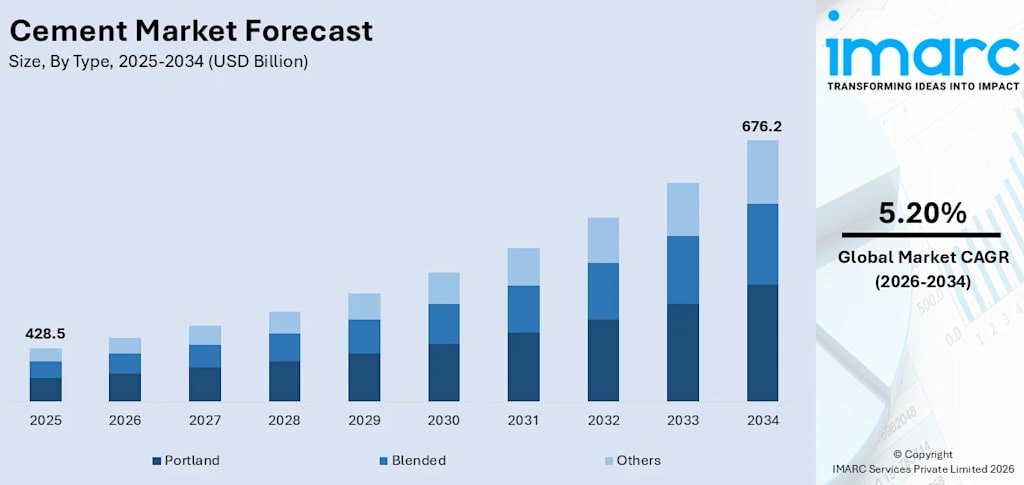
The global cement industry continues to experience robust growth, driven by rapid urbanization, expanding population, and a substantial increase in infrastructure and residential projects worldwide. According to IMARC Group’s latest data, The global cement market size was valued at USD 428.5 Billion in 2025. Looking forward, IMARC Group estimates the market to reach USD 676.2 Billion by 2034, exhibiting a CAGR of 5.20% from 2026-2034.
Cement now represents a cornerstone of global industrial infrastructure, acting as the fundamental binding agent for modern commercial and residential development. Demand is primarily propelled by building and construction expansions fueled by massive global population growth, which the United Nations projects will increase by approximately 2 Billion over the next three decades. With a major shift toward urban centers expected to draw two-thirds of the global population into cities by 2050, construction activities are accelerating rapidly. The market demonstrates structural diversification, where Portland cement maintains a leading position, commanding roughly 47.5% of the overall market share due to its superior compressive strength and durability under heavy loads.
Cement Market Growth Drivers:
- Accelerating Global Urbanization and Population Multipliers
The expansion of metropolitan hubs directly fuels the massive demand for robust structural materials. As global demographics shift, urban centers require extensive high-volume construction to house incoming populations and establish modern commercial facilities. The United Nations highlights that an influx of residents will expand global cities significantly over the next few decades, directly boosting the call for multi-story residential housing, transit networks, and heavy foundation pouring. This continuous urbanization ensures a stable and growing demand layout for premium-strength binders across developing municipal economic zones.
- Substantial Government Capital Expenditure on Infrastructure
National public investment acts as a vital driver for structural cement consumption globally. Federal initiatives, such as the USD 1.2 Trillion Bipartisan Infrastructure Law in the United States, channel immense funding directly into public works, bridges, highways, and transit hubs that rely heavily on durable materials. These large-scale state allocations create massive, multi-year procurement pipelines for manufacturing plants. By locking in major supply agreements for national transport corridors, public utility projects, and structural updates, government spending stabilizes factory production volumes and accelerates sector expansion.
- Surging Volumes in Global Real Estate and Housing
The global real estate market is expanding toward an estimated value of USD 8,654 Billion by the early 2030s, driving an unprecedented surge in building activity. Rising middle-class disposable income, paired with developer focus on high-density residential complexes, creates a massive requirement for foundational materials. Residential building construction requires high-durability Portland formulations capable of managing immense structural stress and adverse weathering. This relentless commercial and private housing development ensures a high, continuous consumption rate for specialized concrete mixes across both mature and emerging regional markets.
Cement Market Trends:
- Rapid Shifts Toward Eco-Friendly and Green Cement Blends
Environmental considerations are fundamentally reshaping product composition across the manufacturing landscape. Stringent carbon emission rules and corporate sustainability benchmarks are forcing a transition away from traditional high-clinker mixtures toward blended alternatives. Manufacturers are aggressively adopting eco-friendly formulations, which incorporate industrial by-products like fly ash and slag to reduce carbon footprints. This shift has accelerated the green cement sector's development, as procurement teams increasingly prioritize low-carbon binders to fulfill building certification requirements and meet global environmental mandates effectively.
- Advanced Manufacturing Digitalization and Kiln Optimization
Producers are integrating cutting-edge industrial technologies to counter volatile energy costs and maximize output efficiency. Modern facilities implement smart automation, real-time sensor arrays, and predictive digital tools directly into kiln operations to stabilize thermal processing and minimize fuel consumption. By shifting fuel sources and utilizing alternative energy matrices, plants successfully insulate their operational margins from localized coal and pet-coke price spikes. This technological transition optimizes production cycles, controls overhead costs, and maintains structural quality standards across competitive regional markets.
- Expansion of Ready-Mix Concrete and Logistics Networks
The rising focus on compressed project timelines drives widespread adoption of specialized ready-mix distribution clusters. Contractors increasingly rely on pre-mixed concrete networks to eliminate on-site mixing errors, reduce labor dependencies, and guarantee uniform material strength. This structural shift prompts manufacturers to set up dedicated grinding units and distribution hubs closer to active metropolitan zones. By optimizing transit logistics and providing immediate pour-ready materials, supply chains significantly enhance field execution speed, capturing valuable commercial market segments across tier-2 and tier-3 urban construction projects.
Recent News and Developments in Cement Market
- March 2026: JSW Cement achieved a major production milestone by commissioning its greenfield integrated cement facility at Nagaur in Rajasthan, adding a 3.3 million tonne clinkerisation unit and an initial 2.5 million tonne grinding layout to boost regional supply.
- March 2026: JSW Cement expanded its domestic manufacturing footprint in eastern India by successfully commissioning a new 1 million tonne grinding unit at Sambalpur, Odisha, executed through its subsidiary entity, Shiva Cement.
- May 2026: JSW Cement announced plans to invest an estimated USD 51.5 Million (Rs 430 crore) to add an extra 2.5 million tonnes of grinding capacity to its Nagaur facility, targeting a total unit output capacity of 6 million tonnes.
Note: If you require specific details, data, or insights that are not currently included in the scope of this report, we are happy to accommodate your request. As part of our customization service, we will gather and provide the additional information you need, tailored to your specific requirements. Please let us know your exact needs, and we will ensure the report is updated accordingly to meet your expectations.
About the Creator
Andrew Sullivan
Hello, I’m Andrew Sullivan. I have over 9+ years of experience as a market research specialist.
Enjoyed the story? Support the Creator.
Subscribe for free to receive all their stories in your feed.
Comments
There are no comments for this story
Be the first to respond and start the conversation.