
CCTV Market in Saudi Arabia: Advanced Video Analytics, IoT Integration & Public Safety Expansion
How real-time video monitoring, AI-powered analytics, and cloud-based surveillance systems are transforming security management and decision-making across the Saudi Arabia CCTV market.

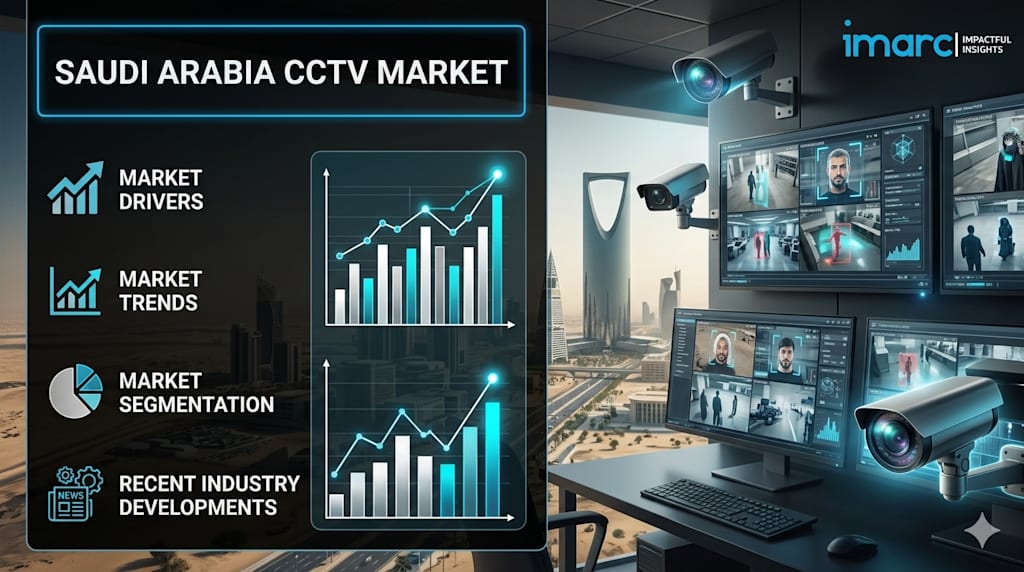
Surging government investments in smart city infrastructure, mandatory regulatory requirements for surveillance installations, and rapid adoption of AI-powered video analytics are collectively transforming the security landscape across Saudi Arabia. According to IMARC Group's latest data, the The Saudi Arabia CCTV market size reached USD 433.3 Million in 2025. Looking forward, IMARC Group expects the market to reach USD 1,682.6 Million by 2034, exhibiting a growth rate (CAGR) of 16.27% during 2026-2034, driven by Vision 2030-linked infrastructure programs, growing public safety mandates, and the accelerating shift from analog to IP-based surveillance systems across government, industrial, transportation, and commercial end-user segments.
The market is growing strongly led by The Vision 2030 plan which has resulted in greater investments being made in developing infrastructure, including transportation systems and smart cities. Increased security threats, including terrorism and crime, have also increased the demand for efficient monitoring solutions in public as well as private sectors. Advances in technology, such as the use of IP-based cameras and video analytics and regulatory requirements for the use of surveillance systems in different institutions have further accelerated the Saudi Arabia CCTV market share.
Saudi Arabia CCTV Market Growth Drivers:
- Vision 2030 and Smart City Infrastructure Development
Saudi Arabia's Vision 2030 plan has become the single most powerful structural driver for the Saudi Arabia CCTV Market, channeling large-scale investment into smart infrastructure across transportation systems, megaprojects, and urban development corridors. Cities including Riyadh, Jeddah, and Mecca are at the forefront of this transformation, with integrated surveillance systems forming a foundational layer of smart city architecture. The National Transformation Program further reinforces this direction by promoting the deployment of advanced monitoring solutions across public venues and critical infrastructure. As billions of dollars flow into giga-projects such as NEOM, the Red Sea Project, and Diriyah Gate, the demand for high-resolution, networked CCTV systems across construction sites, transport hubs, and public spaces is expanding rapidly. Saudi Arabia's sustained government expenditure on IT and security infrastructure has positioned the Kingdom among the leading nations in the Middle East for advanced surveillance technology adoption.
- Government Regulatory Mandates Expanding Surveillance Requirements
Legislative action is playing a decisive role in broadening the installed base of CCTV systems across Saudi Arabia. The Council of Ministers issued a decree mandating the installation of surveillance systems in all hotels, residential apartment complexes, sporting clubs, stadiums, and mosques under public facilities, creating a non-discretionary source of demand across multiple industry verticals. In January 2025, the Ministry of Interior announced stringent penalties under the Security Surveillance Cameras Law, specifying a fine of up to SR 10,000 for tampering with, damaging, or sabotaging CCTV systems or their footage, and a fine of SR 20,000 for the unauthorized sharing or release of surveillance recordings. These regulatory measures are not only accelerating installation rates in sectors such as hospitality, residential real estate, and public services but are also raising standards for system quality, data management, and operator accountability across the Kingdom.
- Rising Security Concerns Driving Demand Across Public and Private Sectors
Heightened concerns around terrorism, crime, and public safety are reinforcing demand for effective monitoring solutions at scale. Both government authorities and private sector operators are investing in surveillance infrastructure to strengthen perimeter security, manage crowd control, and enable rapid incident response. The transportation sector, which encompasses airports, seaports, rail networks, and road corridors, has emerged as a particularly high-priority deployment zone, given the volume of daily transit activity and the critical importance of uninterrupted monitoring. BFSI institutions, including banks and financial centers, are also increasing CCTV deployments to protect assets and comply with financial sector security standards, further broadening the commercial application base of the market.
Saudi Arabia CCTV Market Trends:
- Rapid Transition from Analog to IP-Based Camera Systems
The Saudi Arabian surveillance market is undergoing a fundamental technology shift, with traditional analog solutions being systematically replaced by Internet Protocol video surveillance systems. IP cameras deliver significantly higher resolution, support remote viewing capabilities, integrate seamlessly with smart devices and building management systems, and offer advanced functionalities including motion detection, facial recognition, and license plate identification. The scalability and flexibility of IP-based infrastructure make it the default choice for large-scale urban and infrastructure development programs currently underway across the Kingdom. This transition is elevating the overall value of surveillance deployments and driving higher average selling prices per installation, contributing meaningfully to market revenue growth.
- Integration of AI and Cloud-Based Video Analytics
The convergence of Artificial Intelligence and cloud computing is reshaping the capabilities and commercial value of CCTV systems in Saudi Arabia. AI-powered video analytics enable real-time processing of surveillance feeds, supporting advanced functions such as object detection, behavioral pattern analysis, crowd density monitoring, and predictive maintenance alerts. Cloud-based architectures allow organizations to manage large volumes of video data from centralized platforms, enabling remote monitoring and seamless scalability without proportional increases in on-site hardware investment. These capabilities are particularly valuable in retail, transportation, and public safety environments where timely, accurate situational awareness directly impacts operational outcomes. As AI and cloud technologies continue to mature, their integration within CCTV systems is expected to deepen, strengthening the market's long-term growth fundamentals.
- Growth of Local Manufacturing Aligned with Made in Saudi Initiative
A notable structural trend within the Saudi Arabia CCTV Market is the active localization of surveillance technology manufacturing, driven by the government's Made in Saudi initiative. This program supports the Kingdom's ambition to reduce import dependence and build domestic industrial capabilities aligned with Vision 2030's economic diversification objectives. Global surveillance technology leaders are responding by establishing local production partnerships within Saudi Arabia, bringing high-value manufacturing activity and technology transfer into the Kingdom and strengthening supply chain resilience for the broader security sector.
Recent News and Developments in the Saudi Arabia CCTV Market:
January 2024: Hikvision signed a Memorandum of Understanding with Tahakom, a leading Saudi firm specializing in information technology, traffic control, and industrial safety, formalizing a strategic partnership to advance surveillance and security technology deployment across the Kingdom.
- February 2024: Dahua Technology, in partnership with Alat, a fully-owned subsidiary of Saudi Arabia's Public Investment Fund, announced plans to establish Dahua's first overseas manufacturing facility in the Kingdom. The joint venture, named Alat AIVisio Technology Co. Ltd., is backed by a USD 200 million investment and will produce premium AIoT products and intelligent solutions for commercial and urban infrastructure applications.
- June 2024: Hikvision partnered with alfanar, a major Saudi industrial group, to establish a modern local manufacturing plant in Riyadh. The collaboration is specifically oriented toward realizing the aims of the Made in Saudi initiative, producing high-quality security products domestically to support Vision 2030 economic targets.
- January 2025: The Ministry of Interior of Saudi Arabia announced strict penalties under the Security Surveillance Cameras Law, including fines of up to SR 10,000 for tampering with CCTV systems and SR 20,000 for unauthorized release of surveillance footage, reinforcing regulatory compliance as a structural demand driver across all installation sectors.
- March 2026: Major system integrators operating in Saudi Arabia reported accelerated procurement activity for AI-enabled PTZ and IP camera solutions from government and transportation end users, aligned with ongoing smart city rollouts in Riyadh and the Western Region under Vision 2030 infrastructure programs.
Note: If you require specific details, data, or insights that are not currently included in the scope of this report, we are happy to accommodate your request. As part of our customization service, we will gather and provide the additional information you need, tailored to your specific requirements. Please let us know your exact needs, and we will ensure the report is updated accordingly to meet your expectations.
About the Creator
Kishan Kumar
My name is Kishan Roy and I am a market analyst having 5 years of experience and a skilled researcher with a keen eye for consumer trends and data-driven insights.
Enjoyed the story? Support the Creator.
Subscribe for free to receive all their stories in your feed.
Comments
There are no comments for this story
Be the first to respond and start the conversation.