
Caustic Soda Market Analysis: Supply-Demand Gap, Innovation & Growth Forecast
How evolving chemical manufacturing, sustainability requirements, and supply chain optimization are transforming production processes and market dynamics in the caustic soda industry

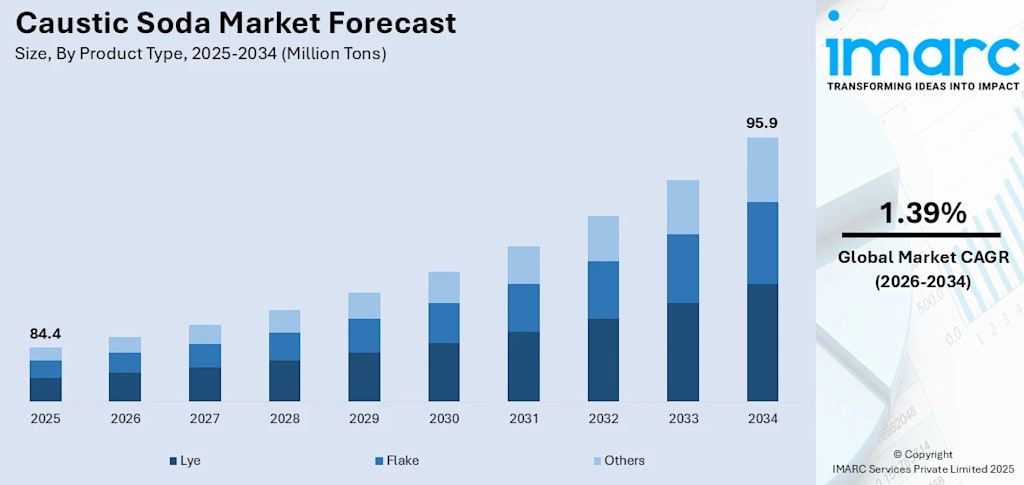
The caustic soda industry is experiencing a significant shift as industrial manufacturing, alumina refining, and water treatment sectors expand their global footprint. Characterized by its essential role in producing aluminum and paper, caustic soda remains a cornerstone of modern industrial chemistry, with rising demand in emerging economies further stabilizing its market position. According to IMARC Group’s latest data, The global caustic soda market size was valued at 84.4 Million Tons in 2025. Looking forward, IMARC Group estimates the market to reach 95.9 Million Tons by 2034, exhibiting a CAGR of 1.39% from 2026-2034.
Caustic soda, or sodium hydroxide, has become an indispensable chemical commodity with a global reach now measured in tens of millions of tons. The market is primarily underpinned by the metallurgical sector, where it is critical for refining bauxite into alumina. Beyond heavy industry, its application in the production of soaps, detergents, and textiles ensures a steady demand from consumer-facing sectors. As sustainability becomes a corporate priority, the industry is seeing a rapid transition toward membrane cell technology, which is more energy-efficient and environmentally friendly than older mercury or diaphragm methods.
Caustic Soda Market Growth Drivers:
- Expansion of Alumina Refining and Aluminum Production
The global push for lightweight materials in the automotive and aerospace sectors is a massive engine for caustic soda demand. In the Bayer process, caustic soda is the primary agent used to dissolve aluminum minerals from bauxite ore. With the aviation industry rebounding and electric vehicle manufacturers seeking to reduce chassis weight to extend battery range, aluminum consumption is hitting new peaks. Consequently, alumina refineries, particularly in regions like Australia, Brazil, and China, are operating at high capacities, requiring massive, consistent volumes of liquid caustic soda to maintain their output.
- Booming Demand in the Pulp and Paper Industry
Despite the digital age, the need for paper and cardboard is surging, driven largely by the global e-commerce revolution. Caustic soda is essential in the kraft pulping process, where it breaks down lignin to separate cellulose fibers. It also serves as a critical bleaching agent to reach desired brightness levels for printing and packaging materials. As sustainable packaging becomes the standard, replacing single-use plastics with paper-based alternatives, the volume of caustic soda utilized in mills is seeing a steady climb, particularly in major export markets like Brazil and North America.
- Vital Role in Global Water Treatment and Sanitation
Rapid urbanization and stricter environmental regulations worldwide are forcing municipalities and industrial plants to upgrade their water treatment facilities. Caustic soda is used extensively for pH regulation and the neutralization of acidic waste streams. Governments in developing nations are launching massive clean-water initiatives, such as India's Jal Jeevan Mission, which indirectly bolsters the demand for treatment chemicals. As nations face increasing water scarcity, the reliance on chemical treatment to recycle and purify water for industrial and domestic use has positioned caustic soda as a non-negotiable component of public infrastructure.
Caustic Soda Market Trends:
- Transition Toward Energy-Efficient Membrane Cell Technology
The industry is undergoing a significant technological overhaul, moving away from mercury and diaphragm cells toward membrane cell electrolysis. This shift is driven by both environmental mandates and the need for cost optimization, as membrane technology reduces electricity consumption by nearly 15% to 20%. Given that electricity accounts for roughly 50% to 60% of total production costs, manufacturers are aggressively retrofitting older plants. This trend is particularly visible in Europe and China, where stringent carbon emission targets and "anti-overcapacity" policies are forcing the retirement of outdated, high-energy facilities in favor of greener, more efficient production lines.
- Strategic Regional Capacity Shifts and Supply Chain Realignment
There is a notable trend of production capacity moving closer to low-cost energy sources and high-growth downstream markets. While China remains the world’s largest producer, accounting for nearly 45% of global output, new capacities are emerging in the Middle East and the U.S. Gulf Coast to take advantage of competitive energy prices. In 2025, the market saw a structural adjustment as European capacity rationalization led to several plant closures, making the region more dependent on imports.
- Integration with Sustainable and Circular Economy Practices
Leading chemical manufacturers are increasingly focusing on "Green Caustic Soda" initiatives, where production is powered by renewable energy sources like wind or solar. Companies are beginning to offer low-carbon versions of the chemical to help downstream users, such as textile and soap manufacturers, meet their Scope 3 emission targets. Furthermore, there is a growing trend in the recovery and recycling of caustic soda within industrial loops, particularly in the textile and alumina sectors.
Recent News and Developments in Caustic Soda Market
- September 2025: The Ministry of Industry and Information Technology in China introduced a new "anti-overcapacity" policy, targeting the elimination of roughly 6 million tons of outdated chlor-alkali production capacity that has been in operation for over two decades.
- January 2026: India officially removed several anti-dumping measures and Bureau of Indian Standards (BIS) requirements on certain chemical imports, effectively reopening the market for U.S. and Middle Eastern caustic soda suppliers to meet the needs of the domestic alumina sector.
- February 2026: Dow Inc. shared progress on its long-term strategy to exit integrated sites in Europe by 2027, a move that is expected to tighten the regional supply of caustic soda and shift the procurement focus toward imported volumes from more cost-competitive regions.
Note: If you require specific details, data, or insights that are not currently included in the scope of this report, we are happy to accommodate your request. As part of our customization service, we will gather and provide the additional information you need, tailored to your specific requirements. Please let us know your exact needs, and we will ensure the report is updated accordingly to meet your expectations.
About the Creator
Andrew Sullivan
Hello, I’m Andrew Sullivan. I have over 9+ years of experience as a market research specialist.
Enjoyed the story? Support the Creator.
Subscribe for free to receive all their stories in your feed.
Comments
There are no comments for this story
Be the first to respond and start the conversation.