
Carbon Neutral Construction Materials Market Accelerates as Builders Race Toward Net-Zero Targets
Public policy, investor pressure, and breakthrough technologies are reshaping the future of sustainable construction worldwide.

The construction industry is entering a new phase where reducing emissions is no longer optional. Around the world, governments, developers, and infrastructure companies are rapidly replacing traditional building materials with lower-carbon alternatives that support long-term climate goals.
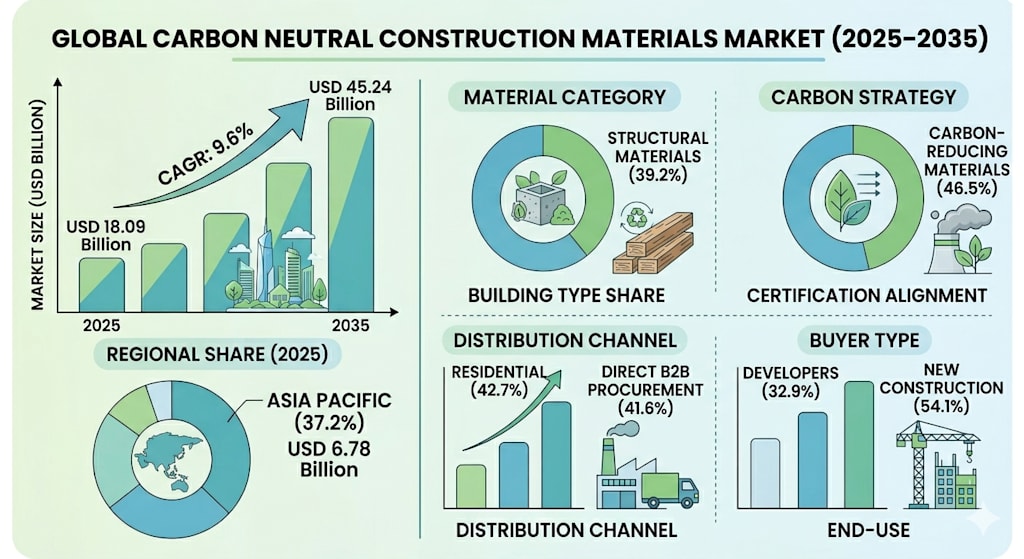
This transition is fueling remarkable growth in the Carbon Neutral Construction Materials Market, which is projected to rise from USD 18.09 billion in 2025 to nearly USD 45.24 billion by 2035, expanding at a CAGR of 9.6%.
The momentum behind this market reflects a deeper transformation in how buildings are designed, financed, and constructed. Materials such as low-carbon cement, fossil-free steel, recycled concrete, mass timber, and bio-based insulation are increasingly becoming part of mainstream procurement strategies.
Rising embodied-carbon regulations, stricter green building standards, and expanding investor scrutiny are forcing the construction sector to rethink the environmental impact of every project from foundation to finish.
Market Highlights
- Asia Pacific leads with 37.2% market share, valued at USD 6.78 Billion
- Structural Materials dominates By Material Category with 39.2% share
- Carbon-Reducing Materials leads By Carbon Strategy with 46.5% share
- Residential leads By Building Type with 42.7% share
- LEED leads By Certification Alignment with 37.4% share
- Developers lead By Buyer Type with 32.9% share
- Direct B2B Procurement leads By Distribution Channel with 41.6% share
- New Construction leads By End-Use with 54.1% share
Why Construction Materials Are Becoming a Climate Priority
Construction has long been one of the world’s largest sources of industrial emissions. Much of this impact comes not from operating buildings, but from producing the materials used to build them. Cement, steel, asphalt, and other structural inputs require energy-intensive manufacturing processes that generate significant amounts of carbon dioxide.
As countries move toward net-zero targets, reducing emissions from construction materials has become a major focus. Policymakers are now introducing embodied-carbon limits in public tenders and building codes, while financial institutions increasingly favor projects with verified sustainability credentials.
Developers are responding quickly. Many commercial real estate firms now face pressure from investors, tenants, and regulators to disclose the environmental footprint of their projects. This has shifted demand toward materials with measurable lifecycle emissions data and certified environmental performance.
Importantly, sustainable alternatives are also becoming more economically attractive. Innovations such as geopolymer concrete and low-carbon cement technologies are reducing both emissions and production costs. In some cases, newer materials can lower construction costs while delivering stronger performance and faster build times, removing one of the biggest barriers to adoption.
Structural Materials Remain at the Center of the Shift
Structural materials currently dominate the market, accounting for 39.2% of total demand. This segment includes steel, concrete, and engineered timber — the core components responsible for the majority of embodied emissions in most buildings.
Because these materials contribute such a large share of construction-related carbon output, replacing conventional versions with lower-emission alternatives delivers the greatest environmental benefit. Electric arc furnace steel, for example, can significantly reduce embodied carbon compared to traditional blast-furnace production methods.
Concrete innovation is also advancing rapidly. New formulations using recycled aggregates, calcined clay, and alternative binders are helping manufacturers reduce emissions without sacrificing durability or structural integrity. Several large-scale projects across Europe and Asia have already demonstrated that low-carbon concrete can perform competitively in major infrastructure developments.
Mass timber is emerging as another important option, particularly for residential and mid-rise commercial projects. Unlike traditional structural materials, timber can store carbon throughout a building’s lifespan, creating opportunities for carbon-negative construction under certain conditions.
Government Policies Are Driving Industry-Wide Adoption
One of the strongest catalysts behind market growth is government regulation. Public procurement rules are increasingly requiring construction suppliers to meet strict embodied-carbon standards before qualifying for large contracts.
In the United States, Buy Clean initiatives are reshaping federal construction spending by establishing carbon thresholds for concrete, steel, glass, and asphalt used in government projects. Similar policies are spreading across Europe, where several countries have already introduced mandatory lifecycle carbon reporting requirements for new buildings.
The European Union’s updated Energy Performance of Buildings Directive is expected to accelerate adoption further by integrating embodied-carbon assessments into future building regulations. Countries such as France and the Netherlands are already moving ahead with national carbon caps for construction materials.
Government funding programs are also helping manufacturers scale production. Public investments supporting fossil-free steel, carbon-neutral cement, and recycled construction materials are reducing financial risk for companies developing cleaner technologies. This support is essential because many low-carbon manufacturing facilities require substantial upfront capital before reaching commercial scale.
In Asia Pacific, policy momentum is equally strong. China’s carbon-neutrality goals, India’s adoption of low-carbon cement technologies, and green building initiatives across Southeast Asia are creating one of the world’s fastest-growing demand centers for sustainable construction materials.
Technology Innovation Is Reshaping the Supply Chain
Technological advancement is rapidly changing what is possible in construction manufacturing. Cement producers, steelmakers, and material science startups are introducing new systems designed to cut emissions dramatically while maintaining commercial scalability.
One major breakthrough is the industrial-scale production of calcined clay cement, which significantly lowers the carbon intensity of traditional cement manufacturing. Large producers have already launched commercial facilities capable of supplying hundreds of thousands of tons annually, proving that low-carbon alternatives can move beyond pilot programs into mainstream markets.
Carbon capture technology is also gaining traction. Several cement plants in Europe are now integrating systems designed to capture substantial portions of their production emissions. Although these facilities require heavy investment, they represent a critical pathway for decarbonizing one of the hardest-to-abate industrial sectors.
Steel production is experiencing similar changes. Fossil-free steel projects powered by renewable electricity and green hydrogen are attracting strong interest from major developers and infrastructure companies. While supply remains limited today, long-term purchase agreements from large buyers are helping justify future capacity expansion.
Regional Markets Are Expanding at Different Speeds
Asia Pacific currently leads the global market with a 37.2% share, valued at approximately USD 6.78 billion. The region’s dominance is closely linked to large-scale urbanization and aggressive climate commitments from major economies such as China and India.
India’s use of low-carbon LC3 cement in major infrastructure projects demonstrates how cost-effective alternatives are becoming viable even in highly price-sensitive markets. Because construction volumes in Asia remain exceptionally high, relatively small shifts toward low-carbon materials can generate enormous market growth.
North America holds the second-largest position, supported by federal procurement mandates, infrastructure spending, and state-level embodied-carbon regulations. Government-backed investment in fossil-free steel and sustainable manufacturing capacity is helping create long-term supply stability.
Europe remains the most mature regulatory environment for sustainable construction. Strict climate policies, carbon-border mechanisms, and advanced certification systems continue to push the industry toward verified low-emission materials at a rapid pace.
Challenges Could Slow the Pace of Transition
Despite strong growth, several barriers continue to limit supply expansion. Producing fossil-free steel, carbon-neutral cement, and other advanced materials requires billions of dollars in capital investment and long development timelines.
Supply chains for green hydrogen, recycled feedstocks, and carbon-capture infrastructure are still developing. This means demand for sustainable materials may continue to outpace available production capacity through much of the coming decade.
Cost also remains a challenge in markets where procurement rules do not yet prioritize embodied-carbon performance. Without policy support or green financing incentives, some buyers may still favor lower-cost conventional materials.
Conclusion
The Carbon Neutral Construction Materials Market is evolving from a specialized sustainability segment into a central pillar of modern construction strategy. Governments are tightening regulations, investors are demanding measurable climate performance, and developers are recognizing that low-carbon materials are becoming essential for long-term competitiveness.
About the Creator
Yash Mule
SEO Specialist with 10+ years of experience at Evolvance Market Research. Expert in technical SEO, content strategy, and data-driven optimization, with a proven track record of significantly increasing organic traffic and search rankings.
Enjoyed the story? Support the Creator.
Subscribe for free to receive all their stories in your feed.
Comments
There are no comments for this story
Be the first to respond and start the conversation.