
Carbon Dioxide Removal Market: Why the Race to Remove Carbon Is Becoming Big Business
As climate goals tighten and emissions persist, carbon removal is emerging as one of the world's fastest-growing environmental industries.

The global conversation around climate change has entered a new phase. For years, the focus was largely on reducing emissions through renewable energy, efficiency improvements, and cleaner technologies. While those efforts remain essential, experts increasingly agree that cutting emissions alone will not be enough. Some greenhouse gases already in the atmosphere will also need to be removed.
This reality is fueling remarkable momentum in the Carbon Dioxide Removal Market, transforming what was once a niche scientific concept into a rapidly expanding commercial sector. Companies are signing long-term contracts, governments are introducing supportive policies, and investors are placing substantial bets on technologies capable of extracting carbon dioxide from the atmosphere.
The market's projected growth reflects more than environmental urgency. It signals a fundamental shift in how businesses, policymakers, and consumers think about achieving a lower-carbon future.
Market Highlights
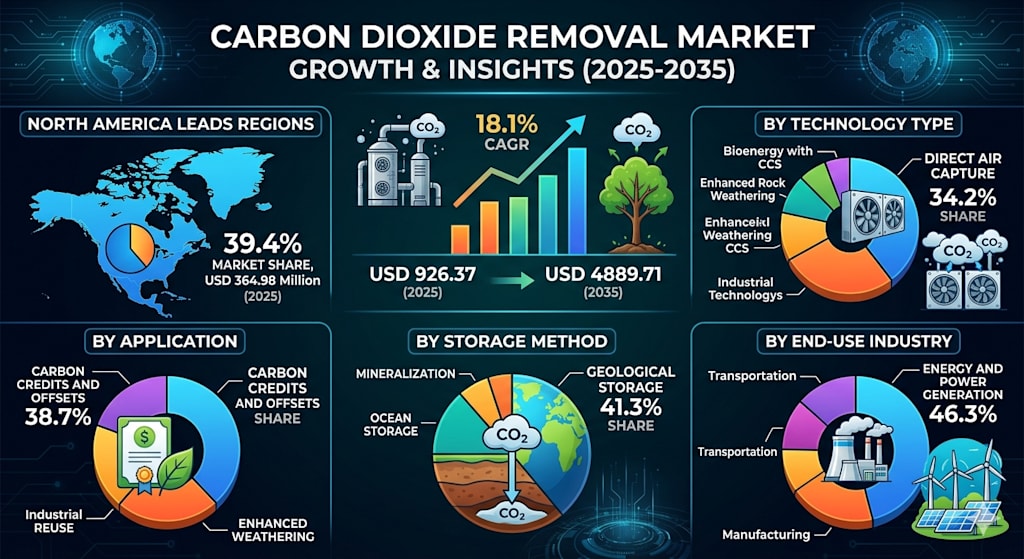
- The Carbon Dioxide Removal Market will grow from USD 926.37 Million in 2025 to USD 4889.71 Million by 2035, at a CAGR of 18.1%.
- North America leads all regions with a 39.4% market share, valued at USD 364.98 Million in 2025.
- Direct Air Capture holds the dominant position with a 34.2% share.
- Carbon Credits and Offsets commands the largest share at 38.7%.
- Geological storage leads with a 41.3% share.
- Energy and Power Generation holds the top position at 46.3%.
Discover 2026 Market Intelligence & Growth Outlook
From Climate Concept to Commercial Opportunity
Carbon dioxide removal, often abbreviated as CDR, refers to methods that actively remove carbon dioxide from the atmosphere and store it for long periods. Unlike traditional emission reduction efforts, which focus on preventing new emissions, these approaches address the carbon that has already accumulated.
The range of solutions is broad. Some methods rely on advanced engineering, such as Direct Air Capture systems that filter carbon directly from ambient air. Others work with natural systems through activities like reforestation, soil carbon enhancement, and biochar production.
What has changed in recent years is the scale of commercial interest. Businesses increasingly view carbon removal not simply as environmental philanthropy but as part of long-term risk management and sustainability planning. Large organizations with net-zero commitments are moving from public promises to actual purchasing decisions.
The result is a market that is evolving quickly, supported by both environmental necessity and economic incentives.
The Technologies Driving Growth
Among the various approaches, Direct Air Capture has emerged as one of the most closely watched technologies.
These systems use chemical processes to pull carbon dioxide directly from the atmosphere before preparing it for storage or utilization. Their appeal lies in permanence and measurability. Buyers can often verify exactly how much carbon has been removed and where it has been stored.
Bioenergy with Carbon Capture and Storage offers another promising pathway. By generating energy from biomass while capturing and permanently storing associated emissions, this approach can produce energy and negative emissions simultaneously.
Emerging technologies such as ocean-based removal and enhanced weathering remain in earlier stages of development. Although they show significant theoretical potential, questions surrounding regulation, monitoring, and ecological impacts still need to be addressed before widespread deployment.
Corporate Buyers Are Reshaping Demand
One of the strongest drivers behind market expansion is corporate procurement.
Many major companies have announced ambitious climate targets that extend beyond reducing operational emissions. Residual emissions from activities such as aviation, heavy manufacturing, and complex supply chains often cannot be eliminated entirely using current technologies.
As a result, businesses are increasingly turning to carbon removal credits to address these unavoidable emissions.
Importantly, the purchasing behavior itself is changing. Instead of buying credits on a short-term basis, organizations are entering multi-year agreements that lock in future delivery. These long-term contracts provide project developers with greater revenue certainty, enabling them to secure financing and expand operations.
This evolution suggests that demand is becoming more structural than symbolic.
Policy Support Is Accelerating the Industry
Government action is playing a crucial role in helping the sector mature.
In the United States, tax incentives and federal initiatives have lowered financial barriers for early-stage projects. By attaching monetary value to verified removals, policymakers help narrow the gap between technological ambition and commercial viability.
Europe is pursuing a different but equally influential strategy. Rather than focusing solely on incentives, regulators are building formal certification systems designed to establish clear standards around permanence, monitoring, and accountability.
These frameworks provide confidence for both buyers and investors. When market participants understand how carbon removals will be measured and recognized, they can make decisions with greater certainty.
Elsewhere, countries throughout Asia-Pacific are beginning to develop their own roadmaps. Although many initiatives remain in early stages, they signal growing recognition that carbon removal may become an important component of national climate strategies.
Together, these developments indicate that supportive policy environments are no longer isolated experiments. They are becoming part of broader climate governance.
The Challenges That Could Slow Progress
Despite the optimism surrounding the sector, significant obstacles remain.
Cost is perhaps the most obvious challenge. Engineered solutions, particularly Direct Air Capture, remain expensive compared with many conventional emission reduction strategies. Until costs decline further, access may remain limited to organizations with substantial sustainability budgets.
Infrastructure also presents difficulties. Removing carbon is only part of the equation. Projects often require transportation networks, storage facilities, monitoring systems, and long-term verification processes.
Questions surrounding measurement standards continue to influence buyer confidence as well. Stakeholders increasingly expect assurance that removals are additional, durable, and accurately quantified. Inconsistent methodologies can undermine trust and slow procurement decisions.
There is also the risk of viewing carbon removal as a substitute for emissions reductions rather than a complement to them. Most experts emphasize that removal should address residual emissions after aggressive mitigation efforts have been pursued.
Maintaining that balance will be critical to preserving the industry's credibility.
A Market Defined by Innovation and Urgency
The future of carbon removal will likely be shaped by both technological breakthroughs and practical realities.
Competition among developers is encouraging innovation aimed at reducing costs and improving efficiency. New financing models are emerging to support project development. Hybrid approaches that combine biological and engineered methods may unlock additional opportunities.
Meanwhile, sectors with limited decarbonization pathways—including aviation, shipping, and heavy industry—are expected to become increasingly important customers.
As climate deadlines approach, organizations may face growing pressure to demonstrate not only intentions but measurable outcomes. Carbon removal offers one avenue for addressing emissions that cannot yet be eliminated through conventional means.
Whether through sophisticated machines, agricultural practices, or geological storage, the objective remains the same: removing carbon already present in the atmosphere while broader decarbonization efforts continue.
Conclusion
The rise of the Carbon Dioxide Removal Market reflects a broader transformation in the global response to climate change. What began as an emerging scientific field is rapidly evolving into a sophisticated marketplace shaped by corporate commitments, supportive policies, and technological innovation.
Challenges related to cost, infrastructure, and verification remain substantial. Yet the momentum behind carbon removal suggests that it will play an increasingly important role in future climate strategies.
Ultimately, success will depend not on viewing removal as a standalone solution, but as one element within a larger effort to reduce emissions, accelerate innovation, and build a more resilient economy. The path ahead is complex, but the growing commitment to removing carbon from the atmosphere signals that the world is expanding its toolkit in the pursuit of lasting climate progress.
About the Creator
Yash Mule
SEO Specialist with 10+ years of experience at Evolvance Market Research. Expert in technical SEO, content strategy, and data-driven optimization, with a proven track record of significantly increasing organic traffic and search rankings.
Enjoyed the story? Support the Creator.
Subscribe for free to receive all their stories in your feed.
Comments
There are no comments for this story
Be the first to respond and start the conversation.