
Carbon Black Market: Industrialization Trends, End-Use Sector Expansion & Future Outlook
How industrialization trends, infrastructure development projects, and expanding construction activities are accelerating demand for carbon black across diverse end-use sectors

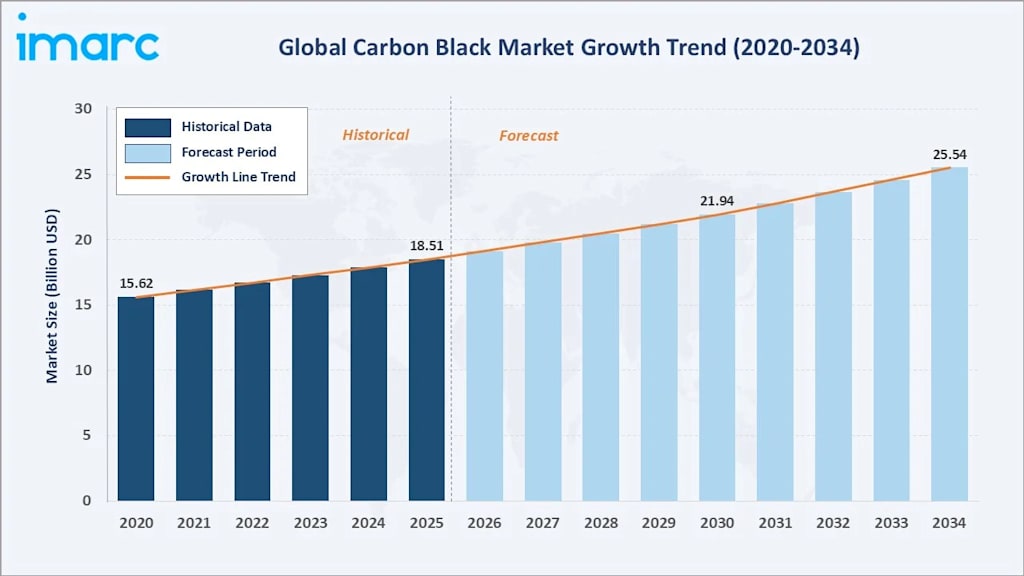
Rising demand from the tire and automotive industry, expanding use across plastics and specialty coatings, rapid scale-up of recovered carbon black (rCB) capacity, and strong industrial growth across the Asia Pacific are driving carbon black demand, supported by manufacturing process advancements, EV battery applications, and infrastructure expansion. According to IMARC Group’s latest data, The global carbon black market size was valued at USD 18.51 Billion in 2025. Looking forward, IMARC Group estimates the market to reach USD 25.54 Billion by 2034, exhibiting a CAGR of 3.46% from 2026-2034.
Carbon black now represents a multi-billion-dollar global market exceeding USD 18 billion and exhibiting steady year-on-year expansion. Demand is driven by rising vehicle production, growing infrastructure spending that favors heavy industrial rubber and coatings, and increased interest in high-purity conductive grades for electronics and electric vehicles. Manufacturing innovation, the commercialization of recovered materials via tire pyrolysis, and product reformulation for enhanced UV protection and conductivity are further accelerating uptake.
Carbon Black Market Growth Drivers:
- Automotive and Tire Industry Expansion
Vehicle production and replacement cycles act as the primary anchor for this industry, where the material constitutes roughly 30% of a standard tire's total weight to ensure structural durability and wear resistance. Global automotive activity saw tire production surpass 2.3 billion units, directly scaling material consumption. This deep structural link to automotive manufacturing ensures a consistent demand floor, especially as commercial truck fleets expand to handle rising logistics volumes. Manufacturers depend heavily on standard furnace grades to achieve the necessary tensile strength, protecting tread blocks from rapid abrasion and oxidative aging during daily highway and urban operations.
- Infrastructure and Heavy Construction Spending
Surging global investments in infrastructure, commercial developments, and public works projects directly boost the consumption of industrial rubber products and architectural formulations. The material serves as a foundational performance additive in concrete pigments, roofing membranes, high-durability sealants, and protective moisture barriers. Additionally, massive electrical grid modernizations require heavy-duty cable sheathing to insulate underground power lines. Because infrastructure projects demand materials that can withstand decades of environmental exposure, builders rely on these specialized formulations to provide critical ultraviolet protection and thermal stability, preventing premature degradation in harsh outdoor environments and demanding engineering applications.
- Surging Demand for Electric Vehicles and Battery-Grade Materials
The rapid transition toward electromobility has introduced a high-value application for specialized, ultra-pure carbon variants within the energy storage supply chain. Cell manufacturers utilize acetylene black and conductive specialty grades as critical additives within the cathode and anode formulations of lithium-ion batteries. With global electric car sales climbing past 17 million units annually, battery supply chains require massive volumes of low-ash, highly conductive agents to maximize energy density and accelerate electron transfer. This rapid technology shift creates a distinct, fast-growing market niche that diversifies demand away from traditional tire manufacturing.
Carbon Black Market Trends:
- Commercialization of Recovered Carbon Black (rCB)
Industrial focus is shifting decisively toward circular economy frameworks, turning end-of-life tire pyrolysis into a viable commercial source for high-quality recovered materials. Major chemical producers are moving away from traditional oil-heavy feedstocks by building dedicated recycling facilities that convert old rubber into sustainable compounding agents. For instance, commercial rollouts like Epsilon Carbon's launch of its specialized line demonstrate an industrial capacity to lower global warming potential by up to 50% compared to conventional manufacturing. This transition allows tire brands and plastic compounders to meet strict corporate sustainability mandates without sacrificing material performance.
- Formulation of Battery-Grade Conductive Agents
The scaling of global gigafactories has sparked a wave of product innovation centered on tight particle-size engineering and advanced surface modification. Specialty chemical companies are actively expanding their manufacturing lines to supply low-ash, high-purity conductive additives tailored for next-generation electric vehicle batteries. Industry leaders like Orion S.A. and Cabot Corporation have recently expanded their dedicated manufacturing operations in key manufacturing hubs across Asia and North America. These highly technical formulations optimize the internal conductivity of energy storage cells, allowing electric vehicles to achieve faster charging times and extended driving ranges.
- Expansion in Specialty Coatings and Plastics Compounding
Beyond mechanical rubber reinforcement, high-performance formulations are increasingly sought after by the electronics, plastics, and industrial coatings sectors. Modern consumer electronics like smartphones, laptops, and televisions require deep black aesthetics alongside electromagnetic interference shielding, driving utilization in engineering plastics. Concurrently, the global push for low-solvent and waterborne paint systems favors high-purity pigments that comply with strict volatile organic compound regulations. This trend allows manufacturers to achieve superior color depth and antistatic properties in automotive finishes, premium packaging, and protective industrial coatings, broadening the overall industrial application mix.
Recent News and Developments in Carbon Black Market
- May 2025: Cabot Corporation completed a major expansion of its specialized conductive carbon black production lines to meet the accelerating demand from lithium-ion battery manufacturers and electric vehicle OEMs globally.
- November 2025: Orion S.A. finalized a long-term supply agreement with a prominent global tire manufacturer to deliver high-performance, low-emission specialty furnace grades aimed at improving fuel efficiency through reduced rolling resistance.
- March 2026: Birla Carbon announced a strategic manufacturing upgrade across its major facilities to integrate automated process controls and yield-management technologies, enhancing production efficiency and narrowing particle-size distribution for premium grades.
Note: If you require specific details, data, or insights that are not currently included in the scope of this report, we are happy to accommodate your request. As part of our customization service, we will gather and provide the additional information you need, tailored to your specific requirements. Please let us know your exact needs, and we will ensure the report is updated accordingly to meet your expectations.
About the Creator
Andrew Sullivan
Hello, I’m Andrew Sullivan. I have over 9+ years of experience as a market research specialist.
Enjoyed the story? Support the Creator.
Subscribe for free to receive all their stories in your feed.
Comments
There are no comments for this story
Be the first to respond and start the conversation.