
Capsule Hotel Market Trends: Budget Travel Demand, Smart Accommodation & Forecast to 2034
How rising demand for affordable accommodations, solo travel trends, and urban tourism growth are driving innovation and expansion in the capsule hotel market

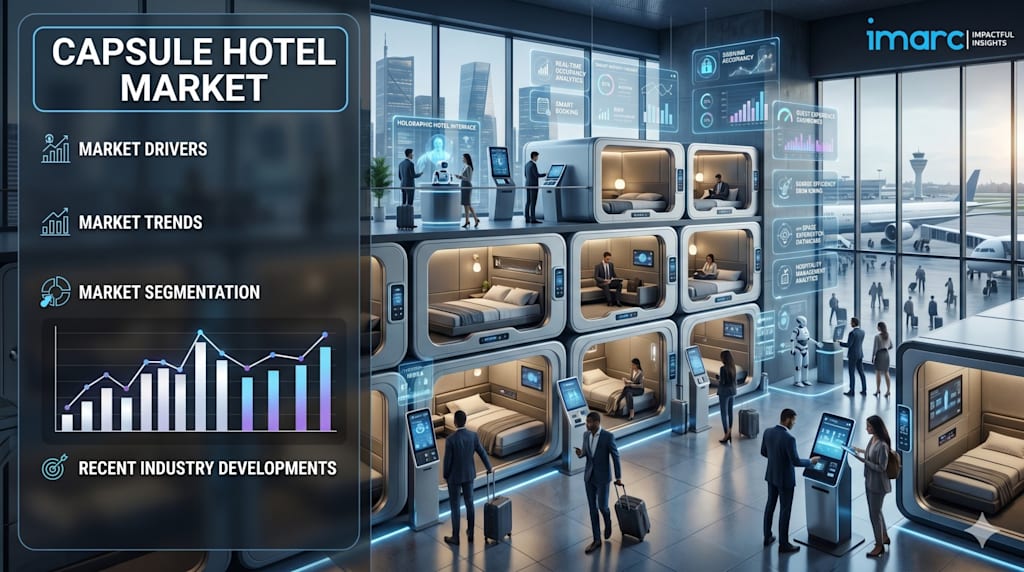
According to IMARC Group's latest research publication, The global capsule hotel market size reached USD 127.3 Million in 2025. Looking forward, IMARC Group expects the market to reach USD 262.5 Million by 2034, exhibiting a growth rate (CAGR) of 8.12% during 2026-2034, exhibiting strong growth momentum driven by the growing number of solo travelers, millennials, and digital nomads seeking unique and cost-effective lodging options, rising importance of affordability in travel choices, and urbanization and high real estate costs.
How Technology and Shifting Travel Behaviors Are Reshaping the Capsule Hotel Market
- Smart Room Automation and Mobile-First Guest Experiences: Capsule hotels are increasingly integrating smart technologies such as mobile check-in systems, automated pod controls, and app-based amenity management to deliver seamless and personalized stays. Generation Z travelers, who constitute the largest age group segment in the market, strongly prefer convenience through mobile interfaces and expect real-time customization of their in-pod environments including lighting, temperature, and entertainment settings. Properties deploying these digital ecosystems are reporting measurable improvements in guest satisfaction scores and repeat booking rates, as tech-savvy urban travelers gravitate toward accommodation concepts that match their digitally integrated lifestyles.
- Space-Efficient Design Innovation for High-Density Urban Markets: As land and real estate costs in city centers continue to rise, capsule hotel operators are developing increasingly sophisticated interior engineering solutions that maximize comfort within compact pod dimensions. Designers are incorporating modular furniture, acoustic insulation panels, and multi-functional storage systems into capsule units to address concerns over privacy and space limitations, which remain the primary barriers to broader adoption among first-time guests. These design advancements are enabling operators to establish competitive properties in premium transit-adjacent locations, including airports, railway stations, and central business districts, where traditional hotel footprints are economically unfeasible.
- Sustainability Integration and Eco-Conscious Operations: The capsule hotel format is inherently aligned with sustainable hospitality principles, consuming significantly less energy, water, and materials per guest compared to full-service hotels. Operators are amplifying this advantage by installing solar energy systems, low-flow water fixtures, and biodegradable amenity packaging to attract eco-conscious travelers from Generation Y and Generation Z demographics who prioritize environmental accountability in their purchasing decisions. Properties actively marketing their green credentials are gaining competitive positioning on online travel platforms where sustainability filters are increasingly used by younger travelers when comparing accommodation options across urban destinations.
- Transit Hub Expansion and Infrastructure Partnership Strategies: Capsule hotel operators are actively pursuing partnerships with transportation authorities and infrastructure managers to establish properties within airports, railway terminals, and bus hubs, serving transit passengers requiring short-duration rest facilities between connections. Urban Pod's association with IRCTC to introduce pod concept rooms at Mumbai Central railway station, featuring 30 classic pods, seven dedicated to female travelers, 10 private pods, and one accessible unit, exemplifies how strategic infrastructure partnerships are opening high-footfall locations previously inaccessible to conventional hotel operators. These transit-embedded properties generate strong occupancy rates from a captive traveler base and require minimal marketing investment due to their inherent location advantage.
- Online Booking Platform Integration and Dynamic Pricing Adoption: Capsule hotel operators are deepening their integration with global online travel agencies, direct booking websites, and travel applications to capture the growing segment of digitally connected travelers who research, compare, and reserve accommodations exclusively through mobile and web channels. While offline booking currently accounts for the largest share of market reservations, online booking is gaining rapid momentum as internet penetration rises across emerging markets and younger traveler demographics dominate booking volumes. Properties adopting AI-powered dynamic pricing tools are optimizing revenue per available capsule by adjusting rates in real time based on demand patterns, seasonal trends, and competitor pricing signals across major urban markets.
Capsule Hotel Industry Overview:
Asia Pacific leads the global capsule hotel market, accounting for the largest regional share, anchored by Japan where the capsule hotel concept originated and continues to represent a culturally embedded accommodation standard. Countries including Japan, South Korea, China, and India maintain well-established networks of capsule properties serving both domestic commuters and international visitors across dense metropolitan centers. The region benefits from exceptionally high urbanization rates and transit infrastructure density that makes compact lodging solutions both practical and commercially viable. Governments across Asia Pacific are investing in transportation corridors, smart city infrastructure, and tourism promotion programs that organically drive footfall toward transit-adjacent hospitality properties including capsule hotels.
North America is emerging as a fast-growing geography for the capsule hotel market, driven by rising demand for cost-effective alternatives to traditional hotels among solo travelers, business professionals, and millennials in major metropolitan areas. Cities including New York, Los Angeles, and Toronto are witnessing the establishment of new capsule hotel concepts targeting urban travelers who prioritize location and affordability over room size. The growth of remote work and the digital nomad lifestyle is expanding the potential guest base for capsule properties, as location-flexible professionals seek short-term urban accommodations that offer reliable connectivity and essential amenities without the premium pricing of conventional hotels.
Europe is experiencing steady adoption of the capsule hotel model, particularly in high-traffic tourist cities and transit hubs across the United Kingdom, Germany, and the Netherlands. The region's well-connected rail and air transportation infrastructure makes capsule hotels a practical choice for travelers in transit, while the popularity of budget travel among young European and international tourists sustains demand across popular city-break destinations. Latin America represents an early-stage but promising market, with Brazil, Mexico, and Argentina beginning to explore the capsule format targeting both domestic and international tourism segments. The Middle East and Africa segment is growing incrementally, with Dubai and major regional airport locations introducing capsule properties to serve short-stay transit passengers.
Capsule Hotel Market Trends and Drivers
Shifting traveler demographics and evolving lifestyle preferences are the most powerful structural drivers of growth in the capsule hotel market. The rising global population of solo travelers, backpackers, digital nomads, and young professionals traveling independently has created a sustained demand base for accommodation formats that prioritize affordability, location convenience, and efficient use of space over traditional hospitality amenities. Generation Z currently represents the largest age group segment within the market, drawn to the innovative and minimalist character of capsule hotels that aligns with their values around sustainability, digital convenience, and experiential travel. The desire for Instagram-worthy and uniquely designed lodging environments is also driving the emergence of themed capsule hotels that attract travelers seeking memorable stays beyond standard accommodation categories.
Urbanization and escalating real estate costs in city centers are creating a structural competitive advantage for capsule hotel operators relative to full-service hotels in prime locations. As land costs in major global cities continue rising, capsule hotels with their space-efficient pod configurations can be established within smaller footprints at a fraction of the capital cost required for conventional hotel development, enabling operators to price rooms affordably while maintaining commercially viable margins. This economic model is particularly relevant in densely populated Asian cities where urban housing pressure is most acute, but is increasingly applicable to European and North American markets where central city accommodation costs have risen significantly. Economic sensitivity among travelers also strengthens the capsule hotel value proposition during periods of reduced consumer spending, as budget-conscious guests actively seek quality accommodation at the lowest possible price point without compromising on safety, cleanliness, or connectivity.
The growing volume of business travel and the rise of professionals attending conferences, seminars, and short-duration corporate assignments in urban centers is expanding the addressable market for capsule hotels beyond purely leisure and backpacker demographics. Business travelers increasingly value the combination of strategic location near transport hubs and business districts, flexible check-in and check-out options compatible with irregular travel schedules, and competitive nightly rates that allow organizations to reduce accommodation budget expenditures. Capsule hotels catering to this segment are investing in dedicated workspace amenities, high-speed internet infrastructure, and privacy-enhanced pod designs that meet the functional requirements of professional travelers while maintaining the cost advantages that differentiate the capsule format from conventional business hotels.
Leading Companies Operating in the Global Capsule Hotel Industry:
- 9h nine hours
- CubeHotelsGroup
- De Bedstee Hotel
- Inbox Capsule Hotel
- Nadeshiko Hotel
- Riccarton Capsule Hotel
- The Bed Bukit Bintang - Capsule Hotel
- The Capsule Hotel
- The POD Boutique Capsule Hotel
- Urbanpod
Capsule Hotel Market Report Segmentation:
By Traveler Type:
- Solo
- Group
Solo travelers represent the largest segment, as backpackers, digital nomads, and business travelers are drawn to capsule hotels for their affordability, convenience, and suitability for single occupants seeking secure and comfortable short-stay lodging.
By Booking Mode:
- Online Booking
- Offline Booking
Offline booking holds the largest market share, with walk-in guests and direct reservations remaining prominent particularly among older travelers and those arriving at capsule hotels located in high foot-traffic tourist and transit areas without prior planning.
By Age Group:
- Generation X
- Generation Y
- Generation Z
Generation Z represents the leading segment, driven by their preference for tech-enabled, minimalist, and sustainability-aligned accommodation experiences that align closely with the functional and aesthetic proposition of modern capsule hotel properties.
By Application:
- Office Workers
- Tourists
- Others
Tourists represent a significant application segment, with domestic and international leisure travelers, backpackers, and weekend getaway travelers seeking affordable lodging options near popular attractions and transit hubs driving consistent occupancy across capsule properties globally.
Regional Insights:
- North America (United States, Canada)
- Asia Pacific (China, Japan, India, South Korea, Australia, Indonesia, Others)
- Europe (Germany, France, United Kingdom, Italy, Spain, Russia, Others)
- Latin America (Brazil, Mexico, Others)
- Middle East and Africa
Asia Pacific exhibits clear dominance in the capsule hotel market due to the concept's Japanese origins, high urbanization rates, and a well-established network of capsule properties serving both domestic commuters and international travelers across the region's densely populated cities.
Recent News and Developments in the Capsule Hotel Market
- February 2024: The POD Boutique Capsule Hotel expanded its Singapore operations with the launch of a newly refurbished property featuring enhanced smart pod technology, app-controlled amenities, and dedicated female-only capsule floors, reflecting the growing demand for privacy-enhanced and digitally integrated capsule accommodation options among solo female travelers in Southeast Asia.
- September 2024: CubeHotelsGroup announced a strategic expansion into the European market with the opening of a new capsule hotel property in Amsterdam targeting budget-conscious international tourists and transit travelers. The property incorporates sustainable design principles including solar energy systems and zero single-use plastic amenities, positioning the brand within the growing eco-conscious travel segment.
- March 2025: Urbanpod launched a new partnership with a major international airport operator in the Gulf region to establish airside capsule rest facilities for transit passengers. The agreement covers the installation of 45 private pods and 20 classic capsule units designed to serve passengers on layovers of two to twelve hours, marking a significant expansion of the capsule hotel concept into premium Middle East transit infrastructure.
Note: If you require specific details, data, or insights that are not currently included in the scope of this report, we are happy to accommodate your request. As part of our customization service, we will gather and provide the additional information you need, tailored to your specific requirements. Please let us know your exact needs, and we will ensure the report is updated accordingly to meet your expectations.
About the Creator
Abhay Rajput
I am working in market research company that provides market and business research intelligence across the globe.
Enjoyed the story? Support the Creator.
Subscribe for free to receive all their stories in your feed.
Comments
There are no comments for this story
Be the first to respond and start the conversation.