
Canned Salmon Market Outlook: Convenient Seafood Consumption and Growth Opportunities
The Canned Salmon Market is experiencing steady growth driven by increasing demand for convenient, nutritious, and shelf-stable seafood products.

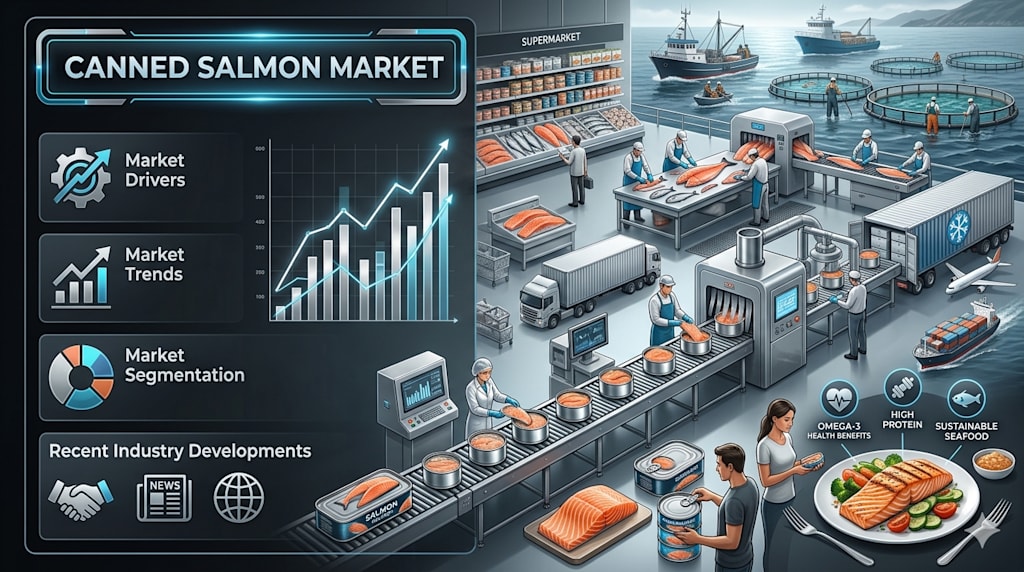
According to IMARC Group's latest research, The global canned salmon market size reached USD 4.4 Billion in 2025. Looking forward, IMARC Group expects the market to reach USD 6.7 Billion by 2034, exhibiting a growth rate (CAGR) of 4.62% during 2026-2034.
Canned Salmon Market Trends
Increasing Adoption of Advanced Processing Technologies
Manufacturers are increasingly utilizing digital technologies and automated systems to improve production efficiency and product quality. Advanced monitoring systems help evaluate nutritional composition, processing conditions, and packaging integrity, contributing to greater consistency across product offerings. Automated inspection technologies are also being implemented to identify defects and improve quality assurance procedures.
Growing Demand for Premium Product Variants
Consumers are showing increasing interest in premium canned seafood products. Manufacturers are responding by introducing skinless and boneless salmon products, flavored varieties, and olive oil-based formulations. Premium packaging formats and value-added products are gaining visibility across supermarkets and specialty retail channels.
Expansion of Sustainable Packaging Solutions
Sustainability considerations are becoming increasingly important across the seafood industry. Producers are investing in environmentally responsible packaging formats and improving supply chain transparency to address changing consumer expectations. Recyclable containers and reduced packaging waste initiatives are becoming more common across the market.

Canned Salmon Industry Overview
Growing consumer awareness regarding the health benefits of seafood, increasing demand for convenient protein-rich food products, and expanding retail distribution networks are supporting the growth of the canned salmon market. According to IMARC Group's latest research, the global canned salmon market size reached USD 4.4 Billion in 2025. Looking forward, IMARC Group expects the market to reach USD 6.7 Billion by 2034, exhibiting a CAGR of 4.62% during 2026-2034.
The canned salmon market forms an important segment of the global processed seafood industry. Demand is being supported by changing dietary preferences, growing interest in high-protein foods, and the convenience offered by shelf-stable seafood products. Canned salmon is widely consumed across households, foodservice establishments, and institutional sectors due to its nutritional value, affordability, and extended shelf life.
Canned Salmon Market Growth Drivers
Rising Health Awareness and Nutritional Demand
Growing awareness regarding the health benefits associated with omega-3 fatty acids, high-quality protein, vitamins, and minerals is contributing to increased consumption of canned salmon. Consumers are increasingly incorporating seafood into their diets as part of broader wellness and preventive healthcare trends. The product is viewed as a convenient alternative to fresh seafood while retaining significant nutritional benefits.
Expanding Demand for Convenient Food Products
Busy lifestyles and changing consumption habits are increasing demand for ready-to-eat and easy-to-prepare food products. Canned salmon offers long shelf life, minimal preparation requirements, and year-round availability, making it an attractive option for consumers seeking convenient meal solutions. Growth in online grocery retailing is also improving product accessibility across multiple regions.
Growth in Global Aquaculture Production
The expansion of aquaculture operations is supporting a stable supply of salmon for processing and canning activities. Countries such as Norway, Chile, and Canada continue to increase salmon production capacity, helping manufacturers maintain consistent product availability. Farmed salmon production provides greater supply reliability compared to seasonal wild-caught sources, supporting long-term market growth.
Market Segmentation
By Type
Fillet
Chunk
Minced
Among these, the chunk segment accounts for a significant share of the market due to its affordability and widespread consumer acceptance.
By Nature
Wild
Farmed
Farmed salmon represents the largest segment owing to stable production volumes, cost efficiency, and year-round availability.
By Sales Channel
Hypermarkets and Supermarkets
Specialty Stores
Online Channels
Others
Hypermarkets and supermarkets continue to dominate distribution due to extensive product availability and established consumer purchasing patterns.
Regional Insights
North America
North America represents the largest regional market, supported by strong seafood consumption patterns, widespread retail availability, and increasing consumer awareness regarding nutritional benefits.
Europe
Europe remains a significant market due to growing demand for premium seafood products and increasing emphasis on sustainable sourcing practices.
Asia-Pacific
Asia-Pacific is expected to witness notable growth driven by rising disposable incomes, urbanization, and increasing seafood consumption across developing economies.
Latin America and Middle East & Africa
These regions are gradually expanding their market presence through growing retail infrastructure, improving consumer awareness, and rising demand for convenient packaged foods.
Leading Companies in the Canned Salmon Market
Key companies operating in the market include:
Bumble Bee Foods LLC
Crown Prince Inc.
Maruha Nichiro Corporation
Pataya Food Industries Ltd.
Peter Pan Seafood Company LLC
Princes Limited (Mitsubishi Corporation)
Raincoast Trading
Tassal Group Limited (Cooke Inc.)
Thai Union Group PCL
The Canfisco Group
The South Australian Fishermans Co-Operative Limited
Trident Seafoods Corporation
Vital Choice Wild Seafood & Organics
Wild Planet Foods Inc. (Bolton Group S.R.L.)
Recent Developments
October 2024: Bumble Bee Seafoods introduced multiple canned salmon product varieties, including low-sodium options and single-serve pouch formats designed to address changing consumer preferences.
July 2025: Cermaq, owned by Mitsubishi Corporation, announced the acquisition of salmon farming assets from Grieg Seafood, strengthening long-term salmon supply capabilities.
January 2024: King Oscar USA launched a premium range of skinless and boneless Atlantic salmon products packaged in extra virgin olive oil for retail distribution.
January 2024: Trident Seafoods secured a major supply contract from the U.S. Department of Agriculture for canned pink salmon products, highlighting continued institutional demand within the sector.
About the Creator
Michael Richard
Michael Richard is a Market Research Expert specializing in market intelligence, competitive analysis, and data-driven insights. He helps organizations understand trends and emerging opportunities through in-depth research.
Enjoyed the story? Support the Creator.
Subscribe for free to receive all their stories in your feed.
Comments
There are no comments for this story
Be the first to respond and start the conversation.