
Cancer Diagnostics Market Outlook: Early Detection Technologies and Growth Opportunities
The Cancer Diagnostics Market is experiencing significant growth driven by increasing focus on early detection and accurate diagnosis of cancer.

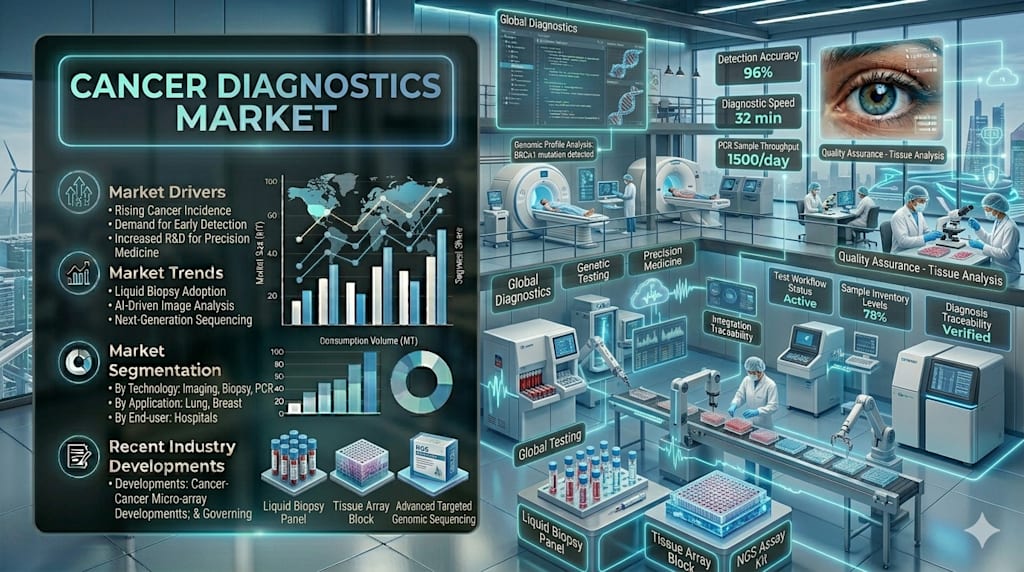
According to IMARC Group's latest research publication, The global cancer diagnostics market size reached USD 218.0 Billion in 2025. Looking forward, IMARC Group expects the market to reach USD 333.3 Billion by 2034, exhibiting a growth rate (CAGR) of 4.68% during 2026-2034.
How AI is Reshaping the Future of Cancer Diagnostics Market
- Enhanced Diagnostic Precision Through Deep Learning: AI algorithms analyze millions of pathology images and radiological scans to detect subtle patterns and abnormalities invisible to human eyes, reducing false negatives by up to 40% in breast and lung cancer screening while accelerating diagnosis times.
- Predictive Treatment Response Modeling: Machine learning systems process genomic profiles, clinical histories, and biomarker data to forecast individual patient responses to specific therapies, enabling oncologists to customize treatment plans with greater precision and minimize exposure to ineffective treatments.
- Automated Workflow Optimization: AI-driven pathology platforms deployed in clinical laboratories automate tissue classification and mutation detection, reducing pathologist workload while maintaining diagnostic accuracy, with several systems receiving FDA approval for prostate and breast cancer detection applications.
Cancer Diagnostics Industry Overview
The cancer diagnostics landscape is experiencing rapid transformation driven by precision medicine adoption and technological innovation. Government initiatives like the Cancer Moonshot aim to reduce cancer deaths by 50% over 25 years through expanded screening access. Major regulatory milestones include FDA approval of next-generation sequencing platforms like TruSight Oncology Comprehensive with multiple companion diagnostic claims, Guardant Shield for blood-based colorectal screening, and DermaSensor AI-powered skin lesion detection.
Cancer Diagnostics Market Trends & Drivers
Rising global cancer incidence is driving unprecedented demand for advanced diagnostic technologies across all age groups. The World Health Organization projects 35 million new cancer cases by 2050, representing a 77% increase from current levels, while the United States reports approximately 623,405 persons living with metastatic cancer. This surge fuels adoption of molecular diagnostics, liquid biopsy, and next-generation sequencing for early detection and targeted treatment selection. Colorectal cancer screening alone reached 153,020 new diagnoses annually in the United States, with screening rates improving through home-delivered test kits and reminder systems that increase compliance among underserved populations.
Government funding and national screening programs are expanding access to life-saving diagnostics worldwide. The National Cancer Institute's Cancer Screening Research Network launched the Vanguard Study evaluating multi-cancer detection blood tests across major health systems, while HRSA awarded nearly $9 million to community health centers for improving cancer screening access. The White House declared April as National Cancer Prevention and Early Detection Month, eliminating patient cost barriers for stool-based screening and follow-up colonoscopies under the Affordable Care Act, driving participation rates higher across demographics.
Commercial innovation and strategic partnerships are accelerating diagnostic capabilities and market growth. Illumina's FDA-approved TruSight Oncology Comprehensive test interrogates over 500 genes in a single assay, enabling rapid matching of patients to targeted therapies and clinical trials. Cleveland Diagnostics secured FDA approval for its IsoPSA prostate cancer detection kit with distribution through Quest Diagnostics' thousands of nationwide locations. Foresight Diagnostics achieved 100% year-over-year revenue growth through pharmaceutical partnerships, while Roche integrated 20+ AI algorithms into its Digital Pathology platform, enhancing diagnostic precision for multiple cancer types through automated analysis and reducing inter-observer variability.
Leading Companies Operating in the Global Cancer Diagnostics Industry
- Abbott Laboratories
- Agilent Technologies, Inc.
- Becton, Dickinson and Company
- bioMerieux
- Bio-Rad Laboratories, Inc.
- F. Hoffmann-La Roche Ltd
- GE HealthCare
- Hologic, Inc.
- Illumina, Inc.
- Koninklijke Philips N.V.
- Qiagen N.V.
- Quest Diagnostics
- Siemens Healthineers AG (Siemens AG)
- Thermo Fisher Scientific Inc.
Cancer Diagnostics Market Report Segmentation
By Product:
- Consumables
- Antibodies
- Kits and Reagents
- Probes
- Others
- Instruments
- Pathology-based Instruments
- Imaging Instruments
- Biopsy Instruments
- By Technology:
- IVD Testing
- Polymerase Chain Reaction (PCR)
- In Situ Hybridization (ISH)
- Immunohistochemistry (IHC)
- Next-generation Sequencing (NGS)
- Microarrays
- Flow Cytometry
- Immunoassays
- Others
- Imaging
- Magnetic Resonance Imaging (MRI)
- Computed Tomography (CT)
- Positron Emission Tomography (PET)
- Mammography
- Ultrasound
- Biopsy Technique
Imaging accounts for the majority of the market share as it offers detailed, non-invasive tumor visualization enabling early identification, accurate diagnosis, and careful disease progression tracking.
By Application:
- Breast Cancer
- Lung Cancer
- Colorectal Cancer
- Melanoma
- Others
Breast cancer represents the largest market share owing to its widespread occurrence and the essential requirement for early identification through advanced diagnostic techniques.
By End User:
- Hospitals and Clinics
- Diagnostic Laboratories
- Others
Hospitals and clinics hold the biggest market share due to their wide patient access, sophisticated diagnostic technologies, and capacity to deliver comprehensive cancer care.
Regional Insights:
- North America (United States, Canada)
- Asia Pacific (China, Japan, India, South Korea, Australia, Indonesia, Others)
- Europe (Germany, France, United Kingdom, Italy, Spain, Russia, Others)
- Latin America (Brazil, Mexico, Others)
- Middle East and Africa
North America exhibits a clear dominance in the cancer diagnostics market due to advanced healthcare infrastructure, robust research and development resources, significant healthcare spending, and widespread adoption of cutting-edge diagnostic technologies.
Recent News and Developments in Cancer Diagnostics Market
- August 2024: Illumina received FDA approval for TruSight Oncology Comprehensive, a next-generation sequencing test profiling over 500 genes with companion diagnostic claims for NTRK gene fusions and RET fusion-positive non-small cell lung cancer, enabling targeted therapy selection across multiple solid tumor types.
- September 2024: Roche expanded its Digital Pathology Open Environment by integrating 20+ advanced AI algorithms from eight collaborators to enhance cancer diagnosis precision. The platform assists pathologists with automated tissue analysis for breast, lung, prostate, and colorectal cancers, improving workflow efficiency and diagnostic consistency.
- August 2024: Foresight Diagnostics received FDA Investigational Device Exemption approval for Foresight CLARITY minimal residual disease detection technology and partnered with Allogene Therapeutics for patient enrollment in the ALPHA3 clinical trial for large B-cell lymphoma, achieving over 100% revenue growth annually since founding.
- December 2025: Cleveland Diagnostics secured FDA approval for its IsoPSA prostate cancer detection kit distributed through Quest Diagnostics' nationwide network. The company is expanding its IsoClear technology platform through pilot studies at Cleveland Clinic, Mayo Clinic, and Columbia University for thyroid cancer detection.
- July 2025: Fred Hutch Cancer Center launched the Vanguard Study, the first trial under the Cancer Screening Research Network evaluating multi-cancer detection blood tests in adults aged 45 to 75. The study compares Avantect and Shield tests to guide future national cancer screening strategies through NCI funding.
Note: If you require specific details, data, or insights that are not currently included in the scope of this report, we are happy to accommodate your request. As part of our customization service, we will gather and provide the additional information you need, tailored to your specific requirements. Please let us know your exact needs, and we will ensure the report is updated accordingly to meet your expectations.
About the Creator
Olivia Smith
Olivia Smits is a Research and Marketing Analyst who specializes in market research, trend analysis, and consumer insights. I help businesses make smarter marketing and strategy decisions by turning data into clear, actionable insights.
Enjoyed the story? Support the Creator.
Subscribe for free to receive all their stories in your feed.
Comments
There are no comments for this story
Be the first to respond and start the conversation.