
Canada Foodservice Market Set for Steady Expansion as Consumer Habits Continue to Evolve
Urban lifestyles, digital ordering, and growing demand for convenience are reshaping Canada’s foodservice landscape, with Renub Research projecting strong long-term growth through 2034.

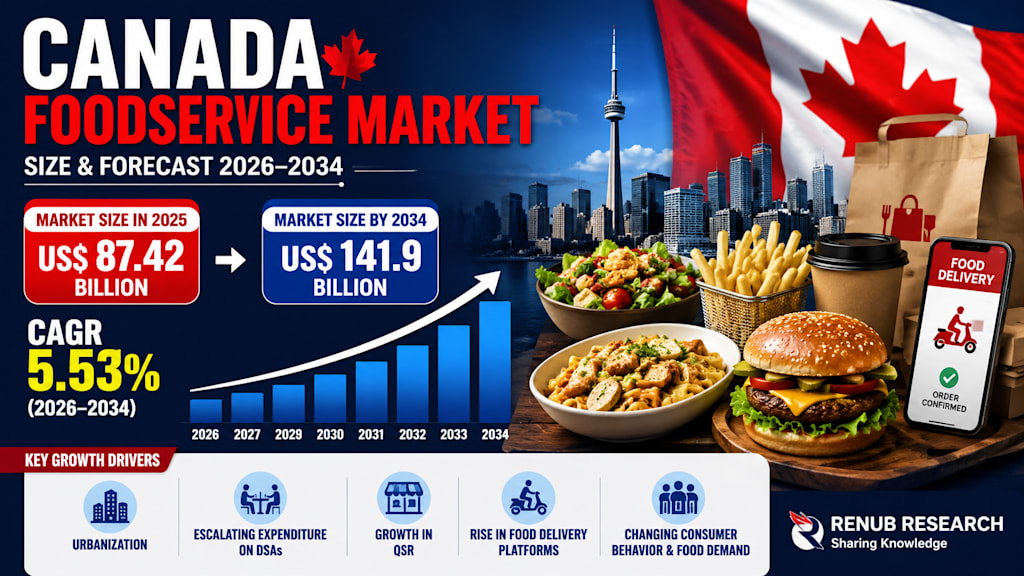
The Canada foodservice market is entering a phase of steady, broad-based expansion as changing lifestyles, urbanization, and digital convenience continue to redefine how Canadians eat outside the home. According to Renub Research, the market is expected to grow from US$ 87.42 billion in 2025 to US$ 141.9 billion by 2034, registering a CAGR of 5.53% from 2026 to 2034. That outlook reflects a market that is not only resilient, but also highly adaptive to shifting consumer expectations and business models.
Foodservice in Canada is far more than a restaurant story. It spans quick-service restaurants, full-service dining, catering, institutional foodservice, accommodation-based foodservice, retail foodservice, and a range of hybrid concepts that blend convenience with experience. From urban office workers grabbing lunch between meetings to families ordering dinner online, foodservice has become deeply embedded in daily life. It supports social events, tourism, education, healthcare, and workplace dining, making it one of the most essential consumer-facing industries in the country.
What makes this market especially interesting is the way it reflects broader social change. Canadians today are eating differently, ordering differently, and expecting more from foodservice operators than ever before. Convenience remains important, but so do quality, health, speed, digital access, and personalization. As a result, the industry is evolving in multiple directions at once, creating opportunities for both large chains and specialized operators.
A Market Powered by Urban Life and Busier Schedules
One of the strongest forces behind the market’s growth is urbanization. Canada’s urban population is already very high, and metropolitan centers continue to concentrate consumer spending, commuting activity, and dining demand. As more people live and work in dense urban environments, foodservice becomes part of the daily routine rather than an occasional treat. Busy schedules encourage consumers to rely on nearby restaurants, drive-throughs, delivery apps, coffee shops, and ready-to-eat meal options.
This urban shift is tightly connected to lifestyle change. Consumers are under pressure to save time, manage work-life balance, and make practical food choices that fit a faster pace of living. That is one reason the market continues to benefit from frequent visits to foodservice outlets and higher spending outside the home. In Canada, the demand is not limited to lunch and dinner. Breakfast, snacks, coffee breaks, and late-night meals all contribute to a more active foodservice economy.
The rise of disposable income has also helped the sector. As household purchasing power improves, consumers are more willing to spend on convenience and experience. That has supported everything from premium café formats and casual dining chains to ethnic cuisine concepts and upscale food delivery. The result is a market that is growing not only in volume, but also in value.
Digital Ordering and Delivery Are Changing the Game
Another major growth engine is the rapid expansion of food delivery platforms and digital ordering systems. This shift has changed customer behavior in a lasting way. Consumers now expect fast access to menus, flexible payment options, real-time tracking, and simple reordering through mobile apps and websites. For businesses, digital channels expand reach without requiring the same level of physical infrastructure as traditional dine-in expansion.
The impact on restaurants has been significant. Delivery-focused concepts, cloud kitchens, and app-based promotions are helping operators serve more customers while improving convenience. Digital loyalty programs and data-driven marketing also make it easier to personalize offers and encourage repeat business. In an industry where consumer loyalty can be fragile, these tools matter a great deal.
This evolution is also attracting international brands. The file notes that Fazoli’s entered the Canadian market through a franchise development agreement to open 25 restaurants over the next decade, beginning in Alberta, with openings expected in 2025. That kind of cross-border expansion shows confidence in the long-term appeal of the Canadian foodservice space and the strength of demand for recognizable branded concepts.
Health, Premiumization, and Variety Are Raising Expectations
Canadian consumers are not only looking for convenience; they are also looking for choice. The market is increasingly shaped by demand for diverse cuisines, premium experiences, and healthier menu options. Canada’s multicultural population supports strong interest in international foods, fusion menus, and regionally inspired offerings. This makes the market especially dynamic for restaurants that can combine authenticity with speed and accessibility.
Health awareness is another important theme. Plant-based meals, organic ingredients, sustainable sourcing, and wellness-oriented menus are becoming more mainstream. As consumers become more selective, businesses that offer healthier meals without sacrificing taste or convenience are finding new growth opportunities. Premium cafés, healthy QSR formats, and brands positioned around better-for-you eating are especially well placed to benefit.
The file points to this shift through the example of Happy Belly Food Group’s healthy QSR concept, Heal Wellness, which secured its first real estate site in Montreal and planned an opening in Q1 2026. That reflects a broader industry pattern: operators are adapting their concepts to match modern preferences around freshness, nutrition, and convenience.
The Industry Still Faces Real Pressure
Despite the optimistic growth outlook, the Canada foodservice market is not without challenges. Rising operating costs remain one of the most serious issues. Ingredient prices, rent, transportation, and wages all put pressure on margins. For smaller and independent operators, these costs can be especially difficult to absorb. Even when sales are growing, profitability can remain under strain.
Labor shortages add another layer of difficulty. Foodservice depends heavily on frontline workers, kitchen staff, delivery personnel, and supervisors. When labor is difficult to source, businesses face higher recruitment and training costs, slower service, and uneven customer experiences. Wage increases can be positive for workers, but they also force operators to rethink staffing models and productivity.
Competition is equally intense. Local restaurants, national chains, and international brands are all fighting for the same consumers. At the same time, customers are increasingly demanding in terms of price, speed, quality, and digital convenience. If a business fails to keep pace with online ordering, sustainability expectations, or healthy menu innovation, it can quickly lose relevance. In such a market, differentiation is not optional; it is survival.
Quick-Service Restaurants Continue to Lead Growth
Among the various segments, quick-service restaurants stand out as one of the fastest-growing. Their appeal is straightforward: affordable pricing, speed, easy access, and predictable brand experience. These are especially important to students, office workers, commuters, and families seeking value and convenience.
QSRs are also benefiting from the digital shift. Mobile apps, delivery partnerships, and self-ordering tools make it easier for customers to buy frequently and quickly. As a result, this segment is playing a central role in market expansion. Its ability to scale, adapt menus, and maintain brand visibility gives it a strong position in both urban and suburban markets.
Catering, Accommodation, Institutional, and Retail Foodservice Add Depth
Beyond restaurants, the broader foodservice ecosystem offers several important growth pillars. Catering remains essential for weddings, corporate functions, social events, and institutional contracts. Its strength lies in personalization, bulk service, and the ability to deliver tailored experiences at scale. As event activity continues to grow, catering benefits from recurring demand and long-term client relationships.
Accommodation foodservice is equally important because it sits at the intersection of hospitality and tourism. Hotels, resorts, and lodges rely on food and beverage services to enhance guest experience, support room service, and host banquets. As tourism and business travel recover and expand, this segment remains a meaningful contributor to the overall market.
Institutional foodservice covers schools, hospitals, nursing homes, military facilities, and workplaces. This segment is driven by the need to serve nutritious, affordable meals on a consistent basis. Wellness, dietary compliance, food safety, and sustainability are increasingly central to these operations. As healthcare and education systems continue to expand, institutional foodservice remains a dependable source of demand.
Retail foodservice is also gaining ground. Supermarkets, convenience stores, and related outlets increasingly offer ready-to-eat meals, hot food, baked goods, and beverages. For consumers, this creates a practical middle ground between grocery shopping and eating out. For retailers, it opens a new revenue stream and helps capture more consumer spending within a single visit.
Regional Differences Shape the Market
Canada’s foodservice market is not uniform across the country. Ontario remains the largest and most influential market, supported by population density, high consumer expenditure, and a wide range of foodservice formats. From QSRs to fine dining, Ontario offers a broad and competitive environment with strong demand for international cuisines and technology-enabled ordering.
British Columbia stands out for its wellness-oriented consumers, multicultural population, and strong tourism base. Demand there leans heavily toward fresh, organic, sustainable, and plant-based options. The province’s lifestyle trends and digital adoption make it a trendsetter within the Canadian market.
Alberta benefits from urban concentration, higher disposable income, and a strong dining culture tied to active city life and major work sectors. Delivery and drive-through formats perform well there, especially in busy metropolitan areas.
Saskatchewan shows a more stable and value-oriented foodservice environment, supported by educational institutions, healthcare demand, and smaller urban centers. While growth is more moderate, it remains steady due to changing consumption habits and the rising popularity of take-away food.
A Competitive Market with a Wide Company Base
The file identifies several well-known companies active in the sector, including Starbucks, Domino’s Pizza, Wendy’s, 7-Eleven, Restaurant Brands International, A&W Food Services of Canada, MTY Food Group, Performance Food Group, Papa John’s International, McDonald’s, Berkshire Hathaway, and Yum! Brands. This lineup highlights the blend of global brands, franchise operators, and foodservice ecosystem players that shape the market’s competitive landscape.
With so many companies competing across formats and provinces, success depends on more than just food quality. Location strategy, menu innovation, pricing discipline, digital execution, and brand reputation all matter. The businesses most likely to thrive are the ones that can respond quickly to shifting consumer expectations while protecting profitability in a high-cost environment.
Final Thoughts
The Canada foodservice market has a strong long-term growth story. It is being supported by urbanization, digital transformation, diversified consumer tastes, and the continuing demand for convenience. At the same time, the industry must navigate rising costs, labor shortages, and intense competition. That combination makes it a challenging market, but also a highly promising one for operators that can adapt quickly.
Renub Research’s forecast, which projects the market to rise from US$ 87.42 billion in 2025 to US$ 141.9 billion by 2034, reinforces the view that Canada’s foodservice sector will remain one of the country’s most dynamic consumer markets over the coming decade. The winners will be those who understand the modern Canadian consumer: busy, digitally connected, health-conscious, value-aware, and open to new dining experiences.
About the Creator
Enjoyed the story? Support the Creator.
Subscribe for free to receive all their stories in your feed.
Comments
There are no comments for this story
Be the first to respond and start the conversation.