
Can we reach another galaxy in a hundred years?
The universe is really, really big.

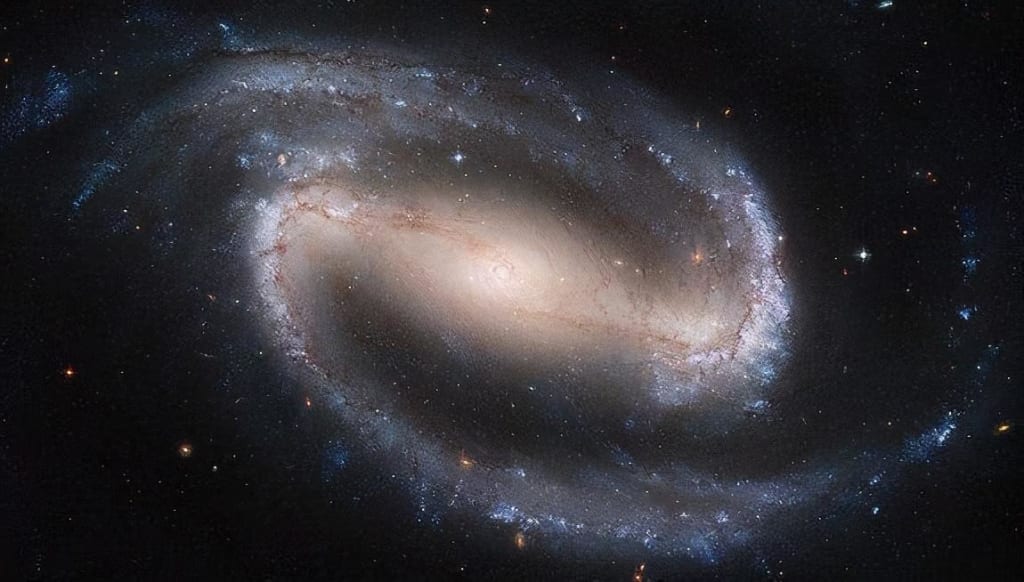
Look at this tiny yellow dot. If you could travel at the speed of light, it would take you a hundred years to leave Earth. Of course, this is measured in Earth time. If you were traveling at close to the speed of light, but using a spaceship, it would take much less time. Although perhaps you would run into problems like hydrogen atom blockage. If you are traveling on a ship that is continuously accelerating to 1 (you need to be healthy at all times), this chart shows the time you spend on the ship.
Note that in 25 years (half the round trip time) of travel time, you could reach the nearest galaxy, Andromeda, in about 1 million years of Earth time.
The closest galaxy to us is Andromeda. It is 2,537,000 light years away from us. In 100 years, odds are we won't have the technology needed to travel anywhere near the speed of light. Given the paucity of this technology, it will still take 2,537,000 light years to reach it. The Andromeda Galaxy is on a collision course for us and will take 4 billion years to reach each other. It's coming faster than we can get there. By then our Sun may go nova and become the nearest galaxy. We may start the journey in the distant future, but I think that two billion years will be a freely variable estimate as we travel to Andromeda and Andromeda comes towards us, with time. And that will be several generations away.
It depends on where we are in terms of technology in the next 100 years. We will never travel through space faster than the speed of light. It will still take 2.5 million light years to reach our nearest galaxy, the Andromeda Galaxy.
However, there is a way to move from point A to point B at several times the speed of light. The way to achieve this, according to the research of Dr. Myra Rubberize, is to create a strong gravitational field in front of your spacecraft, in the direction you want to go. This creates a gravitational wave that compresses the space in front of your ship and expands behind it. You are surfing the front of the wave. Your ship is essentially stationary, while space itself is moving at several times the speed of light.
The energy needed to create these gravitational fields could come from creating antimatter on demand, containing it, mixing it with the matter, and containing and controlling the energy created to drive gravitational engines. These techniques have not yet been invented.
The funny thing is! Do you know how far away the nearest official galaxy (Andromeda) is?
If someone had created a streamlined masterpiece at half the speed of light before humans were human, to this day that streamlined piece would still not get there.
Interstellar travel is not possible for humans - at least not in these transient, fragile, dependent bodies. Even after a few thousand years (not a paltry hundred!) We do cultivate a body that lasts, would you like to waste your life and intelligence on a one-way trip of five million years?
As Arthur C. Clarke said in his "The End of Childhood" - the stars do not belong to mankind.
In 100 years, we won't even be able to reach the nearest star, let alone another galaxy.
"Space is big. You wouldn't believe how big it is, how big it is, it's unbelievably big. I mean, you might think it's a long way to the drugstore, but that's just small for space." (Douglas Adams)
It would take at least millions of years, if not trillions of years, to reach another galaxy.

I don't think we'll ever reach the outermost planets.
I'm afraid it's the only planet we have to live on, so we'd better start looking after it.
Unless we come up with a warp drive, we won't get there in 100 years.
Yes and no. Interstellar travelers may get there. However, observers will experience millions of years. In other words, when the champagne of victory is popped, they won't be around then.
If the ship travels at the speed of light, the journey could be completed in a short time based on such a time projection. Perhaps days, months, years, etc. are possible. It all depends on how precise the speed can be. You can find minute fractions of the speed of light, which would probably reach the goal of reaching another galaxy, say, the Andromeda galaxy, in a hundred years.
Now, because of the expansion of the universe, the fact is that most cosmic galaxies are unreachable even at the speed of light. However, if it is a "neighboring" galaxy, it may be able to reach it. If you have the money and the technology to build the ship, and if you can convince someone to run the ship and leave everyone they know behind, then it really might be possible.
About the Creator
La hole
Love to meet before separation
Enjoyed the story? Support the Creator.
Subscribe for free to receive all their stories in your feed.
Comments
There are no comments for this story
Be the first to respond and start the conversation.