
Business Software and Services Market to Surpass USD 1.48 Trillion by 2033 as AI, Cloud Computing, and Digital Transformation Reshape Enterprises
Organizations worldwide are investing heavily in intelligent software solutions, automation, cloud platforms, and real-time analytics to enhance operational efficiency and maintain competitive advantage.

The Digital Backbone of Modern Business
In today's fast-moving business environment, organizations are under constant pressure to become more agile, efficient, and customer-focused. As a result, business software and services have become indispensable tools that help enterprises automate workflows, manage resources, analyze data, and improve decision-making.
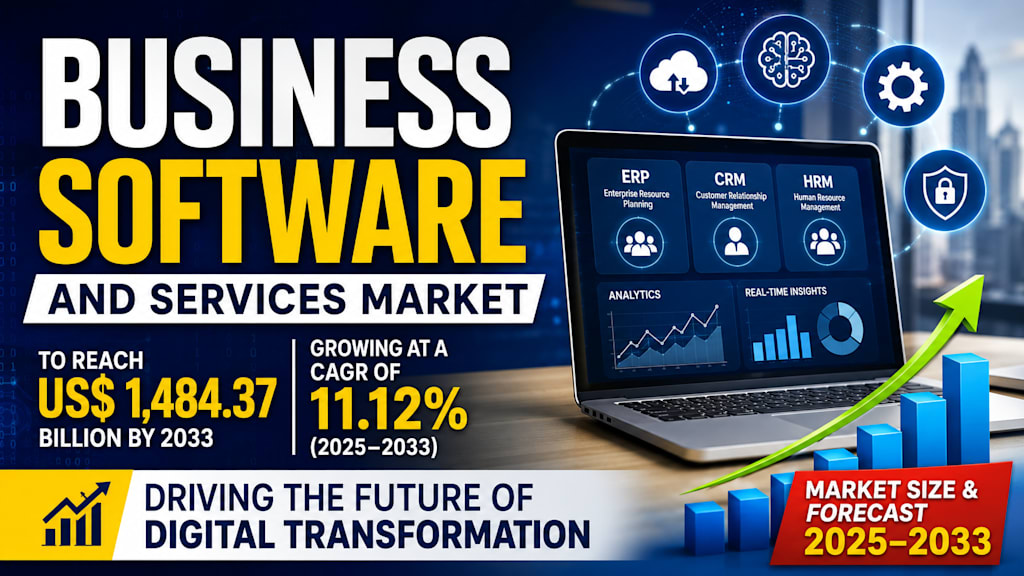
According to industry analysis, the Business Software and Services Market is projected to grow from US$ 574.66 billion in 2024 to US$ 1,484.37 billion by 2033, expanding at a robust CAGR of 11.12% during 2025–2033. This remarkable growth reflects the increasing reliance on digital technologies across industries as businesses strive to improve productivity and competitiveness.
From cloud-based enterprise resource planning systems to AI-powered customer relationship management tools, software solutions are now driving transformation across every business function.
Understanding Business Software and Services
Business software and services encompass a wide range of digital solutions designed to help organizations manage and optimize operations.
These solutions include:
Enterprise Resource Planning (ERP)
Customer Relationship Management (CRM)
Human Resource Management (HRM)
Accounting and Finance Software
Supply Chain Management Platforms
Project Management Tools
Analytics and Business Intelligence Solutions
Beyond software itself, organizations also rely on consulting, implementation, integration, maintenance, and managed services to maximize technology investments.
The rise of Software-as-a-Service (SaaS) and cloud computing has significantly transformed the industry by making enterprise-grade applications more affordable, scalable, and accessible to businesses of all sizes.
Why the Market Is Growing Rapidly
Digital Transformation Has Become a Strategic Priority
Across industries, digital transformation is no longer optional.
Businesses are investing in advanced technologies to modernize legacy systems, streamline operations, and create better customer experiences. Organizations recognize that digital capabilities are essential for survival in an increasingly competitive market.
Cloud infrastructure, automation tools, artificial intelligence, and advanced analytics are helping enterprises become more resilient and responsive to changing business conditions.
As companies continue to digitize operations, demand for software solutions and associated services continues to surge.
Cloud Adoption Is Accelerating Worldwide
Cloud computing remains one of the strongest growth drivers in the business software sector.
Traditional on-premise systems often require significant capital investment and maintenance. Cloud-based solutions, on the other hand, offer:
Lower upfront costs
Faster deployment
Greater scalability
Remote accessibility
Automatic updates
Enhanced collaboration
The growing popularity of hybrid work environments has further accelerated cloud adoption, allowing employees to securely access applications and data from anywhere.
Organizations increasingly view cloud migration as a critical component of long-term business strategy.
Artificial Intelligence Is Transforming Enterprise Operations
Artificial intelligence and machine learning are revolutionizing how organizations operate.
Modern software platforms now leverage AI to:
Predict customer behavior
Automate repetitive tasks
Improve forecasting accuracy
Enhance cybersecurity
Personalize customer experiences
Optimize supply chain management
Businesses are increasingly integrating AI capabilities into everyday operations to improve efficiency and gain deeper insights from data.
As AI technologies continue to mature, software vendors are introducing increasingly sophisticated solutions that drive greater value for customers.
Real-Time Data Analytics Is Becoming Essential
In today's data-driven economy, organizations need access to accurate information in real time.
Business software platforms equipped with advanced analytics capabilities help companies:
Monitor performance metrics
Identify emerging trends
Detect operational inefficiencies
Improve strategic planning
Respond rapidly to market changes
Real-time analytics empowers executives to make informed decisions based on current information rather than historical reports.
The growing demand for visibility and transparency is encouraging organizations to invest heavily in integrated analytics platforms.
Automation Continues to Reshape Business Processes
Automation has become a major competitive differentiator.
Businesses are increasingly adopting Robotic Process Automation (RPA) and intelligent workflow systems to eliminate manual tasks and reduce operational costs.
Common automation applications include:
Invoice processing
Employee onboarding
Customer support
Data entry
Inventory management
Compliance reporting
These technologies help organizations achieve higher productivity while reducing human error and operational inefficiencies.
As labor shortages continue to affect multiple industries, automation solutions are expected to witness even stronger demand.
The Rise of Customized Software Solutions
Every organization has unique operational requirements.
This reality has led software providers to focus heavily on customization and industry-specific solutions. Companies increasingly prefer platforms tailored to their specific workflows, compliance requirements, and business objectives.
The trend toward customization is particularly evident in industries such as:
Healthcare
Financial Services
Manufacturing
Retail
Telecommunications
Government Services
Customized solutions deliver greater operational efficiency and often provide stronger returns on investment compared to generic software platforms.
Challenges Facing the Industry
High Implementation Costs
Despite strong demand, implementation costs remain a significant challenge.
Deploying enterprise software often requires substantial investments in:
Licensing
Infrastructure upgrades
System integration
Employee training
Consulting services
For small and medium-sized businesses, these expenses can create barriers to adoption.
Complex implementation projects may also result in delays and cost overruns, impacting overall return on investment.
Growing Data Security and Privacy Concerns
As organizations store increasing volumes of sensitive information digitally, cybersecurity has become a top priority.
Data breaches, ransomware attacks, and regulatory compliance requirements continue to create challenges for software providers and users alike.
Businesses must invest in:
Advanced cybersecurity tools
Secure cloud environments
Multi-factor authentication
Data encryption
Compliance management systems
Regulations such as GDPR and evolving privacy laws require organizations to maintain strict security standards, increasing operational complexity.
Regional Market Insights
United States
The United States remains one of the largest and most advanced markets for business software and services.
Organizations across sectors are aggressively adopting:
Artificial intelligence
Cloud computing
Automation technologies
Advanced analytics
Strong technology infrastructure and continuous innovation position the U.S. as a global leader in enterprise software adoption.
Germany
Germany's market is expanding steadily as businesses embrace Industry 4.0 initiatives and digital transformation strategies.
Organizations are increasingly leveraging AI, cloud platforms, and automation technologies to improve productivity and maintain global competitiveness.
The country continues to invest heavily in digital infrastructure and smart manufacturing solutions.
India
India has emerged as one of the fastest-growing markets globally.
Several factors are driving growth:
Rapid digitalization
Government initiatives
Expanding startup ecosystem
Strong IT services sector
Rising cloud adoption
Businesses across banking, manufacturing, healthcare, and telecommunications are accelerating investments in software modernization.
Saudi Arabia
Saudi Arabia's Vision 2030 initiative is fueling substantial investment in technology and digital infrastructure.
The government is promoting:
Smart city development
Cloud adoption
AI implementation
Cybersecurity investments
Digital government services
These initiatives are creating significant opportunities for software providers operating in the region.
10 Recent Developments in the Business Software and Services Industry
1. IBM Expands Oracle Consulting Capabilities
IBM announced plans to acquire Applications Software Technology LLC to strengthen Oracle consulting and cloud transformation services.
2. Accumatica Launches Professional Services Edition
Accumatica introduced a specialized solution designed for professional services organizations seeking improved operational efficiency.
3. Microsoft Continues AI Integration Across Enterprise Products
Microsoft is embedding generative AI capabilities across its business software ecosystem.
4. SAP Expands Cloud ERP Portfolio
SAP continues enhancing cloud-native ERP solutions for global enterprises.
5. Oracle Accelerates AI-Powered Business Applications
Oracle is integrating advanced AI functionality into enterprise software offerings.
6. Infor Strengthens Industry-Specific Cloud Solutions
Infor continues developing sector-focused cloud applications for manufacturing and healthcare.
7. Epicor Enhances Manufacturing Software Capabilities
Epicor is investing in automation and predictive analytics features.
8. NetSuite Expands Financial Management Tools
NetSuite continues improving cloud-based accounting and financial planning capabilities.
9. MicroStrategy Advances Enterprise Analytics Solutions
MicroStrategy is enhancing business intelligence platforms for data-driven decision-making.
10. Deltek Focuses on Project-Based Business Software Innovation
Deltek continues expanding solutions for government contractors and professional services organizations.
Competitive Landscape
Major companies operating in the Business Software and Services Market include:
SAP SE
IBM Corporation
Microsoft
Oracle
Infor
Epicor Software Corporation
NetSuite
MicroStrategy Incorporated
Acumatica, Inc.
Deltek, Inc.
Final Thoughts
The Business Software and Services Market is entering a transformative era driven by artificial intelligence, cloud computing, automation, and real-time analytics. As organizations worldwide accelerate digital transformation efforts, demand for scalable, intelligent, and secure software solutions will continue to rise.
With the market expected to exceed US$ 1.48 trillion by 2033, vendors that prioritize innovation, customization, cybersecurity, and cloud-native technologies are likely to emerge as long-term winners. For enterprises seeking sustainable growth and operational excellence, investing in modern business software is no longer a technology decision—it is a strategic business imperative.
About the Creator
Enjoyed the story? Support the Creator.
Subscribe for free to receive all their stories in your feed.
Comments
There are no comments for this story
Be the first to respond and start the conversation.