
Business Continuity Management Market Outlook: Risk Resilience and Growth Opportunities
The Business Continuity Management Market is experiencing strong growth driven by increasing need for organizational resilience and risk mitigation strategies.

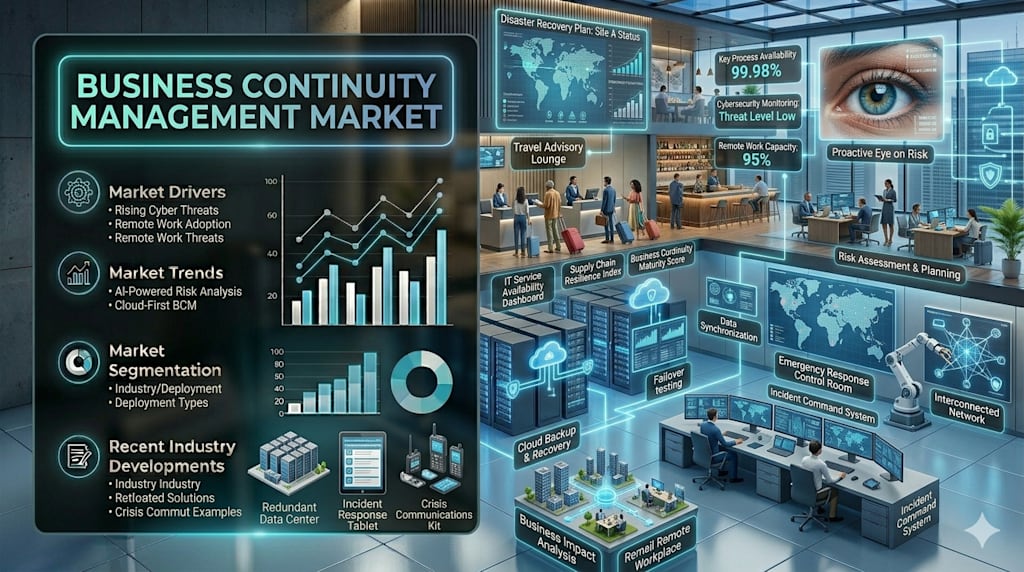
According to IMARC Group's latest research publication, The global business continuity management market size reached USD 852.2 Million in 2025. Looking forward, IMARC Group expects the market to reach USD 2,423.2 Million by 2034, exhibiting a growth rate (CAGR) of 11.94% during 2026-2034.
How AI is Reshaping the Future of Business Continuity Management Market
- Predictive Risk Assessment and Threat Intelligence: AI algorithms analyze massive datasets to identify emerging threats before they escalate. Machine learning models detect patterns in historical disruptions, cyber threats, and environmental factors, enabling proactive risk mitigation strategies that shift organizations from reactive responses to predictive preparedness.
- Automated Incident Response and Recovery: AI-powered platforms automate critical continuity workflows during disruptions. Systems automatically trigger recovery protocols, reroute workloads, and execute pre-defined business continuity plans without human intervention, significantly reducing response times and minimizing operational downtime during crisis situations.
- Real-Time Monitoring and Anomaly Detection: Advanced AI systems continuously monitor IT infrastructure, networks, and operational processes to identify anomalies signaling potential disruptions. These intelligent platforms analyze network traffic, system behaviors, and performance metrics, flagging suspicious activities that could compromise business operations before significant damage occurs.
Business Continuity Management Industry Overview
Regulatory frameworks across financial services, healthcare, and critical infrastructure sectors are driving unprecedented BCM adoption. The Financial Industry Regulatory Authority mandates comprehensive business continuity plans for broker-dealer firms, while healthcare organizations must comply with HIPAA requirements for uninterrupted patient care systems. ISO 22301 certification has become the global standard for business continuity management systems, with organizations pursuing compliance to demonstrate operational resilience capabilities.
Business Continuity Management Market Trends & Drivers
The escalating frequency and sophistication of cyber threats is fundamentally reshaping business continuity priorities worldwide. Internet crime complaints exceeded 859,532 cases with losses surpassing 16 billion dollars in 2025, representing a 33% increase compared to previous years according to Federal Bureau of Investigation reports. Ransomware attacks specifically targeting business infrastructure surged 179% in early 2025, with average recovery costs reaching 1.18 million dollars per incident. Organizations are responding by integrating cybersecurity measures directly into continuity frameworks, recognizing that digital vulnerabilities can cause complete operational paralysis. The AT&T data breach affecting 73 million customers demonstrated how security failures create cascading continuity challenges, prompting companies across all sectors to reassess their disaster recovery strategies and implement more robust incident response capabilities that address both cyber and operational resilience simultaneously.
Cloud-based BCM platforms are transforming how organizations approach continuity planning and disaster recovery operations. The shift from on-premises legacy systems to cloud-native solutions enables real-time data integration, automated workflows, and seamless remote access during disruptions. Hybrid and multi-cloud environments are driving demand for integrated resilience solutions that can automatically shift workloads, balance traffic, and verify data integrity during outages without human intervention. Over 60% of United States organizations now invest in enterprise continuity management solutions, with cloud deployment models offering scalability advantages and significantly lower total cost of ownership compared to traditional infrastructure. SaaS-based BCM platforms provide instant access, automatic updates, and pay-per-use pricing models that make advanced continuity capabilities accessible to organizations of all sizes, democratizing resilience technology that was previously limited to large enterprises with substantial IT budgets.
Small and medium enterprises are emerging as the fastest-growing adoption segment as competitive pressures and supply chain vulnerabilities make continuity planning essential for business survival. SMEs previously viewed BCM as enterprise-exclusive are now recognizing operational resilience as fundamental business capability rather than optional investment. Digital transformation initiatives, remote workforce management challenges, and increasing customer expectations for uninterrupted service availability are compelling smaller organizations to implement structured continuity frameworks. Industry consolidation through acquisitions is strengthening market capabilities, with Everbridge acquiring Infinite Blue and Motorola Solutions purchasing Noggin to deliver integrated critical event management and business continuity solutions. These strategic combinations are creating comprehensive platforms that bundle crisis management, emergency notification services, and operational resilience tools into unified ecosystems accessible to resource-constrained organizations seeking cost-effective but sophisticated continuity protection.
Leading Companies Operating in the Global Business Continuity Management Industry
- Fusion Risk Management Inc.
- International Business Machines Corporation
- Logic Manager Inc.
- MetricStream Inc.
- NAVEX Global Inc.
- Quantivate LLC
- Sungard Availability Services (Fidelity National Information Services Inc.)
- Virtual Corporation
Business Continuity Management Market Report Segmentation
By Offering:
- Solutions
- Crisis Management
- Risk Management
- Audit Management
- Government, Risk, and Compliance (GRC)
- Others
- Services
- Professional
- Managed
Solutions represent the largest class, as organizations prioritize comprehensive platforms that integrate crisis management, risk assessment, and compliance tracking capabilities within unified systems rather than fragmented point solutions.
By Organization Size:
- Small and Medium-sized Enterprises
- Large Enterprises
Large enterprises have the largest market share owing to complex operational structures, dispersed geographic footprints, and massive volumes of critical data requiring sophisticated continuity frameworks to maintain operations during disruptions.
By Industry:
- Banking, Financial Services, and Insurance (BFSI)
- Government
- Healthcare
- Transportation and Logistics
- Energy and Utilities
- Manufacturing and Retail
- Telecom and IT
- Others
Banking, Financial Services, and Insurance have the largest market share due to stringent regulatory requirements, handling of sensitive customer data, and critical need for uninterrupted financial transaction processing during emergencies.
Regional Insights:
- North America (United States, Canada)
- Asia Pacific (China, Japan, India, South Korea, Australia, Indonesia, Others)
- Europe (Germany, France, United Kingdom, Italy, Spain, Russia, Others)
- Latin America (Brazil, Mexico, Others)
- Middle East and Africa
North America exhibits a clear dominance in the business continuity management market due to advanced healthcare systems, extensive regulatory frameworks, and high concentration of technology firms and financial institutions requiring robust operational resilience capabilities.
Recent News and Developments in Business Continuity Management Market
- February 2024: Fusion Risk Management announced general availability of its AI-powered assistant Fusion Resilience Copilot, pre-configured to answer critical questions instantly and enable practitioners to automate manual activities, unlock deeper incident insights, and respond rapidly to disruptions through intelligent automation capabilities.
- February 2024: Riskonnect introduced generative AI enhancements to its Business Continuity & Resilience solution, leveraging artificial intelligence to suggest new content when professionals draft or update business continuity plans, business impact analyses, and incident templates, significantly streamlining traditionally time-intensive planning processes.
- May 2024: Juvare launched the WebEOC Business Continuity Management Solution, a comprehensive platform combining emergency notification services, crisis management, and business continuity capabilities with configurable data integrations and performance monitoring tools enabling organizations to manage risks proactively and sustain operations during disruptions.
- July 2024: Everbridge acquired Infinite Blue for an undisclosed amount, strengthening comprehensive organizational resilience capabilities by integrating advanced continuity planning, risk management, and operational resilience features into its critical event management platform serving enterprise clients across financial services and critical infrastructure sectors.
- November 2024: Riskonnect collaborated with Everbridge to combine business continuity and critical event management into a unified platform, enabling enterprises to respond more effectively to disruptions by integrating complementary capabilities from both leading integrated risk management and critical event management solution providers.
Note: If you require specific details, data, or insights that are not currently included in the scope of this report, we are happy to accommodate your request. As part of our customization service, we will gather and provide the additional information you need, tailored to your specific requirements. Please let us know your exact needs, and we will ensure the report is updated accordingly to meet your expectations.
About the Creator
Michael Richard
Michael Richard is a Market Research Expert specializing in market intelligence, competitive analysis, and data-driven insights. He helps organizations understand trends and emerging opportunities through in-depth research.
Enjoyed the story? Support the Creator.
Subscribe for free to receive all their stories in your feed.
Comments
There are no comments for this story
Be the first to respond and start the conversation.