
Business Analytics Market Trends: Big Data Adoption, Predictive Analytics & Forecast to 2034
How growing adoption of AI-driven analytics, real-time data processing, and cloud-based platforms is transforming enterprise decision-making and operational efficiency in the business analytics market

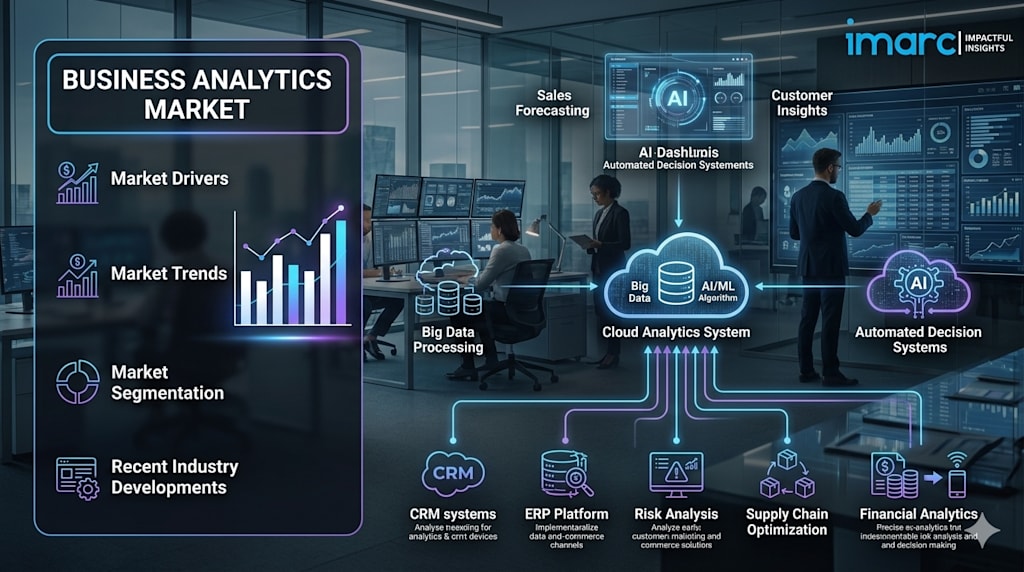
According to IMARC Group's latest research publication, The global business analytics market size reached USD 104.1 Billion in 2025. Looking forward, IMARC Group expects the market to reach USD 203.4 Billion by 2034, exhibiting a growth rate (CAGR) of 7.49% during 2026-2034.
How AI and Data Intelligence Are Reshaping the Future of the Business Analytics Market
- Exponential Data Volume Driving Demand for Advanced Analytics Tools: The widespread adoption of digital technologies, Internet of Things (IoT) devices, and cloud-connected platforms is generating unprecedented volumes of structured and unstructured data across industries. Organizations are increasingly unable to derive actionable value from this data through manual processes alone, creating substantial demand for automated analytics platforms capable of processing vast datasets in real time. The growing complexity of data types, including customer interactions, social media signals, and sensor outputs, is compelling enterprises to adopt advanced analytics tools incorporating natural language processing (NLP), machine learning (ML), and artificial intelligence (AI). This foundational shift in data generation is positioning business analytics as a critical operational infrastructure rather than an optional strategic investment.
- Evolving AI and Machine Learning Capabilities Expanding Analytics Boundaries: Artificial intelligence and machine learning are fundamentally redefining what business analytics can deliver. AI-driven predictive and prescriptive analytics platforms now enable organizations to anticipate market trends, detect operational anomalies, and receive system-generated recommendations for optimal decision-making, capabilities that were computationally unattainable in previous technology generations. The medical sector is increasingly deploying AI-powered analytics to enhance patient diagnosis accuracy and optimize hospital resource allocation, while the BFSI sector is leveraging ML-based analytics for real-time fraudulent transaction detection and risk scoring. These industry-specific applications are broadening the addressable market for analytics vendors and accelerating enterprise-level adoption across verticals that previously relied on traditional reporting tools.
- Regulatory Compliance and Data Privacy Requirements Accelerating Enterprise Adoption: The tightening global regulatory environment surrounding data governance is emerging as a powerful adoption catalyst for business analytics solutions. Frameworks such as the General Data Protection Regulation (GDPR) in Europe and the California Consumer Privacy Act (CCPA) in the United States are imposing stringent requirements on how organizations collect, store, process, and report on customer data. Non-compliance carries the dual risk of substantial financial penalties and significant reputational damage, compelling enterprises across sectors to invest in analytics platforms that ensure transparent data lineage, access control, and audit trail management. Cybersecurity threat escalation is further reinforcing this trend, as organizations require real-time analytics capabilities to detect breaches, monitor compliance postures, and maintain stakeholder trust.
- Cloud-Based Analytics Democratizing Access Across Enterprise Sizes: The accelerating migration of analytics infrastructure to cloud environments is fundamentally altering the competitive dynamics of the business analytics market. Cloud-based solutions offer organizations scalability, deployment flexibility, and a lower total cost of ownership compared to legacy on-premises installations, making sophisticated analytics capabilities accessible to small and medium-sized enterprises (SMEs) that previously lacked the IT budgets to invest in enterprise-grade tools. The shift to subscription-based SaaS models is further lowering the barrier to entry, enabling organizations of all sizes to access advanced analytics, data visualization, and AI-powered reporting without significant upfront capital expenditure. This democratization of analytics is expanding the effective addressable market while intensifying competitive pressure on established vendors to continuously innovate.
- Supply Chain Optimization and HR Analytics Driving Cross-Sector Utilization: Beyond finance and technology, business analytics is recording deep penetration across supply chain management and human resources functions. Organizations are deploying demand forecasting models, inventory optimization algorithms, and supplier performance analytics to build more resilient and cost-efficient supply chains in the face of ongoing global disruptions. Simultaneously, the widespread adoption of HR analytics by both public and private sector organizations is enabling data-driven approaches to talent acquisition, workforce planning, employee engagement measurement, and organizational productivity enhancement. These multi-functional applications across business units are increasing analytics platform utilization per enterprise, driving higher customer lifetime values for vendors and reinforcing the strategic indispensability of business analytics infrastructure.
Business Analytics Industry Overview
North America currently holds a dominant position in the global business analytics market, underpinned by its highly developed technology ecosystem, strong enterprise digitalization culture, and early adoption of cloud and AI infrastructure. The United States, in particular, is home to the world's largest concentration of analytics solution providers and enterprise technology buyers, creating a self-reinforcing innovation and consumption cycle. Government initiatives supporting digital transformation across public sector agencies, including data modernization programs within federal departments and state-level smart governance frameworks, are further stimulating analytics adoption in the region. Europe represents a substantial and rapidly maturing market, where GDPR compliance imperatives have directly accelerated investments in data governance, audit, and analytics platforms across financial services, healthcare, and manufacturing sectors. Asia Pacific is experiencing the fastest demand growth, driven by the rapid digitalization of emerging economies, expanding SME sectors across China, India, and Southeast Asia, and significant government investments in smart city and Industry 4.0 infrastructure. The region's large volume of digital-native businesses and mobile-first consumer markets are generating data environments that inherently require sophisticated analytics tools to unlock competitive value.
Business Analytics Market Trends and Drivers
The business analytics market is undergoing rapid transformation and scale-up as organizations across industries recognize data-driven decision-making as a core competitive differentiator. The data warehousing platform segment dominates the software landscape, functioning as the centralized repository that consolidates structured data from sales, finance, marketing, and customer interaction systems into a unified, consistent source of truth. Its seamless integration with business intelligence tools, combined with robust security features including access controls, encryption, and audit trail management, makes it the foundational layer upon which all higher-order analytics capabilities are built.
On-premises deployment continues to account for the majority of market share in sensitive verticals such as finance, healthcare, and government, where data sovereignty regulations mandate geographic data residency and where legacy system integration complexity makes cloud migration a phased rather than immediate undertaking. However, cloud-based deployment is gaining ground rapidly as organizations in less regulated sectors prioritize agility and cost efficiency, establishing a bifurcated deployment landscape that analytics vendors are addressing through hybrid infrastructure offerings.
From an end-user perspective, small and medium-sized enterprises represent the largest segment, a reflection of the market's ongoing democratization driven by accessible SaaS pricing models and cloud delivery. Large enterprises, while individually higher in spending per account, are outnumbered by the sheer volume of SMEs globally that are integrating analytics into core operational workflows for the first time. Across verticals, BFSI, healthcare, manufacturing, and telecom and IT are recording the deepest analytics penetration, each driven by a unique combination of regulatory, operational, and competitive pressures that make data intelligence a strategic necessity rather than a discretionary capability.
Leading Companies Operating in the Global Business Analytics Industry
- Capgemini SE
- Cisco Systems Inc.
- Google LLC (Alphabet Inc.)
- IBM Corporation
- Information Builders Inc.
- Microsoft Corporation
- MicroStrategy Incorporated
- Oracle Corporation
- Qlik Technologies Inc.
- SAP SE
- SAS Institute Inc.
- Tableau Software LLC (Salesforce Inc.)
- Business Analytics Market Report Segmentation
By Software:
- Query, Reporting and Analysis Tools
- Advanced and Predictive Analytics
- Location Intelligence
- Content Analytics
- Data Warehousing Platform
- Others
Data warehousing platform represents the largest software segment, as it provides a centralized, secure, and integration-ready infrastructure that simplifies data management and serves as the foundational layer for all business intelligence and reporting workflows.
By Deployment Type:
- Cloud-based
- On-Premises
On-premises deployment holds the largest market share, particularly within finance, healthcare, and government verticals where data sovereignty requirements, legacy system integration needs, and sensitivity of stored information make on-premises infrastructure the most viable and compliant deployment model.
By End-User:
- Large Enterprises
- Small and Medium Size Enterprises
Small and medium-sized enterprises represent the largest end-user segment, driven by the accelerating adoption of cloud-based SaaS analytics platforms that make enterprise-grade data intelligence capabilities accessible to organizations with constrained IT budgets and lean technical teams.
By Vertical:
- BFSI
- Energy and Power
- Manufacturing
- Healthcare
- Government
- Education
- Media and Entertainment
- Telecom and IT
- Others
Regional Insights:
- North America (United States, Canada)
- Asia Pacific (China, Japan, India, South Korea, Australia, Indonesia, Others)
- Europe (Germany, France, United Kingdom, Italy, Spain, Russia, Others)
- Latin America (Brazil, Mexico, Others)
- Middle East and Africa
North America exhibits clear dominance in the business analytics market, supported by its advanced enterprise technology infrastructure, high cloud adoption rates, and the concentration of leading analytics solution providers headquartered in the region.
Recent News and Developments in the Business Analytics Market
- September 2024: Microsoft Corporation announced a significant expansion of its Microsoft Fabric analytics platform, integrating new AI-powered data engineering and real-time intelligence capabilities designed to enable enterprises to consolidate their entire analytics workload within a single unified environment. The expansion reflects growing enterprise demand for end-to-end analytics ecosystems that eliminate the complexity and cost associated with managing multiple point solutions across data ingestion, transformation, and visualization workflows.
- November 2024: SAP SE launched an enhanced version of its SAP Analytics Cloud platform, incorporating generative AI capabilities that allow business users to query complex datasets using natural language inputs and receive automatically generated visualizations and narrative summaries. The update targets finance, supply chain, and HR analytics use cases, reducing dependence on specialized data science resources and accelerating time-to-insight for non-technical decision-makers across enterprise organizations.
- February 2025: IBM Corporation introduced new watsonx.data capabilities specifically designed to support hybrid cloud analytics deployments, enabling organizations to govern and analyze data stored across on-premises data centers and multiple public cloud environments from a single unified interface. The announcement addresses a critical pain point for large enterprises managing distributed data estates, with IBM positioning the solution as the analytics backbone for regulated industries including banking, insurance, and healthcare.
- April 2025: Tableau Software, operating under Salesforce, released Tableau Pulse with expanded AI-driven metrics intelligence features, enabling business users to receive automated, personalized analytics digests delivered through Slack and email channels without requiring active dashboard navigation. The feature targets operational decision-makers in sales, marketing, and customer success functions, reinforcing Salesforce's strategy of embedding analytics natively within the daily workflow tools already used by enterprise teams.
- January 2026: Google LLC announced the general availability of its Looker Studio Pro advanced analytics suite with integrated Gemini AI capabilities, enabling enterprise customers to perform natural language data exploration, automated anomaly detection, and AI-generated executive reporting across Google Cloud and third-party data sources. The launch represents a significant intensification of competition in the cloud-native business analytics segment, with Google targeting large enterprise and mid-market customers seeking a tightly integrated analytics and AI platform within a single cloud ecosystem.
Note: If you require specific details, data, or insights that are not currently included in the scope of this report, we are happy to accommodate your request. As part of our customization service, we will gather and provide the additional information you need, tailored to your specific requirements. Please let us know your exact needs, and we will ensure the report is updated accordingly to meet your expectations.
About the Creator
Abhay Rajput
I am working in market research company that provides market and business research intelligence across the globe.
Enjoyed the story? Support the Creator.
Subscribe for free to receive all their stories in your feed.
Comments
There are no comments for this story
Be the first to respond and start the conversation.