
Buildings Construction Market Trends: Smart Cities Expansion, Automation & Industry Forecast to 2033
How smart city initiatives, digital engineering tools, and IoT integration are redefining building construction processes and enhancing operational efficiency worldwide

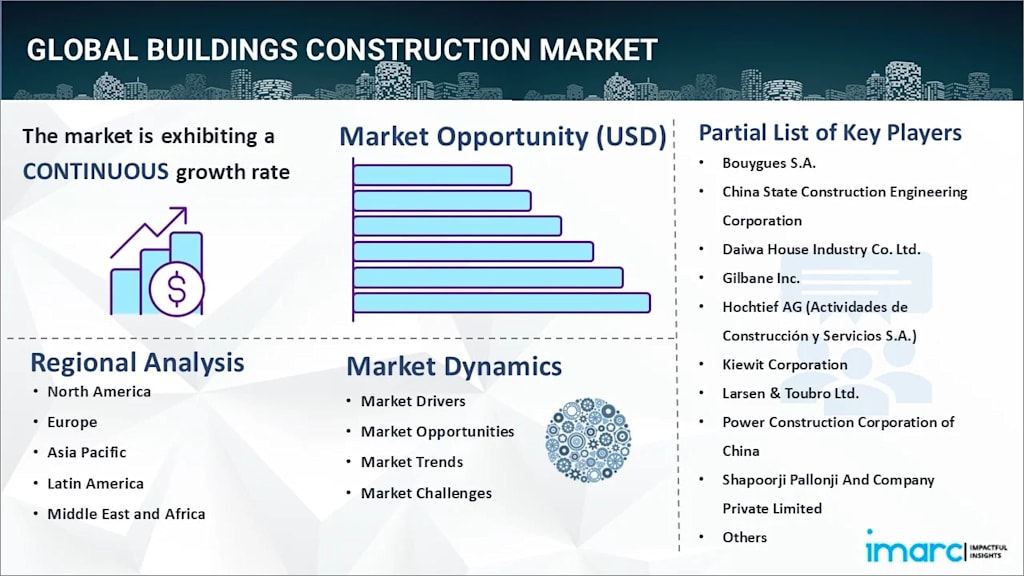
Rapid urbanization, a growing global population, and a significant shift toward sustainable infrastructure are fueling the expansion of the global buildings construction sector. This growth is further bolstered by government-led housing initiatives and the integration of advanced technologies like Building Information Modeling (BIM) and modular construction techniques. According to IMARC Group’s latest data, the global buildings construction market size was valued at USD 6.8 Trillion in 2024. Looking forward, IMARC Group estimates the market to reach USD 10.5 Trillion by 2033, exhibiting a CAGR of 4.9% from 2025-2033.
The buildings construction industry has evolved into a cornerstone of global economic development, currently exceeding a multi-trillion-dollar valuation when accounting for residential, commercial, and industrial segments. Demand is increasingly shaped by the "green building" movement, where developers prioritize energy-efficient designs and low-carbon materials to meet strict environmental regulations. Digital transformation is also playing a critical role; the use of AI for site safety and drones for surveying has moved from experimental to standard practice.
Get Data-Driven Insights on "Buildings Construction Market" – Download Today
Buildings Construction Market Growth Drivers:
- Accelerated Urbanization and Population Expansion
The relentless movement of people toward urban centers is the primary engine for new construction activity. In emerging markets across Asia and Africa, this migration necessitates massive investments in housing and public facilities. Current estimates suggest that nearly 200,000 people move to cities every day, creating an immediate and constant need for residential high-rises and commercial hubs. This pressure forces developers to adopt faster, more efficient building methods to keep pace with housing shortages, fundamentally supporting the global industry's growth and driving long-term infrastructure demand.
- Integration of Advanced Construction Technologies
The industry is undergoing a digital revolution, with Building Information Modeling (BIM) and 3D printing significantly reducing project timelines and material waste. By creating precise digital twins of structures before a single brick is laid, firms can identify design conflicts early, saving millions in potential rework. Real-world applications of AI and IoT sensors on-site are now common, allowing project managers to monitor structural integrity and worker safety in real-time. These technological efficiencies attract higher investment as they promise better margins and more predictable project delivery schedules for stakeholders.
- Government-Led Infrastructure and Housing Schemes
Public sector investment remains a critical driver, with governments worldwide launching ambitious programs to stimulate economic growth. Initiatives like the CHIPS and Science Act in the U.S. or the Saudi Vision 2030 are pouring hundreds of billions into specialized industrial and residential projects. These schemes often include tax incentives for sustainable building, encouraging private developers to align with national goals. Such high-level financial backing ensures a steady pipeline of projects, providing the construction sector with a stable foundation even during periods of broader economic fluctuation or high interest rates.
Buildings Construction Market Trends:
- Shift Toward Sustainable and Net-Zero Building Practices
Environmental accountability has moved from a corporate social responsibility goal to a core business requirement. Modern projects increasingly utilize "green" materials like cross-laminated timber, recycled steel, and low-carbon concrete to reduce the embodied carbon of new structures. This trend is reinforced by certification standards like LEED and BREEAM, which have become benchmarks for premium real estate. With buildings responsible for nearly 40% of global energy-related carbon emissions, the push for net-zero energy buildings is reshaping how architects and engineers approach insulation, HVAC systems, and renewable energy integration.
- Rise of Modular and Off-Site Construction
Modular construction where building components are manufactured in a factory and assembled on-site is gaining significant traction as a solution to labor shortages and rising costs. This method can reduce construction time by up to 50% compared to traditional builds. In 2025, over 70% of modular projects required specialized insurance, reflecting its mainstream status. By shifting the bulk of the work to a controlled environment, developers can avoid weather delays and maintain higher quality control, making it an ideal choice for standardized projects like hotels, student housing, and affordable apartments.
- Premiumization and Smart Building Ecosystems
There is a growing demand for "smart" buildings that offer more than just shelter; they provide an integrated experience through automated lighting, climate control, and advanced security. Premium sourcing of high-end materials and aesthetic architectural designs are being used to attract affluent buyers and high-value commercial tenants. These buildings function as living ecosystems, using data analytics to optimize energy consumption and improve occupant well-being. This focus on high-quality, tech-enabled spaces is driving value growth in major metropolitan areas, where luxury and functionality are increasingly intertwined in the eyes of investors.
Recent News and Developments in Buildings Construction Market
- February 2026: A major global construction firm announced the successful completion of the first 3D-printed multi-story commercial complex in Europe, demonstrating a 40% reduction in labor costs and a significant decrease in material waste compared to traditional methods.
- January 2026: The Saudi Arabian government introduced a new digital, unified framework for regulating all construction and contracting activities, aimed at enhancing transparency and safety standards across the Kingdom's massive megaprojects.
- November 2025: A leading real estate developer unveiled a $1.6 billion smart city project featuring a mix of residential units and offices equipped with AI-driven energy management systems to achieve carbon neutrality.
Note: If you require specific details, data, or insights that are not currently included in the scope of this report, we are happy to accommodate your request. As part of our customization service, we will gather and provide the additional information you need, tailored to your specific requirements. Please let us know your exact needs, and we will ensure the report is updated accordingly to meet your expectations.
About the Creator
Andrew Sullivan
Hello, I’m Andrew Sullivan. I have over 9+ years of experience as a market research specialist.
Enjoyed the story? Support the Creator.
Subscribe for free to receive all their stories in your feed.
Comments
There are no comments for this story
Be the first to respond and start the conversation.