
Building the Future With Less Carbon: Why Sustainable Materials Are Reshaping Construction
As governments tighten climate rules and builders rethink emissions, low-carbon materials are moving from niche innovation to mainstream construction strategy.

The construction industry is entering one of the biggest transitions in its history. For decades, builders focused mainly on cost, speed, and structural performance. Today, carbon emissions have become just as important. Materials once considered standard — especially traditional cement and steel — are now under pressure because of their environmental impact.
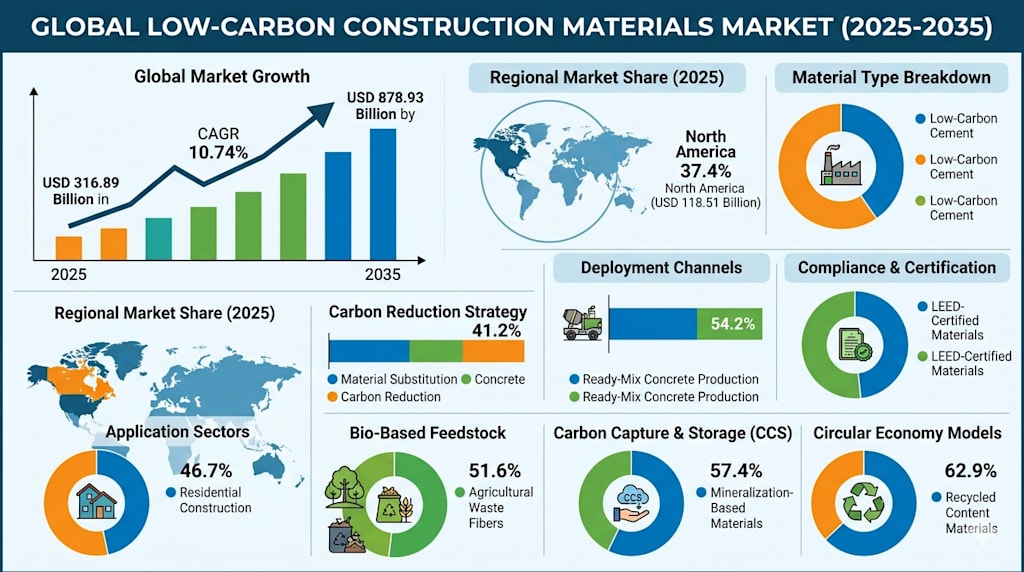
That shift is transforming the global Low-Carbon Construction Materials Market. Valued at USD 316.89 billion in 2025, the market is projected to reach nearly USD 878.93 billion by 2035, growing at a CAGR of 10.74%. The momentum is being driven by stricter regulations, investor expectations, and rapid advances in cleaner production technologies.
What makes this transition significant is that it is no longer based on voluntary sustainability goals alone. Governments are embedding carbon limits directly into procurement policies and building standards. Developers who fail to meet these requirements increasingly risk losing access to major projects, financing opportunities, and public contracts.
Market Highlights
- North America leads all regions with a 37.4% market share, valued at USD 118.51 Billion.
- Low-Carbon Cement holds 40.3% share by material type.
- Material Substitution leads carbon reduction strategy at 41.2%.
- Ready-Mix Concrete Production dominates deployment at 54.2%.
- LEED-Certified Materials lead compliance at 48.1%.
- Residential Construction accounts for 46.7% of applications.
- Agricultural Waste Fibers lead feedstock at 51.6%.
- Mineralization-Based Materials lead carbon storage at 57.4%.
Recycled Content Materials dominate circularity at 62.9%.
Why Construction Materials Are Under Pressure
Construction is one of the world’s largest sources of carbon emissions, and cement production alone contributes roughly 8% of global CO2 emissions. That figure has placed heavy focus on the materials used in buildings, roads, bridges, and infrastructure projects.\
Governments are introducing rules that push contractors toward verified lower-emission products. Public procurement programs in the United States and Europe now require suppliers to provide Environmental Product Declarations, often called EPDs. These documents work like nutritional labels for building products, showing how much carbon is generated during manufacturing and transportation.
The financial side of the equation is changing too. Carbon pricing systems in Europe are making conventional cement production more expensive every year. Once carbon compliance costs rise above the premium for cleaner alternatives, the market naturally shifts toward lower-emission products.
This pressure is not limited to public infrastructure. Large corporations building offices, warehouses, and data centers are also demanding materials with traceable carbon footprints. Developers increasingly view lower-carbon buildings as more attractive to investors and tenants, especially in markets where sustainability reporting has become mandatory.
Cement Is Leading the Transformation
Among all product categories, low-carbon cement holds the strongest position, accounting for 40.3% of the market by material type. That dominance reflects cement’s universal role in construction. Nearly every project depends on it in some form, making it the industry’s largest decarbonization target.
Manufacturers are approaching the challenge in several ways. One method involves replacing portions of traditional clinker — the most carbon-intensive part of cement — with supplementary materials such as fly ash or calcined clay. Another strategy focuses on carbon capture and storage, often referred to as CCS, where emissions are captured before they enter the atmosphere.
Heidelberg Materials has become one of the sector’s most closely watched companies after launching the Brevik CCS facility in Norway. The plant can capture around 400,000 metric tons of CO2 annually, making it the cement industry’s first industrial-scale carbon capture operation.
Companies are experimenting with entirely new chemistries. Startups including Sublime Systems are developing electrochemical cement technologies designed to avoid traditional fossil-fuel-heavy kilns altogether. These innovations may eventually reduce dependence on expensive carbon capture infrastructure.
The industry is also seeing strong growth in carbon-negative concrete. Unlike standard concrete, these systems permanently mineralize captured CO2 inside the finished material. CarbonCure Technologies has already surpassed 500,000 metric tons of avoided CO2 emissions through its injected-concrete systems used across millions of concrete deliveries worldwide.
Builders Want Solutions That Fit Existing Workflows
One reason adoption is accelerating is that many low-carbon products do not require dramatic changes in construction practices. Builders generally prefer solutions that fit within existing supply chains, labor skills, and engineering standards.
Ready-mix concrete production illustrates this clearly. The segment accounts for more than half of deployment activity because producers can integrate lower-carbon mixes and carbon-injection technologies directly into existing operations. Contractors continue using concrete in familiar ways while still reducing project emissions.
Material substitution has emerged as the leading carbon-reduction strategy, representing 41.2% of the market. Replacing high-emission ingredients with recycled or lower-carbon alternatives often provides immediate emissions reductions without requiring entirely new infrastructure.
Recycled-content materials are also gaining strong momentum. Recycled aggregates, reclaimed steel, and industrial byproducts are becoming commercially attractive because they reduce both emissions and raw material costs. In many cases, these products now compete with virgin materials on price, eliminating one of the biggest barriers to adoption.
Mass timber is another fast-growing category, particularly in residential and mid-rise commercial construction. Engineered wood products store carbon throughout a building’s lifespan while requiring less energy-intensive production than concrete or steel. However, regional supply limitations and fire-code restrictions still slow broader adoption in some markets.
Regulations Are Reshaping Global Competition
North America currently leads the market with a 37.4% share valued at USD 118.51 billion. Much of that leadership comes from early federal support and procurement programs tied to the Inflation Reduction Act. The U.S. Environmental Protection Agency’s Low Embodied Carbon Label Program is creating verified purchasing pathways for cleaner construction products used in federally funded projects.
Europe, meanwhile, is leading in carbon pricing and industrial-scale CCS deployment. Norway’s Longship program has become a global model for public-private investment in cement decarbonization. The European Union’s emissions trading system is also increasing financial pressure on conventional manufacturing methods.
Asia Pacific may ultimately become the largest long-term opportunity because of its enormous construction activity. India and China continue to urbanize at massive scale, meaning even small policy shifts can create huge demand increases for cleaner building materials.
India is already signaling stronger movement in this direction through green procurement frameworks and classification systems for lower-carbon industrial products. Meanwhile, Southeast Asian manufacturers are rapidly expanding low-carbon cement production to meet expected demand growth.
Challenges Still Limit Supply Growth
Despite the market’s rapid expansion, major obstacles remain. The biggest is the cost and complexity of scaling production.
Industrial carbon capture systems for cement plants require billions of dollars in investment and years of construction. Many projects depend heavily on government subsidies or co-investment programs to become financially viable. Without public support, widespread deployment would move much more slowly.
Supply shortages are another concern. Demand for verified lower-carbon cement and steel is growing faster than production capacity. Some manufacturers have already pre-sold future output years in advance, reflecting how tight supply conditions have become.
Certification requirements also create challenges for smaller suppliers. Producing Environmental Product Declarations and meeting third-party verification standards can be expensive, which favors large corporations with greater financial resources.
Building codes often lag behind technological innovation. Some advanced alternative binders and cement-free systems perform well technically but remain excluded from regulated projects because standards bodies have not yet formally approved them.
The Industry Is Moving Beyond Experimentation
What stands out most about the current market is that sustainable construction materials are no longer experimental. The industry has moved into large-scale commercialization.
Corporate buyers, infrastructure agencies, and governments are creating stable long-term demand through procurement requirements and emissions targets. Investors are pouring billions into startups and industrial projects aimed at cleaner production systems. Established manufacturers are racing to secure partnerships, acquisitions, and production capacity before competition intensifies further.
The construction sector has historically evolved slowly. But carbon reduction goals, rising climate risks, and tightening regulations are accelerating change at a pace few expected a decade ago.
About the Creator
Yash Mule
SEO Specialist with 10+ years of experience at Evolvance Market Research. Expert in technical SEO, content strategy, and data-driven optimization, with a proven track record of significantly increasing organic traffic and search rankings.
Enjoyed the story? Support the Creator.
Subscribe for free to receive all their stories in your feed.
Comments
There are no comments for this story
Be the first to respond and start the conversation.