
Building Automation Systems Market Moves From Convenience to Necessity
Energy efficiency, smart infrastructure, and AI-driven building control are turning building automation systems into one of the most important pillars of modern real estate and facility management.

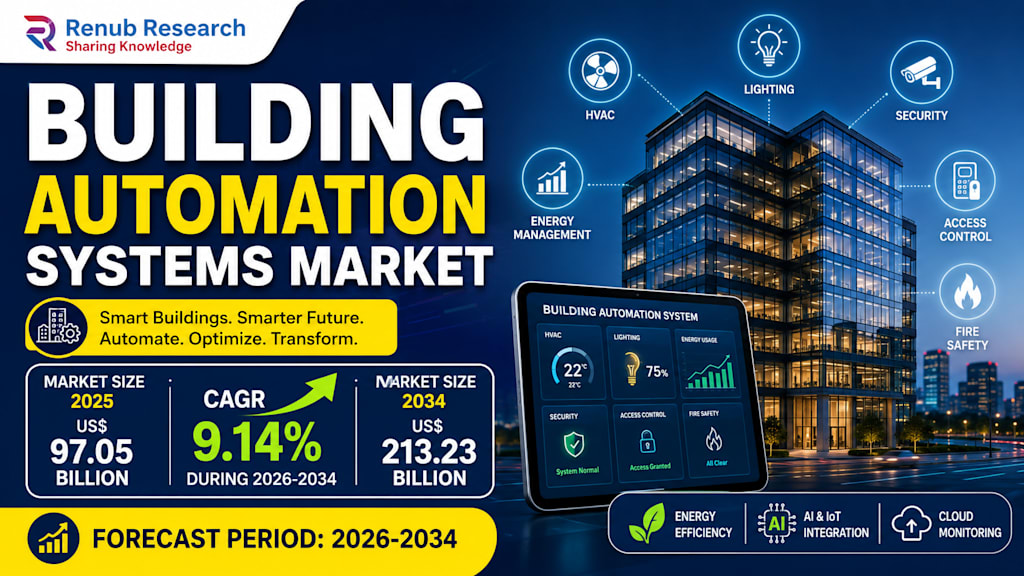
Building Automation Systems are no longer a “nice-to-have” upgrade for modern properties. They are becoming a practical requirement for organizations that want tighter control over energy use, stronger security, smarter operations, and better comfort for occupants. In Renub Research’s market outlook, the global Building Automation Systems market is projected to rise from US$ 97.05 billion in 2025 to US$ 213.23 billion in 2034, growing at a 9.14% CAGR during 2026–2034. That growth is being shaped by energy-efficiency goals, smart infrastructure expansion, and the increasing use of IoT, AI, and cloud-based monitoring in building operations.
Why Building Automation Is Gaining Real Momentum
A Building Automation System, or BAS, brings together the management of heating, ventilation, and air conditioning, lighting, security, energy use, and fire safety inside one integrated framework. The purpose is straightforward: make buildings easier to manage, more efficient to run, and more comfortable for people inside them. Sensors, controllers, and software work together to collect operational data and automatically adjust systems according to occupancy, environmental conditions, and user needs. In practice, that means a building can react intelligently instead of relying only on manual intervention.
That shift is happening because buildings now sit at the center of multiple pressures at once. Owners want lower operating costs. Governments want lower energy consumption. Tenants want safer, smarter, and healthier spaces. And facility teams want better visibility into what is happening across large, complex properties. BAS answers all of those demands in one framework, which is why it is being adopted across commercial buildings, hospitals, airports, shopping malls, residential complexes, and other large facilities. The rise of IoT, cloud computing, and artificial intelligence has only made these systems more capable and more attractive.
Energy Efficiency Is the Biggest Story
The strongest driver behind this market is the growing global push for energy efficiency and sustainability. Buildings consume a major share of global energy, so any improvement in how they are managed can have a meaningful impact. BAS helps reduce waste by adjusting temperature, lighting, and other systems based on actual usage rather than static settings. A room with fewer people does not need the same level of heating or cooling as a packed one, and lighting can be adjusted based on conditions or occupancy. That kind of automation creates direct savings and supports broader environmental goals.
The market is also benefiting from product innovation. ABB’s launch of ABB Ability BuildingPro Suites in March 2026 is a good example of how vendors are positioning software as a way to convert building data into measurable results. It reflects the larger industry direction: better intelligence, better dashboards, and better performance outcomes for owners and operators who want actionable insight rather than raw data alone.
Smart Buildings Are Turning BAS Into the Brain of the Property
Another major force behind BAS adoption is the rapid expansion of smart buildings and smart city programs. In a smart-building environment, heating, lighting, security, energy management, and access systems are not separate islands. They are connected through a common control layer, which makes the building easier to monitor and much faster to optimize. BAS is often the platform that ties all of that together.
This matters because cities are getting denser, facilities are getting more complex, and organizations are expected to provide more comfort and safety with fewer resources. Smart-city development makes BAS even more relevant, since modern urban infrastructure depends on automated systems that can improve resource utilization and support better living and working conditions. IoT sensors, cloud computing, and AI are strengthening this trend by making building systems more connected and more responsive. Honeywell’s AI-powered Connected Solutions launch in 2025 is a clear signal that vendors are moving toward unified operating interfaces rather than separate point solutions.
Operational Efficiency Is Becoming a Boardroom Issue
BAS is also attracting attention because it helps organizations manage operations more intelligently. Large commercial buildings, hospitals, industrial plants, hotels, and educational institutions often have complicated infrastructures that need continuous monitoring. Manual oversight is expensive, slow, and prone to error. Automation reduces that burden by improving visibility and enabling predictive maintenance, so problems can be detected earlier and downtime can be avoided.
That value proposition is showing up in product strategy as well. Johnson Controls’ Metasys 15.0, launched in November 2025, was positioned for mission-critical facilities with stronger scalability, resilience, and energy intelligence. The system’s support for up to 1,000 IP devices per server, along with redundancy and a preconfigured energy-management suite, shows how the market is moving toward deeper performance optimization rather than simple control.
The Market Still Faces Two Big Hurdles
Even with strong growth, BAS adoption is not frictionless. The first challenge is cost. A full automation setup can require investment in sensors, controllers, communication hardware, software, and professional integration services. For older buildings, retrofitting can become especially expensive. That makes adoption harder for smaller organizations or property owners with limited capital, even if the long-term savings are attractive.
The second challenge is integration complexity and cybersecurity. Modern buildings often use multiple systems for HVAC, lighting, fire protection, security, and access control, and each may speak a different technical language. Bringing all of them into one platform is technically demanding. At the same time, BAS is becoming more connected to cloud platforms and internet networks, which increases the need for secure communication, encryption, and regular software maintenance. In other words, the smarter the building becomes, the more disciplined its digital protection needs to be.
Hardware, Software, and Specialized Air-Quality Solutions
The BAS market is broad, but hardware remains one of its foundational layers. Sensors, controllers, actuators, communication hardware, and control panels all play a role in collecting data and executing commands across building systems. These components help create a live interface between the building’s mechanical and digital layers, enabling real-time control over temperature, humidity, lighting, occupancy, and energy use. As smart buildings become more common, demand is rising for compact, reliable, energy-efficient hardware that can support IoT and wireless connectivity.
At the same time, more specialized BAS-linked segments are gaining attention. Electrostatic precipitators and HEPA-related solutions are being integrated into building automation to improve indoor air quality in commercial buildings, hospitals, laboratories, and industrial spaces. This reflects a broader shift in what people expect from modern buildings: not just control and efficiency, but also healthier indoor environments. In a world more focused than ever on air quality and airborne risk, automation is increasingly part of the answer.
Online BAS Is Expanding Access and Visibility
One of the more interesting parts of the market is the rise of online BAS platforms. These systems allow facility managers to monitor and control building operations remotely, receive alerts, and analyze performance through internet-connected dashboards. Cloud computing is making these platforms more useful because it improves visibility across properties and makes system performance easier to track in one place. As more buildings adopt IoT sensors and connected infrastructure, online BAS is likely to become a standard operating layer rather than a premium extra.
Regional Growth Is Not Coming From One Place Alone
The United States remains a strong BAS market because of its mature adoption of intelligent building technologies, its energy regulations, and the growing use of IoT, cloud monitoring, and AI in facility management. The country’s commercial, healthcare, educational, and industrial buildings are increasingly using automation to improve infrastructure control and efficiency. The acquisition of Logical Building Automation by Automated Logic in May 2025 is one more sign that the market is consolidating around stronger technology and service platforms.
The United Kingdom is also moving steadily, helped by environmental regulations, green-building standards, and the modernization of older buildings. BAS is being used there to improve energy management and support more sustainable operations across commercial, public, and institutional properties. A partnership at King’s Cross with KODE Labs in July 2025 shows how major urban developments are using centralized smart-building technology at estate scale.
India is one of the fastest-moving opportunities in the report. Rising urbanization, major infrastructure buildout, and a stronger focus on energy efficiency are pushing demand in cities such as Delhi, Mumbai, and Bangalore. Smart city policy and improving digital connectivity are helping too. ABB’s plan to invest additional capital in India during 2026, along with heavy local manufacturing, reinforces the country’s long-term strategic importance in the automation landscape.
Saudi Arabia is another market to watch. The country’s construction boom, Vision 2030 ambitions, and hot climate make BAS especially valuable for energy control and HVAC management. The strategic manufacturing agreement between Rockwell Automation and alfanar in Riyadh highlights how automation and industrial infrastructure are increasingly tied to national development goals.
What the Segmentation Tells Us About the Market
The market structure itself shows how wide the opportunity has become. Renub Research breaks the market into components such as hardware, software, and services; technology categories such as activated carbon, electrostatic precipitators, HEPA, ion and ozone generators, and others; applications including commercial, industrial, and residential; and end-user channels including offline and online. It also maps the opportunity across major regions including North America, Europe, Asia Pacific, Latin America, and the Middle East & Africa.
That breadth is important because it means BAS is not a single-product story. It is an ecosystem story. Hardware installs the system, software interprets the data, and services keep it running and evolving. Commercial buildings remain the largest visibility point, but industrial facilities, residential complexes, and online-managed environments all contribute to the growth curve. The market is becoming more layered, more connected, and more strategic.
The Bigger Picture
The real takeaway is that BAS is evolving from back-end infrastructure into front-line business strategy. For years, building systems were treated as invisible utilities. Now they are central to sustainability, compliance, digital transformation, and user experience. The market’s expected rise to US$ 213.23 billion by 2034 is not just a sign of bigger spending. It is a sign that buildings themselves are becoming smarter, more responsive, and more valuable as operational assets.
Final Thoughts
Building automation systems are moving into a new phase where efficiency, intelligence, and connectivity are all expected at once. The market is being pushed forward by energy regulation, smart-city growth, facility-management needs, and increasingly sophisticated software and hardware ecosystems. At the same time, cost and cybersecurity remain real barriers, which means the next wave of growth will likely reward vendors that can deliver both performance and trust. For property owners, developers, and facility teams, the message is simple: automation is no longer just about convenience. It is becoming a competitive advantage.
About the Creator
Enjoyed the story? Support the Creator.
Subscribe for free to receive all their stories in your feed.
Comments
There are no comments for this story
Be the first to respond and start the conversation.