
Breaking: What Just Happened Today Could Change Everything in 2026
A quiet signature in Geneva just rewired the internet—and the clock is already ticking toward 2026


I wasn’t planning to rewrite my entire 2026 planning doc on a Thursday morning, but here we are. A few hours ago, a notification buzzed across every newsroom, policy circle, and industry Slack channel I monitor. At first glance, it looked like just another diplomatic communiqué—the kind that usually gets a polite nod and a slow news day mention. But the more I read, the clearer it became: this is the kind of development that quietly rewires the whole board. If you’re running a business, building software, creating content, or just trying to understand where the economy is heading, what happened today will almost certainly land on your doorstep no later than January 1, 2026.
And no, that’s not hyperbole. The actual document—the Global Digital Accord—was signed less than three hours ago in Geneva, and its implementation timeline gives the world roughly 20 months to adapt before full compliance becomes mandatory. Some people are calling it a "GDPR 2.0 on a planetary scale." Others are whispering that it’s the first truly enforceable framework for AI governance and cross-border data flow. I’d call it something simpler: a reason to pay close attention right now. Because once 2026 hits, the rules of the game won’t just shift—they’ll lock into place.
I’ve spent the morning on calls with trade lawyers, tech policy analysts, and a couple of small business owners who are already trying to figure out what this means for their next fiscal year. The mood is a strange mix of anxiety and cautious optimism. Below, I’ll walk through exactly what was signed, why 2026 is the real pivot point, who gets hit hardest, and what you can start doing tomorrow—not next year—to stay ahead of the curve.
1. The Breaking News: A Signature That Reshapes the Digital Future
Let’s rewind to 9:47 a.m. CET, when the official press release hit the wires. After nearly three years of fragmented negotiations, 67 countries—including the U.S., EU member states, Japan, South Korea, Canada, Australia, and a bloc of Southeast Asian nations—finalized the text of the Global Digital Accord. The signing ceremony was short, but the contents run over 800 pages. While most news outlets are still deciphering the fine print, four core pillars are already sending shockwaves through boardrooms:
- A binding international standard for AI transparency and algorithmic auditing
- A streamlined but stringently conditional framework for cross-border data transfers
- A new digital services taxation model that replaces the patchwork of unilateral taxes
- An expanded individual rights charter covering neural data, synthetic media, and automated decision-making
The Accord doesn’t replace existing regulations like GDPR or the California Privacy Rights Act outright. Instead, it creates a baseline that every participating nation must meet—and in many areas, the baseline is higher than what most countries currently enforce. The implications for global e-commerce, SaaS platforms, social media, healthcare tech, and freelance marketplaces are hard to overstate.
But here’s the part that makes this breaking news so urgent: the signatories agreed on a rapid ratification schedule, with the full enforcement date set at January 1, 2026. No more kicked cans down the road. No more “we’ll wait and see.” The sand in the hourglass is already falling.
2. Why 2026 Is the Real Shockwave
You might be wondering, why fixate on 2026? If the agreement was signed today, aren’t we already living the consequences? Not exactly. The Accord includes a deliberate transition window—a grace period where businesses and governments can align their systems, train personnel, and renegotiate international data agreements. During 2025, signatories will transpose the rules into national laws, and regulators will issue guidance. Early compliance is encouraged, but penalties won’t start biting until the clock strikes 2026.
I’ve seen this pattern before with major regulatory shifts. The transition period tends to create a false sense of calm. Many organizations will procrastinate, assuming deadlines will get pushed again. They won’t. The Accord’s enforcement mechanism is unusually sharp: non-complying countries can lose data-sharing privileges with the entire bloc, and companies operating in a non-compliant country may find themselves frozen out of crucial digital markets.
Think about what happens in the 18 months leading up to a hard deadline. Lawyers get swamped, consultants triple their rates, and small businesses that waited too long end up scrambling. The smart play is to treat today as the starting pistol, not January 2026.
From Phased Rollout to Full Compliance
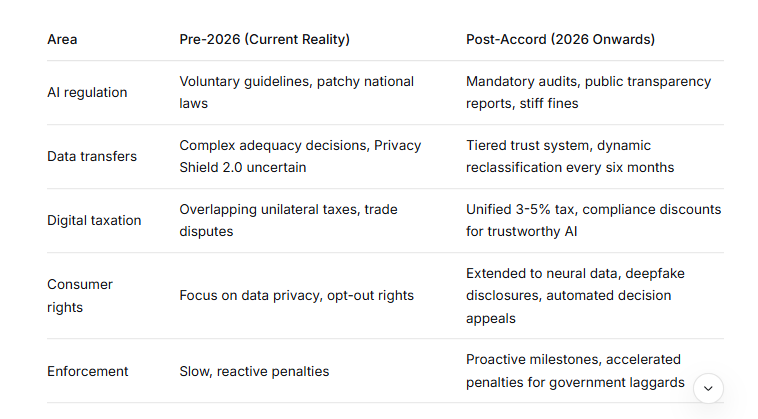
The Accord sets quarterly review milestones starting in Q2 2025. Each milestone requires signatory nations to show measurable progress on legislative alignment and enforcement infrastructure. If a country misses two consecutive milestones, accelerated economic penalties kick in early—before the 2026 deadline. That means businesses operating internationally can’t just watch their own preparations; they also need to monitor how host governments are tracking. If you rely on a supply chain that touches a lagging nation, you could get collateral disruption.
3. What’s Inside the Accord? Key Provisions That Will Flip the Table
Instead of summarizing all 800 pages, I’ll focus on the three chapters that have tech executives and legal teams burning through their caffeine reserves.
Mandatory AI Audits and Transparent Algorithms
By 2026, any AI system that makes consequential decisions—hiring, credit scoring, medical triage, content moderation at scale—must undergo an annual third-party audit. Audit reports on high-risk systems will be partially public. Companies will need to demonstrate not just accuracy, but fairness metrics, bias mitigation strategies, and human override mechanisms. The fine for non-compliance can reach up to 4% of global annual turnover, modeled after GDPR’s penalty structure.
For startups training recommendation engines or deploying chatbots that inadvertently influence financial decisions, this isn’t trivial. The cost of auditing a single model could run tens of thousands of dollars. Open-source model providers might need to supply documentation that doesn’t exist yet. Expect a cottage industry of accredited AI audit firms to explode.
Cross-Border Data Flow with Strings Attached
The Accord guts the convoluted web of “adequacy decisions” and bilateral data-transfer agreements. In their place, it creates a tiered trust system: nations with robust privacy frameworks (Tier 1) can freely share data; Tier 2 countries can share under standard contractual clauses with additional safeguards; Tier 3 countries face strict limitations and may need case-by-case approvals.
The twist? A country’s tier assignment isn’t static. It gets reviewed every six months based on its track record of human rights protections, cybersecurity incidents, and government access to private data. So a cloud provider hosting data in a Tier 2 country today might need to migrate to a Tier 1 jurisdiction by mid-2026 to keep operating smoothly. This upends data residency strategies and will likely accelerate investment in regions that can quickly lock in Tier 1 status.
Digital Taxation Overhaul
Unilateral digital services taxes (think France’s GAFA tax or India’s equalization levy) will be phased out and replaced by a harmonized formula under the Accord. The new system taxes digital revenue where users are located, not where headquarters sit, at a standardized rate between 3% and 5% of gross digital turnover above a certain threshold. However, businesses that comply with the AI and data standards get a 1% rate reduction—a carrot designed to nudge companies toward proactive compliance. The net effect: your tax liability in 2026 won’t just be about profit margins; it’ll be partially tied to how trustworthy your algorithms are.
4. How Industries Will Look Radically Different by Mid-2026
To make this concrete, let’s look at a few scenarios. This isn’t speculative fiction; it’s the logical trajectory based on the Accord’s text and enforcement mechanisms.
A Quick Landscape Comparison
The E-Commerce Brand Caught Mid-Stream
Consider a mid-sized direct-to-consumer brand, “EcoWear,” that sells sustainable clothing across the U.S., Germany, and Japan. Pre-2026, EcoWear uses a mix of Shopify, third-party logistics with customer data stored in cloud servers across multiple regions. Their AI-powered product recommendation engine has never been externally audited because nobody required it.
Under the Accord, by January 2026, EcoWear must ensure their recommendation system goes through a certified audit—even if they’re a small company—because the system influences purchasing decisions and could, in theory, discriminate based on inferred demographic profiles. Their customer data flows between continents will need to map to Tier 1 jurisdictions, or they’ll face restrictions. If their hosting provider keeps backups in a country that slips to Tier 2, they might need to renegotiate contracts.
The silver lining: EcoWear’s tax rate on digital sales will be more predictable, and if their AI audit comes back clean, they get a 1% discount on the harmonized digital tax. The net outcome? Higher compliance costs but reduced tax uncertainty and a potential trust badge they can market to privacy-conscious customers.
Social Media Platforms and the Content Moderation Conundrum
Large platforms will need to disclose the logic behind their content-recommendation algorithms to regulators—and in high-level summaries, to the public. While trade secrets are partially protected, the Accord pushes for transparency that could fundamentally change how viral content spreads. Automated moderation tools that remove posts will fall under the “high-risk” AI category, requiring bias audits. Expect platforms to restrict some AI-driven moderation features in Tier 2 and 3 countries to avoid legal exposure, which will fragment user experiences by region.
5. Practical Steps to Start Preparing Today
If you’re reading this and feeling a bit overwhelmed, you’re not alone. The good news is that 20 months is a workable runway if you start now. Below are actionable moves, broken down by who you are in the ecosystem.
For Business Owners (SMEs and Enterprises)
Map your data flows immediately. Identify where every byte of customer data resides, moves, and rests. Flag any storage in countries at high risk of landing in Tier 2 or 3. Start conversations with cloud providers about migration options.
Inventory AI tools. Even if you only use a plug-and-play chatbot or an email subject line optimizer, list it. Check whether the vendor has published an AI audit roadmap. If not, consider alternatives that are already preparing compliance documentation.
Budget for audit costs now. The cost of an algorithmic audit in 2026 will likely be higher than engaging a firm in 2025. Early engagement also buys you time to fix problems before they become fines.
Engage a policy liaison. Larger companies should designate someone to track quarterly milestone assessments by country. For SMEs, consider joining an industry association that will provide updates.
For Content Creators and Marketers
Expect synthetic media labeling requirements. The Accord mandates clear labels on AI-generated or substantially altered content across signatory nations. If your workflow uses generative AI for ad creatives, start trialing disclosure standards now so it’s baked into your process.
Understand the “automated decision” definition. If you use AI to segment audiences, trigger personalized offers, or adjust pricing automatically, those systems could be classified as medium-risk. Document your logic and consider building human override steps.
SEO and ad tech shifts. With the digital tax harmonization, ad platforms may adjust pricing models. If you’re running Google Ads or Facebook Ads, watch for changes in cost-per-click structures in different markets as platforms pass through tax obligations.
[For a deeper look at how AI regulation is already rewriting marketing playbooks, see our earlier piece: AI Jobs in 2025: The New Rules of the Game. And if you want to dig into data sovereignty, Where Your Data Lives Matters More Than Ever might save you a few headaches.]
For Everyday Consumers
You won’t need to file compliance reports, but the Accord affects you directly. By 2026, you’ll have stronger rights to contest AI decisions—like a loan denial or an insurance premium hike—with a guaranteed human review. Apps that collect biometric or neurological data (yes, some wearables already do that) will require explicit consent with clearer explanations. The “deepfake disclosure” layer might show up as a badge in your social feed, similar to content warning labels. It’s a shift toward making the digital world a bit more legible, but it might also frustrate people who enjoy seamless autotune-style AI filters without realizing how much data they feed.
6. The Hidden Risks Nobody’s Talking About
Every silver lining has a storm cloud. A few concerns caught my attention while reading the Accord and talking to policy folks:
Tier gaming. Wealthy nations could invest heavily to stay Tier 1, while lower-income countries get stuck in Tier 2 or 3 through no fault of their own. This could entrench digital inequality, making it harder for startups in emerging markets to access global data pools.
Audit bottleneck. There aren’t enough qualified AI auditors on the planet to handle the demand that will explode in late 2025. Expect a rush of self-proclaimed “certification” mills, some of questionable quality. Shoddy audits might create a false sense of security.
Innovation chill in high-risk AI. If the cost of compliance for potentially consequential AI is too steep, small innovators might abandon sectors like edtech diagnostics or mental health chatbots rather than risk fines. Big tech could consolidate further, simply because they can shoulder audit expenses.
Data localization 2.0. The tiered trust system could morph into a new form of forced localization, where governments pressure companies to host data domestically to maintain Tier 1 status—ironically undermining the free flow the Accord aims to achieve.
None of these are dealbreakers, but they’re reasons to stay vocal. The Accord’s success depends on how flexibly regulators implement the rules in the first two years.
7. Why This Might Actually Be a Good Thing
I don’t often say this about international regulations that span hundreds of pages, but the Global Digital Accord could genuinely make life better for the average person and more predictable for responsible businesses. Here’s the optimistic thesis.
First, a unified framework replaces the exhausting fragmentation we’ve lived with for a decade. Instead of 27 different interpretations of “legitimate interest” and a dozen different tax regimes, companies get one core set of standards. That simplification, once the initial compliance hump is crossed, might lower the cost of operating globally.
Second, the AI transparency push will force a long-overdue public conversation about algorithmic fairness. In sectors like hiring and lending, we might actually see bias reduction that individual lawsuits have been too slow to achieve. The 1% tax discount for verified trustworthy AI is a subtle but powerful nudge—money talks, and when tax savings depend on fairness, the accountants suddenly care as much as the ethics team.
Third, consumer trust is a market advantage. Companies that embrace the spirit of the Accord early—not just the letter—could differentiate themselves in a landscape where trust is increasingly scarce. Imagine an e-commerce site that displays not only a secure checkout badge but an “Accredited Fair AI” seal. That’s marketing gold.
Finally, the 2026 deadline forces governments to cooperate in ways they’ve resisted. The milestone mechanism creates peer pressure that informal summits never could. If a handful of nations lead, others will scramble to catch up rather than risk economic isolation. The result could be a more resilient global digital infrastructure, one that’s better equipped to handle the next generation of cyber threats and synthetic media manipulation.
Bringing It Back to Today
So, what just happened today that could change everything in 2026? It’s not a dramatic revelation or a single piece of technology. It’s a signature on a document that, for the first time, treats the digital space as a shared public commons with rules that carry teeth. The countdown has begun, and the window for reactive, wait-and-see behavior is closing fast.
I’ll keep updating as the analysis rolls in and industries react. But if you take one thing away, let it be this: start your compliance journey now. Talk to your team. Map your data. Ask your vendors the hard questions. The businesses that thrive in 2026 won’t necessarily be the biggest—they’ll be the ones that didn’t wait for the alarm to ring.
FAQ
When exactly does the Global Digital Accord take full effect?
Full enforcement begins January 1, 2026. Several compliance milestones and reporting obligations kick in during 2025, so waiting until the deadline carries real risk.
Does this Accord replace GDPR and the California Privacy Rights Act?
No. It sets an international baseline. Where existing laws are stricter, they still apply. The aim is to harmonize minimal global standards, not overwrite stronger regional protections.
How will small businesses afford AI audits?
Recognizing the cost burden, the Accord allows scaled audits for low-risk and medium-risk systems. Industry bodies and governments are expected to launch subsidized audit programs for SMEs. Start researching those now—early adopters will secure the best rates.
What happens if my country drops to Tier 2 or Tier 3 for data transfers?
You may need to switch data storage and processing to a Tier 1 country for cross-border flows to remain seamless. Companies operating in multiple jurisdictions should build contingency plans and consider multi-region architecture that avoids Tier dependencies.
Will social media feeds look different in 2026?
Probably. Transparency requirements and synthetic media labels will add new UI elements. Some AI-driven curation might be dialed back in high-risk categories, which could subtly change what content gets amplified.
Is the tax discount for trustworthy AI automatic?
No. Companies must submit audit results and apply through their national digital authority. The discount is renewable annually, contingent on maintaining compliance.
Where can I track the quarterly milestone assessments?
Each signatory country will publish progress reports on a public portal maintained by the Accord secretariat. I’ll cover major updates in our regular series, so subscribe to stay in the loop.
Could the deadline get postponed?
It’s always possible in geopolitics, but the Accord’s accelerated penalty mechanism makes postponement less likely than previous agreements. The structure is designed to punish delay, making a last-minute extension costly for governments. Prepare for the deadline as if it’s firm.
About the Creator
Kamel Saidani
Psychology graduate passionate about understanding human behavior, mindset, and personal growth. I share simple, practical insights to help people think deeper, grow stronger, and live more intentionally.
Enjoyed the story? Support the Creator.
Subscribe for free to receive all their stories in your feed.
Comments
There are no comments for this story
Be the first to respond and start the conversation.