
Breaking the "One Giant Prompt" Habit: How Multi-Agent AI and Next-Gen Tools Are Rewriting Productivity
Why the era of massive prompts is ending, and how open-source ecosystems like Gemma 4 are turning AI into a highly specialized team.

We have all been there. You open your favorite AI tool, stare at the blank input box, and paste a massive, paragraph-long prompt. You ask it to research a topic, write a 2,000-word article, format it for SEO, and generate social media captions—all in one go.
The result? A generic, slightly chaotic output that feels distinctly... robotic.
As search trends spike globally around next-generation AI models—like Google’s recently discussed Gemma 4 ecosystem—and concepts like Multi-Agent Systems, the tech world is sending a clear message: The era of the "one giant prompt" is officially over.
If you want to unlock the true power of artificial intelligence in 2026, you need to stop treating AI like a single calculator and start managing it like a highly specialized corporate team. Here is how the landscape is shifting, and how you can ride the wave to supercharge your workflow.
The Rise of the "AI Team": What are Multi-Agent Systems?
To understand where AI is going, we have to look at how humans work best. In a successful business, you don’t ask the accountant to write the marketing strategy, nor do you ask the graphic designer to write legal contracts. You break big goals into specialized roles.
This is exactly how Multi-Agent Systems (MAS) work.
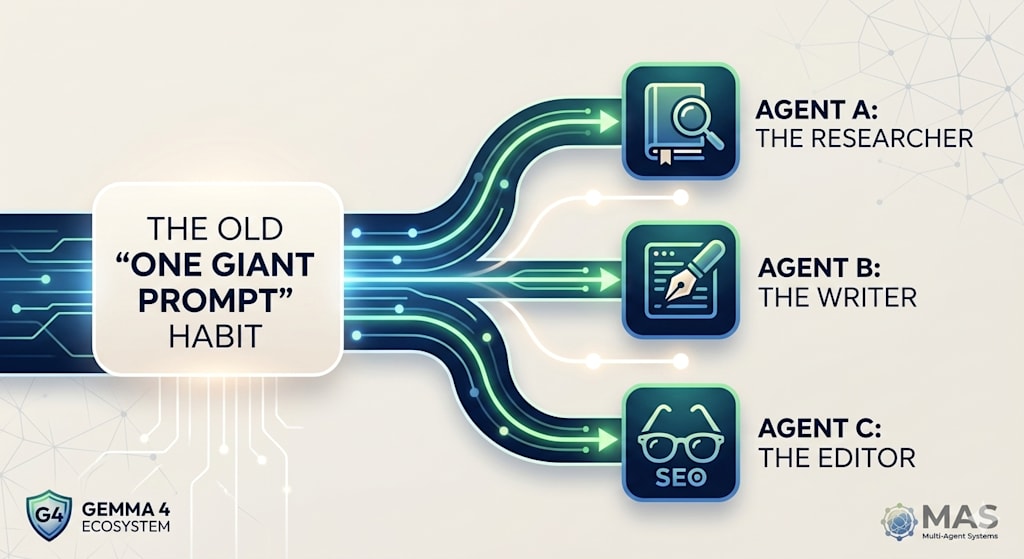
Instead of relying on one massive LLM (Large Language Model) to do everything, developers and power-users are now using frameworks to split tasks among specialized "agents."
- Agent A (The Researcher): Scours the web, verifies data, and extracts facts.
- Agent B (The Writer): Takes the facts and drafts a compelling narrative.
- Agent C (The Editor): Reviews the draft for tone, style, and SEO optimization.
Because each agent has a single, hyper-focused role, the final output is incredibly refined, deeply analytical, and remarkably human.
From Gemma 4 to Copilots: Why Open-Source and Tailored AI Matter
The massive surge in global search queries highlights another fascinating shift: people are moving away from locked, "one-size-fits-all" platforms. Instead, there is an explosion of interest in open-source architectures.
Models like Google’s open-weights Gemma series have democratized how we interact with technology. Independent creators, developers, and writers no longer have to adapt to how a generic AI thinks. Instead, they can tweak these nimble, powerful models to think exactly like them.
Combined with everyday tools like GitHub Copilot for creators who code, or advanced text-summarizers, AI is shifting from a novelty tool into an invisible background engine that simply makes us faster and smarter.
How to Apply Next-Gen AI Thinking to Your Daily Life Today
You don’t need to be a software engineer to benefit from this architectural shift. You can start applying the "multi-agent" mindset to your own productivity right now:
1. Deconstruct Your Prompts
Stop asking AI to do five things at once. Break your workflow into steps. First, ask the AI to generate an outline. Review it. Then, ask it to draft section by section. Finally, prompt it to act as a harsh editor to clean up the prose.
2. Embrace Niche Ecosystems
Look beyond the basic chatbots. Explore specialized tools built on top of APIs that are designed for singular tasks—whether that’s ultra-fast document summarization, hyper-realistic imagery, or automated data analysis.
3. Focus on Curation, Not Just Creation
As AI makes generating content easier, the internet is becoming flooded with noise. Your value as a human in 2026 is no longer just about "making things," but about curating, fact-checking, and injecting authentic human perspective into what the machines assist you with.
The Verdict: Don't Just Use AI—Direct It
The tools of 2026 are faster, more open, and incredibly modular. The future belongs not to those who can write the longest prompt, but to those who know how to delegate, orchestrate, and connect different AI capabilities together.
Stop treating AI as a magic wand, and start treating it as your internal agency. Happy building!
What about you? Are you still trying to solve everything with a single prompt, or have you started breaking your workflow down into specialized steps? Let’s discuss in the comments below!
About the Creator
AI Lens
Exploring the profound intersection of human nature, philosophy, and the future of artificial intelligence. Writing about our evolving digital world.
Enjoyed the story? Support the Creator.
Subscribe for free to receive all their stories in your feed.
Comments
There are no comments for this story
Be the first to respond and start the conversation.