
Blockchain Supply Chain Market Report: Digital Ledger Innovation, Cross-Border Trade Trends to 2034
How smart contracts, automated trade compliance, and real-time shipment tracking are creating new opportunities in the blockchain supply chain market to 2034.

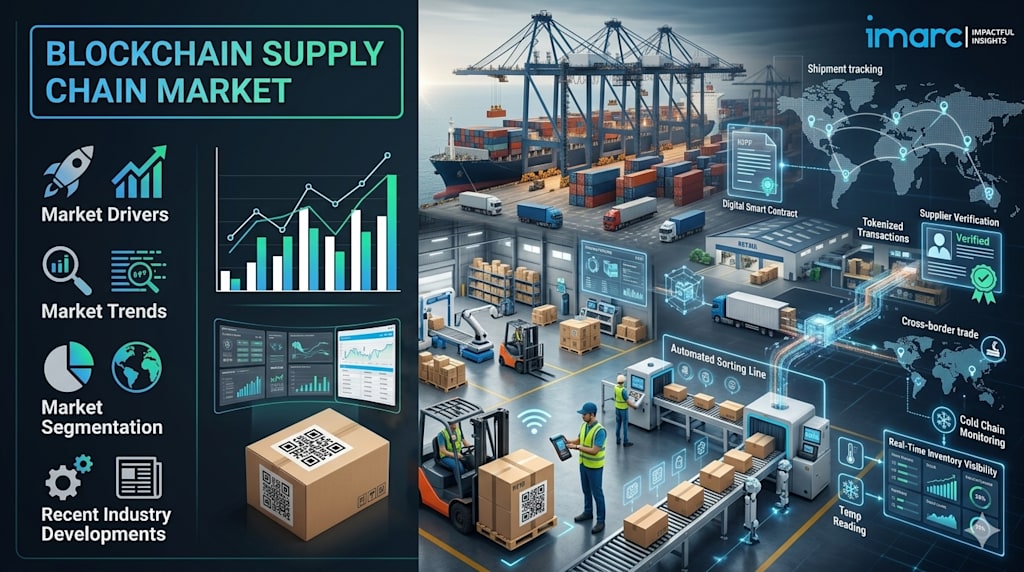
Rising demand for end-to-end transparency, fraud prevention, and real-time traceability across global trade networks is accelerating blockchain adoption in supply chain management. According to IMARC Group's latest data,The global blockchain supply chain market size reached USD 1,637.1 Million in 2025. Looking forward, IMARC Group expects the market to reach USD 34,991.8 Million by 2034, exhibiting a growth rate (CAGR) of 38.50% during 2026-2034., exhibiting strong growth momentum from 2026 onward. North America currently dominates the market, driven by the rapid adoption of blockchain technologies across industries and the presence of leading technology companies shaping platform and services innovation across the region.
Blockchain supply chain solutions provide a decentralized, immutable ledger that records every transaction and movement of goods from point of origin to end consumer. By replacing fragmented, paper-based documentation systems with a single shared record accessible to all authorized stakeholders simultaneously, blockchain eliminates the information asymmetries that drive counterfeiting, compliance failures, payment disputes, and inventory inaccuracies across complex multi-party networks.
Evaluate Market Potential Before You Invest – Get the Report Sample
Blockchain Supply Chain Market Growth Drivers:
Rising Utilization of Advanced Technologies in Business Strategies
The convergence of AI, machine learning, and blockchain is fundamentally reshaping how enterprises approach supply chain optimization. AI and ML algorithms enhance blockchain's capabilities by enabling predictive demand forecasting, anomaly detection, and fraud identification within transaction data stored on distributed ledgers. When integrated with smart contracts on blockchain networks, AI supports automated and adaptive decision-making across procurement, inventory management, and order fulfillment workflows, reducing manual intervention and associated error rates at every stage.
Rapid Business Automation Through Smart Contracts
The automation of supply chain operations is one of the most compelling forces driving blockchain adoption across industries. Smart contracts, which are self-executing agreements activated by predetermined conditions recorded on the blockchain, are eliminating bottlenecks in inventory management, order processing, and payment settlement that previously required manual authorization at multiple stages.
Widespread Adoption of Smart Devices and IoT Integration
IoT sensors, RFID tags, and connected devices are generating large volumes of real-time data about the location, condition, and handling status of goods throughout the supply chain. Blockchain provides the secure, tamper-resistant infrastructure needed to store and share this data reliably across multiple stakeholders without dependence on a central authority.
Blockchain Supply Chain Market Trends:
Product Traceability Leading Application Segment Demand
Product traceability currently represents the largest application segment within the blockchain supply chain market, reflecting a fundamental shift in how businesses and regulators approach accountability across global trade. Retailers, manufacturers, and government bodies are increasingly mandating end-to-end visibility into product origins, processing history, and distribution pathways as consumer demand for transparency intensifies and regulatory frameworks tighten.
Platform Component Commanding the Largest Market Share
The platform segment accounts for the largest share of the blockchain supply chain market as technology providers invest heavily in building scalable, interoperable infrastructure capable of supporting complex, multi-enterprise supply networks. Blockchain platforms provide the foundational protocols, consensus mechanisms, and developer tools that organizations require to build and manage supply chain applications without constructing underlying infrastructure from scratch.
Retail Sector Driving Highest Industry Vertical Adoption
Retail leads all industry verticals in blockchain supply chain adoption, driven by competitive pressure to deliver verifiable supply chain transparency to consumers and regulators simultaneously. Retailers managing thousands of product lines across global supplier networks face persistent challenges in authenticating products, preventing counterfeit goods from entering distribution channels, and demonstrating ethical sourcing compliance at scale.
Recent News and Developments in the Blockchain Supply Chain Market
February 2026: IBM announced an expanded collaboration with a major global shipping consortium to deploy its blockchain-based trade documentation platform across additional Asia-Pacific ports, targeting significant reductions in paper-based customs processing time by streamlining bill-of-lading verification and freight settlement through distributed ledger technology.
November 2025: SAP SE launched an enhanced version of its SAP Business Network featuring deeper blockchain integration for supplier compliance monitoring, enabling manufacturers to verify sustainability certifications and ethical sourcing documentation across multi-tier supply chains in real time.
August 2025: Oracle Corporation introduced new blockchain-powered inventory reconciliation features within its Fusion Cloud SCM platform, allowing retail and manufacturing customers to automate multi-party stock verification and reduce discrepancies across warehouse and distribution center networks.
April 2025: The European Commission published updated guidelines under its Digital Product Passport initiative, mandating blockchain-compatible traceability infrastructure for select product categories including batteries and textiles, creating a significant regulatory tailwind accelerating enterprise adoption across EU-based supply chain operators.
September 2024: Walmart expanded its blockchain-based food traceability program to cover additional fresh produce categories across its North American supplier network, building on existing deployments to reduce the time required to trace contamination events from several days to mere seconds across participating suppliers.
March 2024: Maersk and a consortium of global freight forwarders announced renewed investment in interoperable blockchain documentation standards for container shipping, signaling sustained industry commitment to rebuilding shared digital trade infrastructure on open blockchain protocols following earlier platform transitions.
Note: If you require specific details, data, or insights that are not currently included in the scope of this report, we are happy to accommodate your request. As part of our customization service, we will gather and provide the additional information you need, tailored to your specific requirements. Please let us know your exact needs, and we will ensure the report is updated accordingly to meet your expectations.
About the Creator
Suhaira Yusuf
I specialize in Consumer Insights, focusing on transforming detailed market data into strategic business solutions that accelerate growth and improve customer engagement.
Enjoyed the story? Support the Creator.
Subscribe for free to receive all their stories in your feed.
Comments
There are no comments for this story
Be the first to respond and start the conversation.