
Blockchain in Manufacturing Market Trends: Quality Assurance, End-to-End Visibility & Trends Outlook
Analyzing how blockchain technology, anti-counterfeiting solutions, and improved traceability are ensuring product quality and authenticity in increasingly complex manufacturing environments.

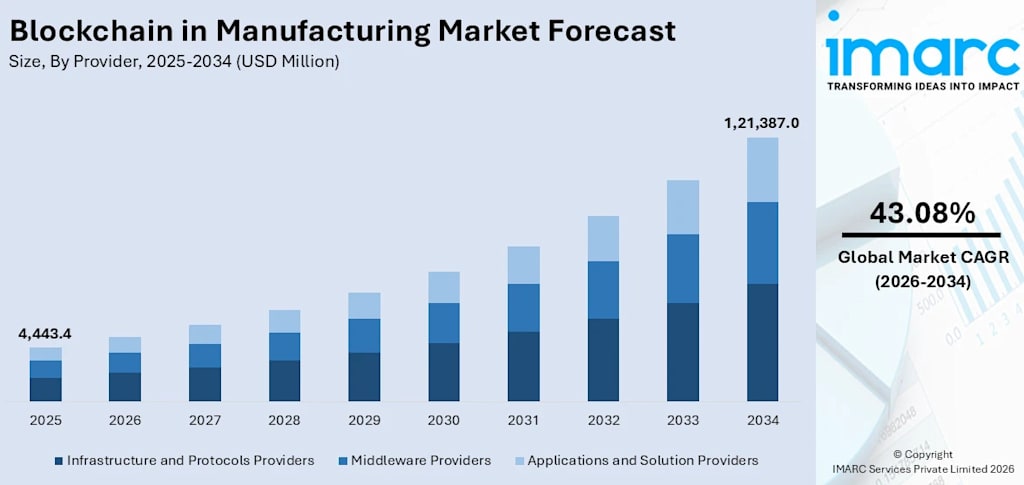
Increasing adoption of Industry 4.0 technologies, the need for improved supply chain transparency, and the rising risk of counterfeit components are contributing to the growth of blockchain in manufacturing. These trends are supported by government initiatives focused on digital transformation and the integration of IoT with distributed ledger technologies.
According to IMARC Group’s latest data, the global blockchain in manufacturing market size reached USD 4,443.4 Million in 2025. Looking forward, the market is projected to reach USD 1,21,387.0 Million by 2034, exhibiting a CAGR of 43.08% during 2026–2034.
Blockchain is increasingly being adopted as a foundational technology within manufacturing operations. It enables secure data sharing, improves traceability across supply chains, and supports automation through smart contracts. Manufacturers are using blockchain systems to manage logistics, protect intellectual property, and meet compliance requirements in sectors such as aerospace, automotive, and pharmaceuticals.
Download the "Blockchain in Manufacturing Market" Report Sample & Stay Ahead!
Blockchain in Manufacturing Market Growth Drivers:
- Need for Supply Chain Transparency and Traceability
Manufacturing supply chains are often complex and involve multiple stakeholders across different regions. Blockchain provides a decentralized and immutable record of transactions, allowing companies to track materials and products throughout their lifecycle. This improves visibility into supplier networks and enhances coordination between stakeholders.
- Reduction of Counterfeit Products and Intellectual Property Risks
Counterfeit components remain a challenge in industries such as electronics, aerospace, and pharmaceuticals. Blockchain-based systems help verify product authenticity by recording component-level data across the supply chain. This approach supports quality assurance and reduces risks associated with unauthorized or substandard products.
- Integration with IoT and Smart Manufacturing Systems
The integration of blockchain with IoT technologies supports real-time monitoring and data validation in manufacturing environments. Sensors collect operational data, which can be securely recorded on blockchain networks to ensure accuracy and reliability. This combination enables better decision-making, predictive maintenance, and improved quality control processes.
Blockchain in Manufacturing Market Trends:
- Shift Toward Permissioned and Hybrid Blockchain Networks
Manufacturers are increasingly adopting permissioned or hybrid blockchain models instead of fully public networks. These systems provide greater control over data access while maintaining the benefits of decentralized record-keeping. This approach allows organizations to share operational data securely while protecting sensitive business information.
- Adoption of Smart Contracts in Procurement Processes
Smart contracts are being used to automate procurement and supplier transactions. These contracts execute predefined actions, such as releasing payments, once specific conditions are met. This reduces manual intervention, minimizes disputes, and improves operational efficiency within supply chains.
- Focus on Sustainability and ESG Reporting
There is a growing emphasis on tracking environmental and sustainability metrics within manufacturing processes. Blockchain enables transparent monitoring of resource usage, emissions, and waste management. This supports compliance with environmental regulations and helps organizations provide verifiable sustainability data.
Recent News and Developments:
- February 2026: European Commission expanded its Digital Product Passport initiative to track material composition and recyclability of industrial products.
- March 2026: A semiconductor manufacturer introduced a blockchain-based platform to enhance supply chain coordination and improve inventory visibility across supplier networks.
- April 2026: IBM collaborated with global logistics providers to develop a blockchain-enabled framework for automating cross-border trade documentation and processes.
Note: If you require specific details, data, or insights that are not currently included in the scope of this report, we are happy to accommodate your request. As part of our customization service, we will gather and provide the additional information you need, tailored to your specific requirements. Please let us know your exact needs, and we will ensure the report is updated accordingly to meet your expectations.
About the Creator
Andrew Sullivan
Hello, I’m Andrew Sullivan. I have over 9+ years of experience as a market research specialist.
Enjoyed the story? Support the Creator.
Subscribe for free to receive all their stories in your feed.
Comments
There are no comments for this story
Be the first to respond and start the conversation.