
Biomass Gasification Market Witnesses Strong Growth in Clean Energy
The Biomass Gasification Market is experiencing strong growth driven by increasing demand for renewable energy and sustainable waste-to-energy technologies.

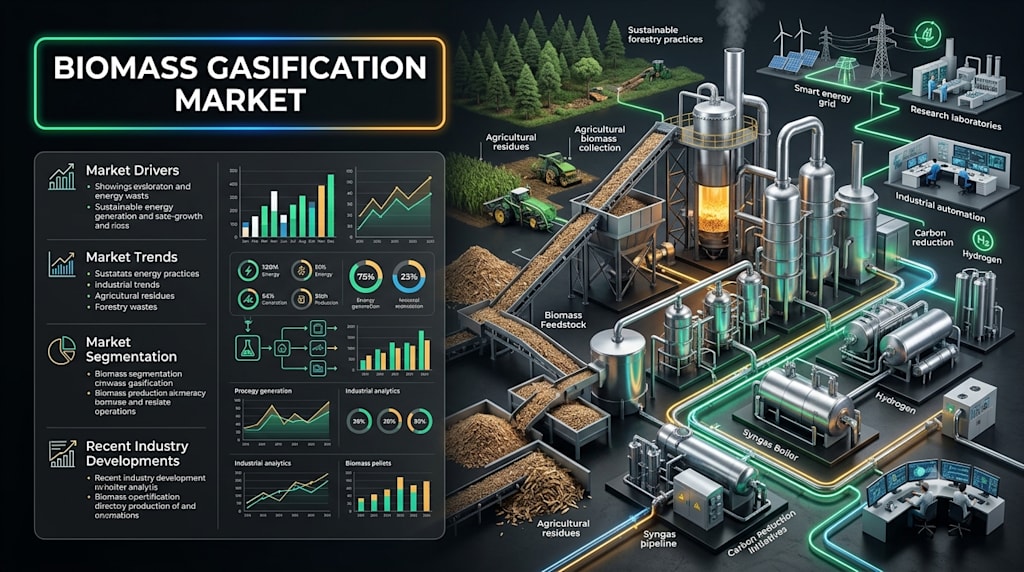
According to IMARC Group's latest research,The global biomass gasification market size was valued at USD 132.24 Billion in 2025. Looking forward, IMARC Group estimates the market to reach USD 214.99 Billion by 2034, exhibiting a CAGR of 5.08% from 2026-2034. The market's expansion is driven by increasing global demand for renewable energy alternatives, growing urgency to reduce greenhouse gas emissions, advancing hydrogen production pathways, and the technology's ability to convert diverse organic materials including agricultural residues, wood chips, and municipal waste into clean syngas for power generation, heating, and chemical production.
How AI is Reshaping the Future of the Biomass Gasification Market
- Real-Time Process Optimization and Efficiency Monitoring: AI-powered control systems continuously analyze gasifier operating parameters including temperature, pressure, and feedstock composition. Machine learning algorithms optimize syngas yield by 15-20 percent, reducing operational costs while maximizing energy output from each unit of biomass input.
- Predictive Equipment Maintenance and Downtime Prevention: Advanced diagnostics using machine learning predict component failures weeks in advance by monitoring sensor data patterns. Companies implementing predictive maintenance have reduced unplanned downtime by approximately 30 percent, improving facility utilization and revenue consistency across gasification plants.
- Smart Feedstock Quality Assessment and Sorting: AI-integrated vision systems automatically inspect and sort incoming biomass, identifying optimal feedstock combinations for different gasifier configurations. Real-time quality grading ensures consistent syngas properties while minimizing preprocessing waste and improving overall plant efficiency.

Biomass Gasification Industry Overview
Europe dominates the global biomass gasification market with 41.6 percent market share, anchored by comprehensive renewable energy mandates, mature district heating infrastructure, and abundant forestry residues from Northern and Central European countries. The region benefits from established supply chains, supportive policy frameworks including EU Renewable Energy Directive III targeting 42.5 percent renewable energy by 2030, and EUR 28.4 billion in committed private investment in biomethane development. Strong regulatory incentives, high electricity prices, and deep integration of bioenergy into industrial operations create favorable conditions for sustained market expansion across the continent.
Biomass Gasification Market Trends & Drivers
Accelerating Clean Energy Transition and Waste-to-Energy Expansion: Governments and industries worldwide are prioritizing clean energy alternatives and sustainable waste management solutions, positioning biomass gasification as a critical decarbonization technology. Waste-to-energy facilities convert municipal solid waste, agricultural residues, and industrial byproducts into renewable syngas, simultaneously addressing energy security and waste challenges. Indonesia's announcement in March 2025 to develop waste-to-energy facilities across 30 cities exemplifies accelerating global adoption. The technology's versatility across diverse feedstocks makes it particularly attractive to developing economies seeking energy independence alongside environmental responsibility and waste reduction.
Integration with Green Hydrogen Production and Hard-to-Decarbonize Sectors: Biomass gasification is becoming central to the emerging hydrogen economy, providing cost-effective pathways for green hydrogen production without intermittency limitations of electrolysis. The thermochemical conversion of biomass into syngas rich in hydrogen supports decarbonization of steel manufacturing, ammonia synthesis, and long-distance transportation. Germany's biogas and biomethane production of 329 PJ in 2024 demonstrates infrastructure maturity supporting expanded hydrogen applications. Government hydrogen strategies with dedicated public funding across Europe and North America are stimulating research and commercial deployment of gasification-integrated systems.
Continuous Technology Advancement and Efficiency Improvements: Innovation in gasifier design, catalyst systems, and syngas purification technologies is redefining market economics, improving reactor flexibility for diverse feedstocks including high-moisture and ash-rich materials. Digital monitoring platforms incorporating AI and machine learning optimize operational parameters, reducing levelized production costs substantially. Advanced tar reduction systems and carbon capture integration are enabling bioenergy with carbon removal applications. These innovations make biomass gasification increasingly competitive against conventional energy sources while expanding addressable markets across industrial, residential, and transportation sectors.
Biomass Gasification Market Segmentation
By Source
- Solid Biomass: Dominant segment accounting for 45.2 percent market share, encompassing wood chips, crop residues, rice husks, sugarcane bagasse, and lignocellulosic materials from agriculture and forestry with high carbon content and calorific value
- Biogas: Growing segment derived from anaerobic decomposition of organic materials, featuring in power generation and thermal applications
- Municipal Waste: Expanding segment leveraging non-recyclable waste streams for energy production and waste valorization
- Liquid Biomass: Emerging segment including bio-oils and liquid biochar feedstocks for specialized applications
By Technology Type
- Fixed-Bed Gasifiers: Established technology for diverse feedstocks with proven reliability
- Fluidized-Bed Gasifiers: Advanced systems offering superior feedstock flexibility and efficiency
- Entrained-Flow Gasifiers: High-capacity systems for large-scale industrial applications and hydrogen production
- Other Advanced Configurations: Emerging technologies targeting specific feedstock or product optimization
By Application
- Power Generation: Primary application segment utilizing syngas for electricity production
- Industrial Heat and Thermal Energy: Growing segment supporting district heating and combined heat and power systems
- Chemical Production and Synthesis: Expanding application for producing chemicals and materials from syngas
- Hydrogen and Biofuel Production: Fastest-growing segment aligned with clean hydrogen economy and sustainable aviation fuel pathways
- Other Specialized Applications: Emerging uses in agriculture and waste management sectors
By Region
- Europe: Market leader holding 41.6 percent share, supported by mature bioenergy infrastructure and strong policy frameworks
- North America: Significant market driven by abundant biomass feedstock and federal renewable energy incentives
- Asia-Pacific: Rapidly emerging market with expanding agricultural biomass resources and industrialization growth
- Latin America: Developing market benefiting from sugarcane and forestry byproducts
- Middle East and Africa: Early-stage market with growing potential for rural electrification and waste management solutions
Leading Companies Operating in the Global Biomass Gasification Industry
- ANDRITZ AG
- Babcock Wilcox Enterprises Inc.
- Boralex Inc.
- Clariant Ltd.
- Compte R. & Cie S.A.
- Covanta Energy Corporation
- COP GmbH
- Dalkia
- Emerald Biofuels Inc.
- Ener-Core Inc.
- Enersyntec Corporation
- ESCO Technologies Inc.
- Frontier Energy
- Gasholding GmbH
- Gea Group AG
- General Electric Company
- Gotaverken Energy Systems GmbH
- Harbour Energy
- Infinium Inc.
- Waste to Energy Advanced Solutions (WtEnergy)
- Xanavi Energy Systems
Recent News and Developments in the Biomass Gasification Market
- February 2026: Barcelona-based Waste to Energy Advanced Solutions (WtEnergy) raised 10 million euros to expand deployment of its biomass and industrial waste gasification technology across Europe. The funding will support project execution, standardized plant development, organizational expansion, and development of new syngas utilization applications, accelerating the company's ability to deliver scalable gasification solutions across the continent.
- June 2025: Honeywell, Johnson Matthey, GIDARA Energy, and SAMSUNG E&A formed a strategic technology partnership to introduce an integrated global solution for producing sustainable aviation fuel from biomass and municipal solid waste. The collaboration combines expertise across feedstock processing, syngas conversion, and fuel synthesis, supporting customers across the entire sustainable aviation fuel value chain from raw material processing through final fuel production.
- June 2025: DP CleanTech entered a Memorandum of Understanding with RAW Power to develop biomass power projects in Sarawak, Malaysia, targeting scalable capacities of 50 to 400 megawatts using straw and tropical grass feedstock. The partnership demonstrates expanding regional interest in large-scale gasification capacity supported by abundant agricultural residues throughout Southeast Asia.
- September 2024: The U.S. Department of Energy announced USD 15 million in federal funding supporting research and development on entrained-flow and fluidized-bed gasification technologies, specifically targeting clean hydrogen production from diverse feedstocks including biomass and municipal waste streams, reinforcing government commitment to advancing gasification infrastructure.
- 2025: The United States biogas industry added 20 new landfill gas capture projects, bringing total operational facilities to 599, representing USD 912 million in investment. Industry-wide biogas capture capacity reached 780.7 billion cubic feet annually, reflecting 7.5 percent growth, demonstrating sustained momentum behind national bioenergy infrastructure expansion and waste valorization.
Note : If you require specific details, data, or insights that are not currently included in the scope of this report, we are happy to accommodate your request. As part of our customization service, we will gather and provide the additional information you need, tailored to your specific requirements. Please let us know your exact needs, and we will ensure the report is updated accordingly to meet your expectations.
About the Creator
Michael Richard
Michael Richard is a Market Research Expert specializing in market intelligence, competitive analysis, and data-driven insights. He helps organizations understand trends and emerging opportunities through in-depth research.
Enjoyed the story? Support the Creator.
Subscribe for free to receive all their stories in your feed.
Comments
There are no comments for this story
Be the first to respond and start the conversation.