
Bioethanol Market Witnesses Strong Growth Amid Clean Energy Demand
The Bioethanol Market is experiencing strong growth driven by increasing demand for sustainable and low-carbon fuel alternatives.

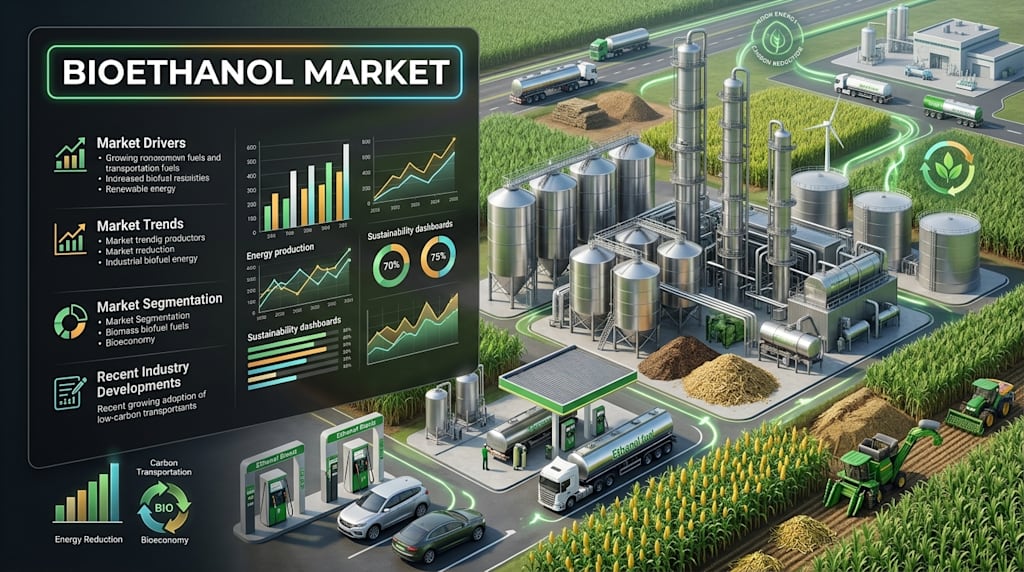
According to IMARC Group's latest research, The global bioethanol market size was valued at USD 11.36 Billion in 2025 and is projected to reach USD 19.17 Billion by 2034, exhibiting a CAGR of 5.81% during the forecast period 2026-2034. Rising crude oil price volatility, strengthening national biofuel blending mandates across India, the United States, and Brazil, and accelerating decarbonisation of transport fuels are reshaping the industry. Sugarcane-based ethanol leads at 50 percent of the market, while E10 blend dominates fuel blending at 55 percent. Asia-Pacific accounts for 40 percent of global revenue, emerging as the world's largest regional bioethanol hub.
How AI is Reshaping the Future of Bioethanol Market
- Fermentation Process Optimization and Yield Enhancement: AI algorithms monitor fermentation parameters in real-time, optimizing temperature, pH, and nutrient levels to maximize ethanol output by up to 15 percent. Machine learning models predict optimal fermentation cycles, reducing production time and improving overall conversion efficiency across biorefineries.
- Feedstock Quality Assessment and Supply Chain Analytics: Computer vision and AI systems analyze incoming feedstock for quality characteristics, moisture content, and contamination levels instantaneously. Automated grading reduces manual inspection time by 80 percent while improving accuracy in determining optimal processing pathways for different biomass types.
- Energy Consumption Reduction and Equipment Optimization: AI-driven predictive maintenance identifies equipment inefficiencies before failures occur, reducing distillation energy costs by 10-12 percent annually. Smart automation systems optimize heating and cooling cycles based on real-time production demand and ambient conditions.

Bioethanol Industry Overview
Bioethanol production is fundamentally transforming global fuel markets through escalating government mandates and decarbonisation initiatives. Brazil maintains dominance as the world's second-largest producer with annual output exceeding 33 billion litres, while the U.S. produced a record 16.1 billion gallons in 2024. India's E20 programme lifted national blending rates from 1.5 percent to over 15 percent by mid-2024. These structural shifts are driven by energy security needs, carbon reduction targets, and flex-fuel vehicle expansion across major markets globally.
Bioethanol Market Trends and Drivers
National Blending Mandates and Energy Security Imperative: Over 65 countries implemented biofuel mandates by 2024, creating structural demand for renewable transport fuels. India's crude oil import bill exceeded USD 132 Billion annually, driving policy toward 20 percent blending targets. Brazil maintains a 27 percent anhydrous ethanol mandate in gasoline, while the U.S. Renewable Fuel Standard framework continues supporting domestic production expansion. These mandates reflect broader energy independence strategies and climate commitments reshaping global fuel supply chains.
Sustainable Aviation Fuel and Emerging High-Value Applications: Ethanol-derived sustainable aviation fuel is reducing lifecycle emissions by up to 80 percent compared to conventional jet fuel. United Airlines committed to purchasing 1 billion gallons of ethanol-based SAF over ten years, fuelling 50,000 flights annually. Delta Airlines and Gevo partnered to deliver 75 million gallons of ethanol SAF annually, demonstrating aviation industry traction. These multi-billion-dollar commitments establish SAF as a transformative growth vector converting bioethanol from commodity fuel into premium decarbonisation solution.
Second-Generation Cellulosic Expansion and Carbon Capture Integration: Cellulosic ethanol from agricultural residues and forestry waste eliminates food-versus-fuel tensions, growing at 8.9 percent annually. Raízen's R$1 billion investment in Andradina, São Paulo established an 82 million-litre annual capacity second-generation facility. Summit Carbon Solutions' USD 9 billion pipeline in the U.S. Midwest captures 18 million tonnes of CO2 annually from ethanol plants. These developments position second-generation biorefineries as cornerstone infrastructure for transport decarbonisation and industrial carbon sequestration objectives globally.
Bioethanol Market Segmentation
By Type
- Sugarcane-based Ethanol: 50.0 percent share, largest segment driven by Brazil's production dominance and India's expansion
- Starch-based Ethanol: 27.5 percent share, anchored by U.S. corn infrastructure and domestic production
- Cellulosic Ethanol: 14.3 percent share, fastest-growing segment at approximately 8.9 percent annually
- Others: 8.2 percent share, including molasses and dedicated energy-crop pathways
By Fuel Blend
- E10: 55.0 percent share, dominates fuel blending with universal vehicle compatibility
- E20 and E25: 18.6 percent share, driven by India's E20 roadmap and Brazil's mandates
- E85: 11.4 percent share, concentrated in Brazil and U.S. Midwest flex-fuel corridors
- E70 and E75: 7.5 percent share, primarily in cold-weather markets
- Others: 7.5 percent share, specialty blends and regional applications
By Region
- Asia-Pacific: 40.0 percent share, largest region fuelled by India's E20 mandate and China's fuel ethanol pilots
- North America: 24.5 percent share, anchored by U.S. corn-belt output and RFS framework
- Europe: 20.3 percent share, governed by RED III renewable energy directives
- Latin America: 9.2 percent share, led by Brazil's 27 percent mandate and RenovaBio programme
- Middle East and Africa: 6.0 percent share, emerging opportunities and pilot programmes
Leading Companies Operating in the Global Bioethanol Industry
- ADM (Archer-Daniels-Midland Company)
- POET LLC
- Royal Dutch Shell plc (Raízen)
- BP p.l.c.
- Südzucker AG
- Clonbio Group
- Praj Industries
- Cargill
- Green Plains Inc.
- Neste Corporation
Recent News and Developments in Bioethanol Market
- February 2026: NASCAR announced a landmark partnership with POET LLC, naming the company the Official Bioethanol Partner of NASCAR. NASCAR will utilize zero-carbon bioethanol in combination with existing fuel partnerships, marking the first major motorsports series to adopt high-blend bioethanol fuel, reinforcing sport's commitment to innovation and environmental responsibility while demonstrating mainstream market acceptance.
- January 2025: Brazil's Development Bank (BNDES) approved a R$1 billion loan for Raízen Energia to construct its third second-generation ethanol production facility in Andradina, São Paulo. The facility will feature annual production capacity of up to 82 million litres, strengthening Brazil's position as the world's largest sugarcane ethanol producer while advancing cellulosic technology commercialisation.
- August 2025: Cargill announced construction of a corn ethanol plant adjacent to its existing sugarcane facility in Brazil, integrating dual-feedstock capabilities. This strategic move increases production flexibility and feedstock optimization across regions, demonstrating industry movement toward diversified bioethanol platforms that capitalize on regional agricultural strengths.
- September 2024: LanzaTech and LanzaJet entered collaboration with Wagner Sustainable Fuels to assess integration of their CirculAir technology platform at Wagner's Brisbane SAF Refinery. This initiative advances sustainable aviation fuel production in Australia, showcasing ethanol-derived SAF scale-up across Asia-Pacific markets aligned with decarbonisation commitments.
- February 2024: Raízen and Wärtsilä formed a strategic partnership to accelerate marine decarbonization through ethanol-based fuel solutions. The collaboration focused on testing cellulosic ethanol as a primary marine fuel, validating ethanol's expansion beyond road transport and aviation into shipping industry decarbonisation pathways globally.
Note: If you require specific details, data, or insights not currently included in the scope of this report, we are happy to accommodate your request. As part of our customization service, we will gather and provide the additional information you need, tailored to your specific requirements. Please let us know your exact needs, and we will ensure the report is updated accordingly to meet your expectations.
About the Creator
Michael Richard
Michael Richard is a Market Research Expert specializing in market intelligence, competitive analysis, and data-driven insights. He helps organizations understand trends and emerging opportunities through in-depth research.
Enjoyed the story? Support the Creator.
Subscribe for free to receive all their stories in your feed.
Comments
There are no comments for this story
Be the first to respond and start the conversation.