
Bioenergy Market: Powering the Transition to a Cleaner and More Sustainable Energy Future
As governments, industries, and consumers embrace cleaner energy solutions, bioenergy is emerging as a key pillar of the global energy transformation.

The global energy landscape is changing rapidly as countries strive to reduce greenhouse gas emissions while meeting growing energy demand. Among the many renewable energy sources gaining momentum, bioenergy has established itself as one of the most versatile and practical solutions. Unlike intermittent renewable sources such as wind and solar, bioenergy can provide consistent power while making productive use of agricultural waste, forestry residues, municipal solid waste, and other organic materials.
In recent years, stronger environmental regulations, corporate sustainability commitments, and investments in renewable technologies have accelerated the adoption of bioenergy across multiple sectors. From electricity generation and transportation fuels to industrial heating and combined heat and power systems, bioenergy is becoming an essential component of national energy strategies around the world.
Market Highlights
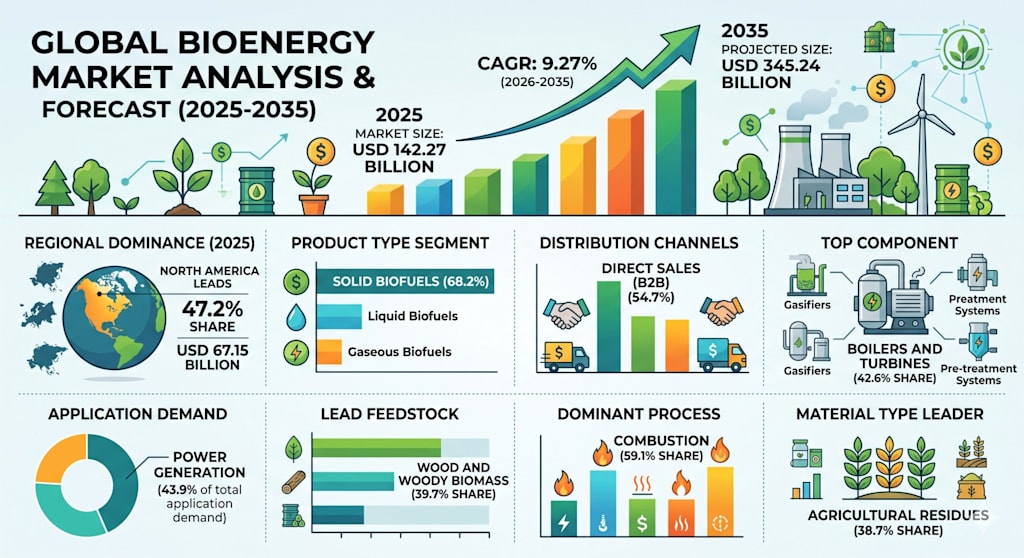
- The Global Bioenergy Market size will be worth around USD 345.24 Bn by 2035 from USD 142.27 Bn in 2025, at a CAGR of 9.27%.
- North America leads all regions with a 47.2% share, valued at USD 67.15 Billion in 2025.
- Solid Biofuels dominate the product type segment with a 68.2% share.
- Direct Sales (B2B) leads distribution channels with a 54.7% share.
- Boilers and Turbines hold the top component position with a 42.6% share.
- Power Generation accounts for 43.9% of total application demand.
- Wood and Woody Biomass leads feedstock with a 39.7% share.
- Combustion dominates the process segment with a 59.1% share.
- Agricultural Residues lead material type with a 38.7% share.
A Growing Market Driven by Sustainability
The global bioenergy sector is experiencing significant growth, supported by favorable government policies and increasing private-sector investments. As countries pursue ambitious carbon reduction targets, renewable fuel mandates and low-carbon energy incentives are encouraging both producers and consumers to shift toward cleaner alternatives.
One of the greatest strengths of bioenergy lies in its flexibility. It can generate electricity, produce liquid transportation fuels such as biodiesel and ethanol, supply renewable gas, and provide industrial heat. This diversity allows it to support multiple industries while reducing dependence on fossil fuels.
Large industrial organizations are also integrating bioenergy into their sustainability strategies. Many businesses are adopting renewable energy sources to meet environmental, social, and governance (ESG) goals while preparing for stricter emissions regulations. This commercial demand has transformed bioenergy from a niche renewable option into an increasingly important part of the global energy economy.
Understanding the Different Forms of Bioenergy
Bioenergy is not a single technology but a broad category of renewable energy produced from biological materials. Each form serves different applications and offers unique advantages depending on local resources and infrastructure.
Solid biofuels remain the most widely used category. Materials such as wood pellets, wood chips, and agricultural residues are commonly burned in boilers and power plants to generate electricity and heat. Existing thermal power infrastructure can often be adapted to use these fuels, making them attractive for utilities transitioning away from coal.
Liquid biofuels, including biodiesel, renewable diesel, ethanol, and sustainable aviation fuel, are becoming increasingly important for decarbonizing transportation. Aviation, shipping, and heavy-duty road transport have limited alternatives to liquid fuels, making bio-based fuels a practical pathway toward lower emissions.
Biogas represents another rapidly growing segment. Produced through the anaerobic digestion of organic waste, biogas simultaneously addresses waste management challenges while generating renewable energy. It can be used for electricity production, heating, or upgraded into biomethane for injection into natural gas networks.
Together, these technologies demonstrate the adaptability of bioenergy across a wide range of energy applications.
Technology and Feedstocks Are Expanding Opportunities
The continued evolution of bioenergy technologies has greatly improved efficiency while expanding the variety of materials that can be converted into useful energy.
Traditional feedstocks such as wood and forestry residues remain important due to their established supply chains and high energy content. However, agricultural residues—including corn stover, rice husks, wheat straw, and sugarcane waste—are increasingly valued because they convert low-value by-products into renewable energy resources.
Municipal solid waste and industrial organic waste are also attracting attention. Rather than sending these materials to landfills, many regions are investing in waste-to-energy facilities that reduce methane emissions while generating electricity or renewable gas.
Advanced conversion technologies such as gasification, pyrolysis, anaerobic digestion, fermentation, and transesterification continue to improve production efficiency and expand the range of usable feedstocks. Digital monitoring systems are also enhancing feedstock traceability, helping producers verify sustainability credentials and comply with increasingly rigorous certification requirements.
As technology advances, bioenergy production is becoming more efficient, environmentally responsible, and economically competitive.
Regional Trends Shaping Global Development
Although bioenergy is expanding worldwide, regional priorities differ according to available resources, government policies, and industrial needs.
North America currently maintains a leading position thanks to well-established renewable fuel programs, significant production capacity, and extensive infrastructure. Strong policy support has encouraged investment in renewable diesel, ethanol, biomass power generation, and sustainable aviation fuel.
Europe continues to strengthen its position through ambitious climate legislation and renewable energy targets. Policies supporting sustainable aviation fuel, biomass electricity, and carbon reduction have encouraged continued investment throughout the region.
The Asia-Pacific region is emerging as one of the fastest-growing markets. Rapid industrialization, increasing energy demand, and abundant agricultural residues provide ideal conditions for expanding bioenergy production. Countries throughout the region are exploring ways to convert agricultural waste into valuable energy while reducing dependence on imported fossil fuels.
Latin America benefits from extensive agricultural production, particularly sugarcane, which has supported successful ethanol and biogas industries. Meanwhile, parts of the Middle East and Africa are beginning to explore decentralized bioenergy systems that can improve energy access while utilizing locally available organic waste.
These regional differences illustrate how bioenergy solutions can be adapted to meet diverse economic and environmental needs.
Challenges and the Road Ahead
Despite its promising outlook, the bioenergy industry still faces several important challenges.
Feedstock availability and pricing remain among the most significant concerns. Agricultural commodities often serve multiple markets, including food, animal feed, and industrial manufacturing. Price fluctuations can directly affect production costs and project profitability.
Large-scale bioenergy facilities also require substantial upfront investment. Developing new plants involves permitting processes, environmental assessments, feedstock supply agreements, and long-term customer contracts, all of which can extend project timelines.
Sustainability remains another critical consideration. Responsible sourcing practices are essential to ensure that bioenergy production genuinely reduces emissions without creating unintended environmental impacts such as deforestation or biodiversity loss. Increasingly rigorous certification systems are helping improve transparency throughout the supply chain.
Nevertheless, technological innovation continues to strengthen the industry's long-term prospects. Second-generation biofuels produced from non-food biomass, advanced waste-to-energy systems, digital supply chain management, and carbon capture integration are creating new opportunities for growth. Sustainable aviation fuel, in particular, is expected to become one of the fastest-growing applications as airlines work toward reducing their carbon footprint.
With continued investment, supportive policies, and ongoing technological progress, many of today's challenges are likely to become more manageable over time.
Conclusion
Bioenergy has evolved into a critical component of the global transition toward cleaner, more sustainable energy systems. Its ability to generate electricity, produce renewable transportation fuels, manage organic waste, and support industrial operations gives it a unique position within the renewable energy landscape. Unlike many other renewable sources, bioenergy offers dispatchable energy that can complement intermittent power generation while contributing to circular economy principles.
As governments strengthen climate commitments and industries pursue ambitious decarbonization goals, demand for reliable renewable energy solutions is expected to continue growing. While challenges related to feedstock supply, investment costs, and sustainability remain important, ongoing innovation and supportive policy frameworks are creating a strong foundation for future expansion. By converting biological resources into valuable energy, bioenergy is helping build a more resilient, diversified, and environmentally responsible global energy future.
About the Creator
Yash Mule
SEO Specialist with 10+ years of experience at Evolvance Market Research. Expert in technical SEO, content strategy, and data-driven optimization, with a proven track record of significantly increasing organic traffic and search rankings.
Enjoyed the story? Support the Creator.
Subscribe for free to receive all their stories in your feed.
Comments
There are no comments for this story
Be the first to respond and start the conversation.