
Biodegradable Polymers Market Poised for Massive Growth as Global Packaging Rules Tighten
Rising environmental regulations, certified compostable packaging demand, and large-scale PLA investments are transforming the future of sustainable materials.

The global shift away from conventional plastics is accelerating faster than many industry observers expected. Governments are introducing stricter packaging rules, major brands are redesigning products around sustainability goals, and consumers are becoming more aware of plastic waste. At the center of this transformation is the growing demand for biodegradable polymers — materials designed to break down naturally under specific environmental conditions.
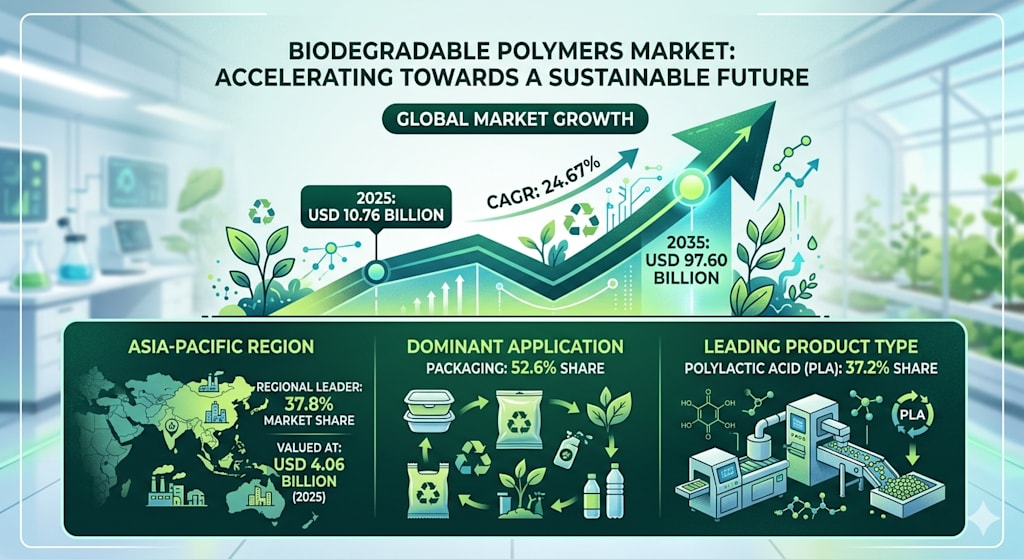
The global Biodegradable Polymers Market is projected to grow from USD 10.76 billion in 2025 to nearly USD 97.60 billion by 2035, expanding at a remarkable compound annual growth rate (CAGR) of 24.67%. While environmental awareness remains an important factor, the real momentum now comes from regulation, industrial investment, and supply-chain transformation.
Market Highlights
- Asia-Pacific leads with 37.8% market share, valued at USD 4.06 Billion in 2025
- Packaging is the dominant application segment with 52.6% share.
- Polylactic Acid (PLA) leads by product type with 37.2% share
Why Biodegradable Polymers Are Becoming Essential
Biodegradable polymers are materials that decompose into water, carbon dioxide, and biomass through biological activity. Unlike conventional petroleum-based plastics, these materials are designed to reduce long-term environmental impact when processed correctly. Common examples include Polylactic Acid (PLA), starch blends, Polyhydroxyalkanoates (PHA), PBAT, PBS, and cellulose-based polymers.
For years, many companies promoted “bio-based” products without clear proof that the materials would fully break down. That approach is changing rapidly. Today, manufacturers and retailers increasingly demand internationally recognized certifications such as ASTM D6400 and EN 13432 before approving materials for commercial use.
This shift toward certified compostability is reshaping procurement standards across industries. Large food brands, retailers, and packaging suppliers now prioritize materials that meet strict environmental compliance requirements rather than relying on broad sustainability claims. As a result, suppliers with verified products are gaining a significant competitive advantage.
The transition is especially visible in food-contact packaging, where regulations are becoming stricter across Europe and North America. Companies that fail to adapt may face compliance risks, while those that move early are securing long-term contracts with major buyers.
Packaging Leads the Market Transformation
Packaging remains the largest application segment, accounting for more than half of total market demand. The reason is simple: packaging waste has become one of the most visible environmental concerns worldwide.
European regulations are playing a particularly important role. The European Union’s Packaging and Packaging Waste Regulation is pushing manufacturers to adopt recyclable and compostable packaging solutions before 2030 deadlines arrive. This has triggered a wave of investment in biodegradable materials suitable for food packaging, coffee pods, flexible films, and takeaway containers.
At the same time, global foodservice companies are moving toward PFAS-free and compostable packaging formats. This dual requirement is creating new opportunities for suppliers capable of meeting both safety and sustainability standards simultaneously.
Beyond packaging, agriculture is also becoming a strong growth area. Farmers increasingly use biodegradable mulch films and seedling containers that naturally break down after use, eliminating the need for expensive plastic recovery operations. In many regions, recovering traditional agricultural plastic films is difficult and costly, making biodegradable alternatives more practical.
Healthcare applications are expanding as well. Biodegradable polymers are now used in sutures, drug delivery systems, implants, and medical packaging. In this sector, once a material receives medical approval, suppliers often benefit from long-term demand because switching materials can be expensive and time-consuming.
PLA Emerges as the Dominant Material
Among all biodegradable polymer types, Polylactic Acid (PLA) has emerged as the market leader with a 37.2% share. PLA’s dominance comes from its scalability, versatility, and growing production infrastructure.
Unlike many competing materials, PLA benefits from vertically integrated manufacturing systems. Companies such as NatureWorks and TotalEnergies Corbion have invested heavily in large-scale facilities in Thailand that combine feedstock processing, lactic acid production, lactide manufacturing, and polymer production within a single operation.
This integration lowers production costs and improves supply reliability. As a result, PLA has become more competitive with traditional plastics, especially in high-volume packaging applications.
The expansion of PLA capacity is also reducing historical supply shortages. Global production capacity recently increased substantially following the commissioning of major facilities in Thailand. This additional supply is helping stabilize pricing and making biodegradable materials more accessible to industrial buyers.
PLA demand is extending beyond packaging. The material is now widely used in textiles, disposable consumer products, and 3D printing. Manufacturers value PLA because it can be processed through existing industrial equipment with relatively minor adjustments.
Other materials continue to play important supporting roles. PBAT is commonly blended with PLA to improve flexibility and tear resistance, while PHA is attracting interest for marine-biodegradable applications. PBS is gaining traction in agricultural films and rigid packaging where additional durability is required.
Asia-Pacific Becomes the Global Production Hub
Asia-Pacific currently holds the largest regional market share at 37.8%, valued at USD 4.06 billion in 2025. The region’s leadership is driven largely by Thailand’s emergence as a major production center for biodegradable polymers.
Government support has played a critical role in this rise. Thailand’s Bio-Circular-Green economic strategy has encouraged large investments in biopolymer manufacturing through financing programs and investment incentives. These policies have attracted global producers looking for cost-efficient production locations with strong agricultural feedstock availability.
Thailand’s sugarcane industry also provides an important advantage. Sugarcane-derived feedstocks are increasingly used in PLA production, helping manufacturers reduce carbon footprints while improving supply stability.
North America remains a strong demand center, especially in foodservice packaging and retail applications. Compostable coffee pods and sustainable food packaging formats are becoming more common as brands attempt to reduce plastic waste and comply with changing environmental expectations.
Europe, however, continues to lead from a regulatory perspective. European legislation is effectively setting the global benchmark for packaging sustainability standards. Producers seeking access to European markets must now meet increasingly strict compostability and recyclability requirements.
Infrastructure Challenges Still Threaten Growth
Despite rapid market expansion, the industry faces a major obstacle: limited industrial composting infrastructure.
Many biodegradable materials, especially PLA, require controlled industrial composting environments with temperatures between 60 and 65 degrees Celsius to break down effectively. Unfortunately, many municipal waste systems around the world lack the facilities needed to process these materials correctly.
Without proper composting infrastructure, biodegradable products may still end up in landfills or incinerators, reducing the environmental benefits that justify their higher costs.
This infrastructure gap creates hesitation among some buyers, particularly in regions where organics recycling systems remain underdeveloped. Procurement teams increasingly evaluate not only material performance but also whether local waste management systems can support compostable packaging at scale.
Regulatory scrutiny is also increasing. Authorities are cracking down on vague or misleading environmental claims, forcing manufacturers to invest more heavily in testing, certification, and compliance programs. While this raises costs, it also strengthens the position of established companies with verified products and strong regulatory expertise.
The Future of Sustainable Materials Is Becoming More Commercial
The biodegradable polymers industry is no longer driven purely by environmental activism or niche consumer preferences. It is becoming a commercially strategic market shaped by regulation, industrial supply chains, and long-term procurement planning.
Large-scale investments in Thailand and other production hubs are improving supply reliability and lowering costs. At the same time, tightening packaging laws are making certified compostable materials increasingly necessary for global brands operating in regulated markets.
The next phase of growth will likely depend on two factors: expanding composting infrastructure and continuing innovation in material performance. Companies capable of delivering certified, scalable, and cost-effective solutions are positioned to dominate the market over the next decade.
As governments and corporations continue pushing for lower-waste packaging systems, biodegradable polymers are evolving from a sustainability alternative into a mainstream industrial material. The coming years may determine not only how packaging is produced, but also how global industries rethink the lifecycle of plastics altogether.
About the Creator
Yash Mule
SEO Specialist with 10+ years of experience at Evolvance Market Research. Expert in technical SEO, content strategy, and data-driven optimization, with a proven track record of significantly increasing organic traffic and search rankings.
Enjoyed the story? Support the Creator.
Subscribe for free to receive all their stories in your feed.
Comments
There are no comments for this story
Be the first to respond and start the conversation.