
Biodegradable Packaging Market Outlook: Sustainable Materials Demand and Growth Opportunities
The Biodegradable Packaging Market is experiencing strong growth driven by increasing demand for eco-friendly and sustainable packaging solutions.

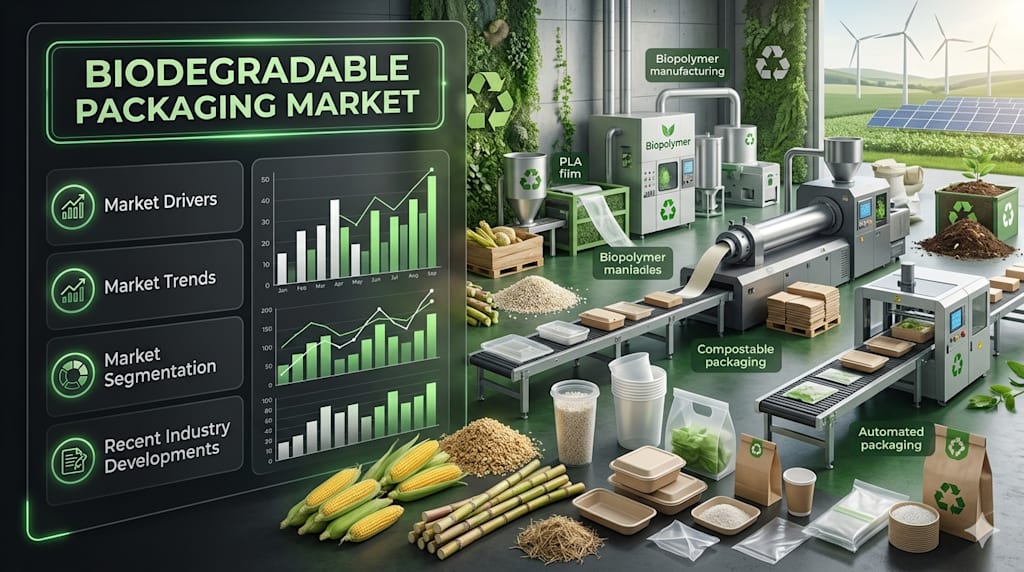
According to IMARC Group's latest research publication, The global biodegradable packaging market size reached USD 113.3 Billion in 2025. Looking forward, IMARC Group expects the market to reach USD 179.3 Billion by 2034, exhibiting a growth rate (CAGR) of 5.20% during 2026-2034.
How AI is Reshaping the Future of the Biodegradable Packaging Market
- Smart Material Design and R&D Acceleration: AI is fundamentally transforming how biodegradable packaging materials are developed, enabling researchers to model the degradation behaviour of novel bio-polymers such as polylactic acid (PLA), polyhydroxyalkanoates (PHA), and starch blends before physical prototyping. Companies implementing AI-driven computational design have cut development cycles by up to 30%, allowing faster iterations on barrier coatings and structural performance.
- Predictive Quality Control and Defect Detection: Machine learning algorithms integrated with computer vision are enabling automated visual inspections across paper kraft, corrugated fiberboard, and bio-plastic packaging production lines, flagging defects, moisture irregularities, and contamination in real time. AI-powered inspection systems analyse colour consistency, seal integrity, and surface aberrations at speeds that manual checks cannot replicate, ensuring that only premium-quality biodegradable packaging reaches food and beverage end users.
- Supply Chain Optimisation and Demand Forecasting: AI-powered forecasting systems analyse historical procurement data, seasonal consumption patterns, and raw material availability including corn starch and sugarcane inputs for PLA production to predict demand with greater precision. Companies adopting AI-driven inventory tools have reported short-term forecast accuracy improvements of up to 40%, helping them manage the structural cost volatility inherent in bio-based feedstocks.
Biodegradable Packaging Industry Overview
Europe commands the largest share of the global biodegradable packaging market, driven by the EU's Packaging and Packaging Waste Regulation (PPWR), which entered into force in February 2025 and begins full application from August 2026 onward. The regulation mandates that all packaging must be designed for recyclability by 2030, requires plastic packaging to incorporate minimum recycled content thresholds by 2026, and bans PFAS and other hazardous chemicals from food-contact packaging starting August 2026.
Biodegradable Packaging Market Trends and Drivers
The food packaging segment holds the largest application share in the global biodegradable packaging market, accounting for over 42% of total revenue in 2025. Heightened consumer concern about food safety, rising organic product consumption, and the proliferation of home delivery meal kits are all reinforcing demand for packaging that avoids petroleum-derived chemicals.
The paper segment maintains the dominant material type share within the biodegradable packaging market, representing the largest category by material. Growth here is driven by the expanding e-commerce sector, which generates consistent demand for paper-based mailers, corrugated shipping boxes, and compostable void-fill materials. Regulatory initiatives banning single-use plastics across multiple jurisdictions have further reinforced paper's position. Technological improvements have enhanced the moisture resistance, barrier performance, and printing quality of kraft paper and corrugated fiberboard, making these substrates increasingly competitive with rigid plastic alternatives in food service and retail environments.
The beverages sector represents another high-growth application segment, propelled by sustainability commitments from major drinks producers and rising community awareness of ocean plastic pollution. The EU's mandate for plastic beverage bottles to contain at least 25% recycled content is redirecting industry investment toward bio-based bottle formats.
Leading Companies Operating in the Global Biodegradable Packaging Industry
- Amcor Plc
- Berkley
- BioPak
- Ecovative Design LLC
- Elevate Packaging
- International Paper Company
- Kruger Inc.
- Mondi plc
- Ranpak
- Smurfit Westrock plc
- Tetra Pak International S.A.
- Vegware Ltd
Biodegradable Packaging Market Report Segmentation
By Material Type:
- Plastic (Starch-based Plastics, Cellulose-based Plastics, Polylactic Acid (PLA), Poly-3-Hydroxybutyrate (PHB), Polyhydroxyalkanoates (PHA), Others)
- Paper (Kraft Paper, Flexible Paper, Corrugated Fiberboard, Boxboard)
Paper represents the largest material segment, driven by growing consumer preference for eco-friendly solutions and bans on single-use plastics accelerating adoption. Within the plastic sub-segment, PLA currently contributes the largest share by volume, reflecting established production scale at NatureWorks' 150,000-tonne US facility and TotalEnergies Corbion's 75,000-tonne Thailand plant.
By Application:
- Food Packaging
- Beverage Packaging
- Pharmaceutical Packaging
- Personal/Homecare Packaging
- Others
Food packaging accounts for the majority of the market share, supported by safety regulations, the organic food industry's growth, and enhanced preservation technologies extending shelf life within biodegradable formats.
By Region:
- North America (United States, Canada)
- Asia Pacific (China, Japan, India, South Korea, Australia, Indonesia, Others)
- Europe (Germany, France, United Kingdom, Italy, Spain, Russia, Others)
- Latin America (Brazil, Mexico, Others)
- Middle East and Africa
Europe exhibits clear dominance, supported by the EU Circular Economy Action Plan, the PPWR regulatory framework, and a highly consumer-aware regional population. North America and Asia-Pacific are emerging as the fastest-growing regions.
Recent News and Developments in the Biodegradable Packaging Market
- April 2026: Amcor, Mondini, and Metsä entered a strategic collaboration to accelerate the adoption of recyclable fibre-based packaging in the food industry, combining Metsä's paperboard, Mondini's tray-forming technology, and Amcor's barrier-lidding systems. The integrated solution allows food manufacturers to transition away from rigid plastic trays without requiring significant capital expenditure on new equipment.
- March 2026: Shellworks raised USD 15 million in Series A funding to advance plastic-free packaging developed from waste and microorganisms, reflecting continued investor appetite for bio-based material innovation at commercial scale.
- February 2026: Amazon partnered with the Indian Institute of Technology Roorkee (IIT Roorkee) to develop packaging materials from agricultural waste, underlining the shift toward crop-residue feedstocks as a cost-competitive and locally sourced alternative to virgin bio-based inputs.
- January 2026: Sabert launched PulpUltra, a range of fibre-based, PFAS-free food packaging, across Europe, the UK, and Ireland, directly addressing tightening EU chemical restrictions in food-contact materials.
- September 2025: Tetra Pak launched a new initiative to increase the recyclability of its packaging portfolio by investing in advanced recycling technologies and partnering with local governments across key markets to upgrade composting and recycling infrastructure.
- July 2025: Mondi Group expanded its Asia operations by acquiring a local packaging firm specialising in biodegradable materials, strengthening its competitive position in a region where regulatory pressure and consumer demand for sustainable packaging are both accelerating rapidly.
- April 2025: Amcor introduced monomaterial pouches across Europe for bulk foodservice applications, with a lifecycle assessment certified by the Carbon Trust indicating that the pouches reduce carbon emissions by up to 79% and use 84% less water compared to legacy formats.
- January 2025: Researchers at the University of Connecticut partnered with Novamont to examine the marine degradation performance of Mater-Bi, a starch-based polymer. Published findings in the Journal of Polymers and the Environment showed that Mater-Bi degraded by nearly 50% over nine months in a marine environment, significantly outperforming conventional plastics.
- November 2024: ABB Group initiated a three-part industry paper series on innovation in pulp and paper, highlighting technology's role in enabling sustainable and resource-efficient production processes as part of its global Real Progress sustainability programme.
- October 2024: SABIC, Lamb Weston, and OpackGroup launched an innovative sustainable packaging solution for frozen food products using at least 60% bio-renewable polyethylene derived from used cooking oil, with an ISCC PLUS-certified multilayer film reducing carbon footprint by approximately 30% while maintaining food safety compliance.
Note: If you require specific details, data, or insights that are not currently included in the scope of this report, we are happy to accommodate your request. As part of our customization service, we will gather and provide the additional information you need, tailored to your specific requirements. Please let us know your exact needs, and we will ensure the report is updated accordingly to meet your expectations.
About the Creator
Olivia Smith
Olivia Smits is a Research and Marketing Analyst who specializes in market research, trend analysis, and consumer insights. I help businesses make smarter marketing and strategy decisions by turning data into clear, actionable insights.
Enjoyed the story? Support the Creator.
Subscribe for free to receive all their stories in your feed.
Comments
There are no comments for this story
Be the first to respond and start the conversation.