
Biodegradable Diapers Market Witnesses Strong Growth Amid Eco-Friendly Demand
The biodegradable diapers market is growing due to rising demand for eco-friendly and sustainable baby care products worldwide.

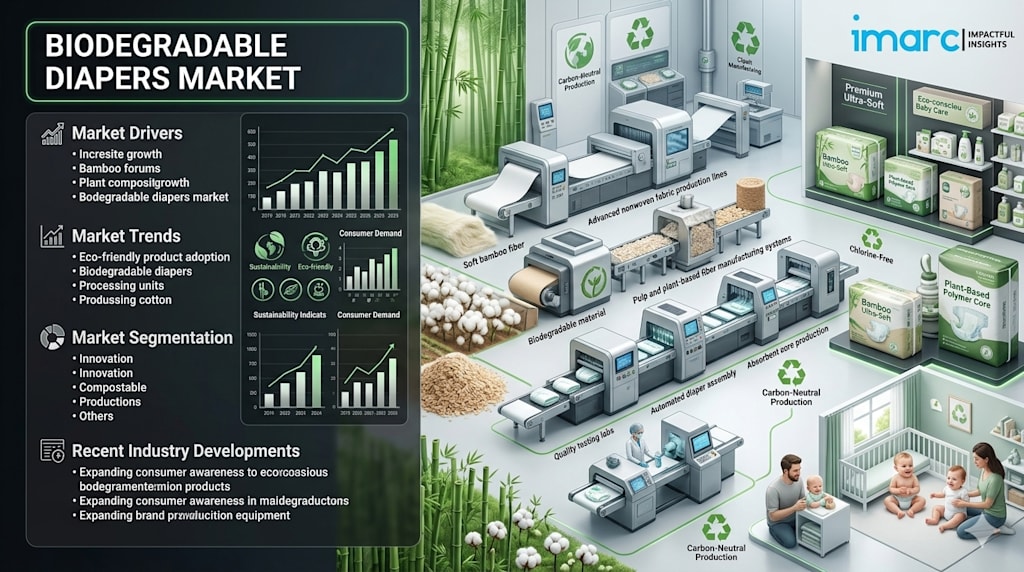
According to IMARC Group’s latest research publication, global biodegradable diapers market size reached USD 4.6 Billion in 2025. Looking forward, IMARC Group expects the market to reach USD 8.7 Billion by 2034, exhibiting a growth rate (CAGR) of 7.20% during 2026-2034.
How AI is Reshaping the Future of Biodegradable Diapers Market
- AI-Powered Material Innovation and Formulation Optimization: AI algorithms accelerate the discovery of next-generation biodegradable polymers and plant-based superabsorbent materials, cutting R&D cycles significantly while improving product performance and eco-compatibility.
- Smart Quality Inspection and Defect Detection: Machine learning-driven computer vision systems inspect biodegradable diaper production lines in real time, detecting micro-defects and material inconsistencies before products reach consumers, boosting quality standards substantially.
- Predictive Supply Chain and Demand Forecasting: AI-driven demand forecasting tools analyze purchasing patterns, seasonal shifts, and demographic trends, enabling biodegradable diaper brands to optimize raw material sourcing and reduce waste across distribution networks.
Biodegradable Diapers Industry Overview:
The biodegradable diapers market is experiencing strong growth momentum, driven by rising environmental consciousness, a growing geriatric population, and increasing prevalence of urinary incontinence globally. Government eco-labeling initiatives—like India’s Ecomark Rules, 2024—and the U.S. EPA’s push to reduce landfill waste are accelerating consumer adoption. Over 20 billion disposable diapers are discarded annually in the United States alone, making the shift toward biodegradable alternatives both an environmental imperative and a significant market opportunity.
Biodegradable Diapers Market Trends & Drivers
Surging environmental awareness is the defining force reshaping the biodegradable diapers market. Conventional disposable diapers take hundreds of years to decompose in landfills, and with over 300,000 diapers discarded globally every minute, the environmental toll is undeniable. Eco-conscious millennial and Gen Z parents are actively seeking alternatives—brands like The Honest Company and Bambo Nature have responded with plant-based, chlorine-free formulations. In July 2025, The Honest Company launched its Clean Conscious Diapers, featuring Comfort Dry Technology tested against more than 350 harmful chemicals, reflecting accelerating demand for transparent, toxin-free baby care.
The rising prevalence of urinary incontinence among the adult population, particularly seniors, is creating strong parallel demand in the adult biodegradable diapers segment. As healthcare systems worldwide shift toward geriatric care, demand for hypoallergenic, skin-friendly, and sustainably sourced adult incontinence products is growing steadily. Pharmacies remain the dominant distribution channel, benefiting from healthcare professionals who actively recommend certified biodegradable options. Meanwhile, online retail platforms are rapidly gaining ground—baby-focused e-commerce channels have reported close to 39% year-on-year growth in biodegradable diaper sales, accelerating brand accessibility.
Government regulatory frameworks and sustainability mandates are emerging as powerful tailwinds for biodegradable diaper adoption worldwide. India’s Ecomark Rules, 2024 introduced by the Ministry of Environment, Forest and Climate Change, actively promote eco-certified products, nudging manufacturers to reformulate using bamboo, starch, and cotton-based materials. In May 2025, Cottonsie launched the world’s first 100% cotton disposable diaper—biodegradable by up to 82% within 18 months. North America currently leads the market, supported by the U.S. EPA’s national strategy to reduce plastic pollution, while green subsidies in Europe are further boosting local biodegradable diaper manufacturing capacity.
Leading Companies Operating in the Global Biodegradable Diapers Industry:
- Bamboo Nature
- Seventh Generation
- Kimberly-Clark
- GroVia
- Naty AB
- The Honest Company
- Ontex Group
- Pampers
- Flip Diaper
Biodegradable Diapers Market Report Segmentation:
By Raw Material:
- Cotton/Wood Pulp
- Bamboo
- Starch
- Others
Cotton/wood pulp represents the largest segment, driven by rising awareness of hygiene and the preference for natural, skin-friendly materials that do not cause rashes or irritation.
By End-User:
- Babies
- Adults
Babies account for the largest market share, as biodegradable baby diapers are manufactured from waterproof, sustainable fabrics that are skin-friendly, convenient, and cost-effective.
By Distribution Channel:
- Pharmacies
- Supermarkets and Hypermarkets
- Convenience Stores
- Online
- Others
Pharmacies hold the largest distribution share due to their proximity to residential areas and the added benefit of pharmacist-guided product advice for consumers.
Regional Insights:
- North America (United States, Canada)
- Asia Pacific (China, Japan, India, South Korea, Australia, Indonesia, Others)
- Europe (Germany, France, United Kingdom, Italy, Spain, Russia, Others)
- Latin America (Brazil, Mexico, Others)
- Middle East and Africa
North America exhibits clear dominance in the biodegradable diapers market, supported by an advanced healthcare system, high consumer awareness, growing geriatric population, and strong regulatory backing for eco-friendly products.
Recent News and Developments in Biodegradable Diapers Market
July 2025: The Honest Company launched its Clean Conscious Diapers featuring proprietary Comfort Dry Technology. The product has been independently tested against over 350 potentially harmful chemicals, raising the bar for safety and transparency in the biodegradable baby care space.
May 2025: Cottonsie introduced the world’s first 100% cotton disposable diaper, utilizing patent-pending technology that replaces plastic components across key diaper layers. The product is primarily plant-based and can biodegrade by up to 82% within 18 months, directly addressing growing landfill concerns.
September 2025: Dyper, Inc. partnered with the National Diaper Bank Network to expand access to free biodegradable diapers for underserved communities across the United States, blending social impact with sustainability mission.
2024: India’s Ministry of Environment, Forest and Climate Change introduced the Ecomark Rules, 2024, promoting eco-certified product labeling. The regulation is pushing diaper manufacturers to reformulate using bamboo, starch, and organic cotton alternatives to earn government-backed sustainability credentials.
2024: The Greater Good Diaper Project expanded its circular diaper composting program to Pacific Island nations following a successful launch in Samoa, demonstrating a viable regional model for diaper waste reduction that eliminates approximately 1,500 pounds of diaper waste and generates 400 pounds of compost weekly.
Note: If you require specific details, data, or insights that are not currently included in the scope of this report, we are happy to accommodate your request. As part of our customization service, we will gather and provide the additional information you need, tailored to your specific requirements. Please let us know your exact needs, and we will ensure the report is updated accordingly to meet your expectations.
About the Creator
sujeet. imarcgroup
With 2 years of hands-on experience at IMARC Group, I have conducted in-depth market research and analysis across diverse industries including technology, healthcare, agriculture, and consumer goods.
Enjoyed the story? Support the Creator.
Subscribe for free to receive all their stories in your feed.
Comments
There are no comments for this story
Be the first to respond and start the conversation.