
Beyond the Cloud: How Local AI Code Editors are Rewriting Desktop Software Development
The shift from remote browser extensions to localized, hardware-accelerated development environments is transforming how engineers build at the silicon layer.

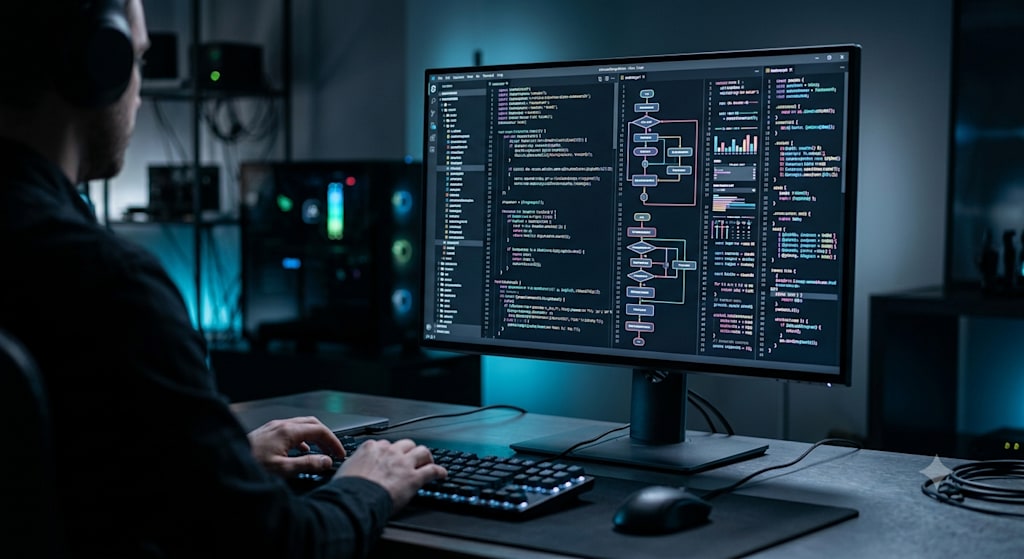
If you have spent any time writing code or configuring local databases over the last year, you have probably noticed a subtle shift in the developer ecosystem. For a while, everyone was perfectly content copying and pasting snippets from a browser window into their code editor. It was a manual, slightly disconnected workflow, but it worked.
But lately, something is changing. Live technical telemetry from June 29, 2026, shows a steady 10% growth spike in global search interest for "cursor ai" and localized text editing systems. Software engineers and system builders are moving away from external, subscription-gated web companions. Instead, they are demanding tools that live directly inside their local workspace environments, operating closer to the physical hardware.
The Local Imperative: Deep Context and Hardware Sync
The sudden market movement toward independent code editors like Cursor AI highlights a massive operational breakthrough: the power of complete, local codebase indexing. Traditional browser-based assistance is fundamentally limited. It can only analyze the few lines of text you copy into a prompt box, lacking any understanding of your project's overall structure, underlying data models, or hardware requirements.
A dedicated local editor fixes this by operating directly at the desktop architecture layer. By indexing your entire file repository locally, these systems understand how your software interacts with your local processor and system memory.
When you ask for optimization, the tool does not just guess a generic solution. It looks at how your data routes through internal memory arrays and physical hardware pipelines, proposing code adjustments that prevent thermal lag and optimize local core distribution. This localized execution path ensures that sensitive source code remains secure within your private workstation build, completely isolated from external multi-tenant cloud networks.
The Friction of Cloud Networks and the Rise of Open Weights
While developers are investing heavily in local workspace upgrades, the massive cloud providers are hitting an integration bottleneck. Industry metrics confirm that while corporate systems like Google's "gemini ai" maintain an absolute 100% index baseline for general web inquiries, flexible and customizable platforms like "claude ai" are climbing by 30% as developers search for deep contextual logic.
This data trend proves that the programming community is running out of patience with slow, remote network latency. Waiting on cloud response queues or dealing with connection drops during a heavy compilation run destroys an engineer's workflow. By integrating open-weight neural networks directly into local code editors, developers can run predictive logic checks, automatic refactoring, and real-time debugging directly on their personal hardware, avoiding subscription fees and keeping their systems immune to cloud server outages.
Engineering at the Edge: Pruning the Development Stack
To make this offline development environment a reality on standard workstations, software compilers are going through an intense optimization phase. Running high-volume predictive coding engines simultaneously with complex local software environments demands extreme memory efficiency.
Instead of letting background processes consume entire system blocks, modern developer tools are heavily optimized to interact cleanly with specialized graphics processing units and desktop silicon cores. This seamless coordination between local software architecture and microchip physical pathways allows creators to build, test, and ship applications locally. It reduces ongoing infrastructure overhead down to zero, turning standard office desktop configurations into powerful, self-sustaining development servers.
The Future of Software Architecture: Complete Standalone Autonomy
The current momentum behind localized AI development tools is a clear indication that the engineering landscape is moving toward decentralization. The software platforms of tomorrow will not be designed by linking endless networks of unstable web interfaces together.
For system developers, corporate technology directors, and hardware enthusiasts, adapting to this shift requires a complete rethink of workspace infrastructure. Relying on remote, proprietary cloud layers to write and secure your core application logic is an operational liability. The true innovators of tomorrow will be the teams that host their entire development and deployment pipelines locally, leveraging private on-chip processing units to guarantee absolute data security, ultimate processing speed, and total independence from external corporate networks.
Do you believe that hosting local AI development environments will completely phase out our reliance on centralized cloud APIs, or will server-side computing always hold the scaling advantage? Share your workstation specs, local compiler configurations, and development workflows in the comments section below.
Determined to monitor the rapid evolution of localized programming frameworks, edge-compute architectures, and global digital technology trends? Support our high-context tech journalism by leaving a Like, Sharing this analysis with your engineering community, and hitting Follow for unfiltered business intelligence.
About the Creator
AI Lens
Exploring the profound intersection of human nature, philosophy, and the future of artificial intelligence. Writing about our evolving digital world.
Enjoyed the story? Support the Creator.
Subscribe for free to receive all their stories in your feed.
Comments
There are no comments for this story
Be the first to respond and start the conversation.