
Battery Materials Market: Strategic Investments, Capacity Expansion & Future Growth
How strategic collaborations between miners, refiners, and battery manufacturers are fostering supply chain integration within the battery materials market

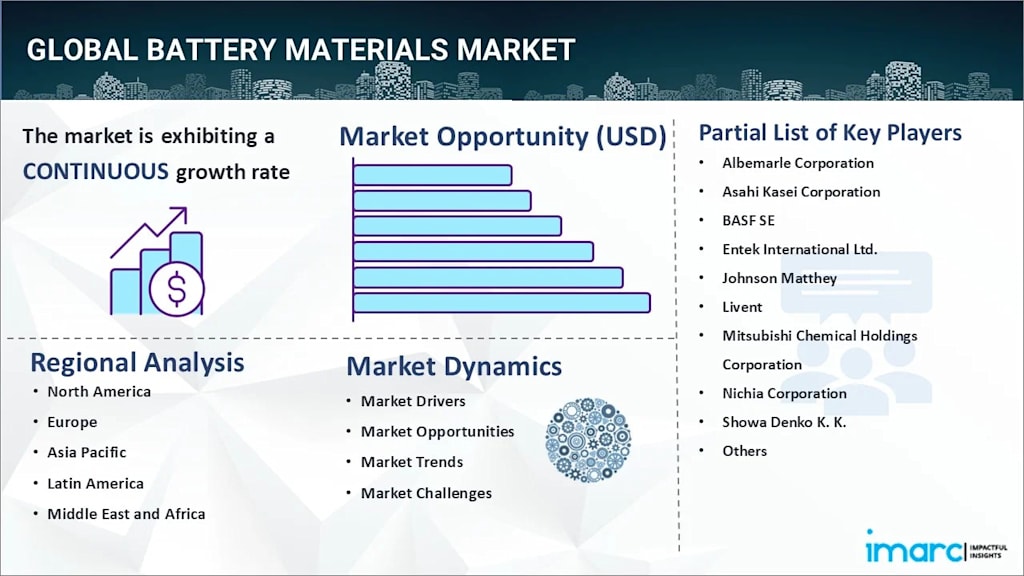
The increasing number of electric mobility initiatives, the rising trend of industrial automation, and an enhanced focus on reducing carbon emissions are driving battery materials demand, supported by considerable growth in research and development (R&D) investments and strategic collaborations in battery supply chains by key players. According to IMARC Group’s latest data, The global battery materials market size was valued at USD 59.4 Billion in 2025. Looking forward, IMARC Group estimates the market to reach USD 90.8 Billion by 2034, exhibiting a CAGR of 4.69% from 2026-2034.
Battery materials now represent a foundational pillar of the global clean energy transition, exceeding tens of billions of dollars in valuation and exhibiting steady year-on-year expansion. Demand is driven by the rapid shift toward sustainable transportation, the wide-scale deployment of grid-level energy storage systems, and the relentless evolution of high-capacity consumer electronics. Strategic investments, automotive vertical integration, and structural material advancements for increased energy density are further accelerating market uptake.
Battery Materials Market Growth Drivers:
- Growing Electric Vehicle Adoption
The massive push toward sustainable transportation acts as a primary catalyst for material consumption. Automakers are aggressively expanding their electric fleets to comply with strict international emission regulations and meet growing consumer demand. This structural shift requires vast quantities of high-purity lithium, cobalt, and nickel to construct long-range power cells. Industrial tracking indicates that localized manufacturing lines are expanding rapidly, directly escalating the bulk acquisition of active cathode and anode materials. This commercial pressure keeps extraction plants and raw material refiners operating at maximum capacity to prevent critical supply deficits.
- Surging Demand for Renewable Energy Storage
The global transition toward wind and solar energy requires robust grid-scale energy storage systems to mitigate intermittent power generation. Utilities are implementing massive lithium-ion and lead-acid installations to stabilize municipal power distribution and secure emergency backup reserves. Government infrastructure grants and favorable regulatory tax credits are lowering deployment costs, sparking immense corporate demand for battery components. This commercial scaling ensures a steady volume of large-scale material orders, as energy providers build out resilient electrical infrastructure capable of handling high-capacity industrial storage demands across diverse regional networks.
- Advancements in Consumer Electronics and Connected Devices
The continuous evolution of smartphones, laptops, and wearable technologies places strict performance requirements on modern battery architectures. Consumers demand thinner, lighter devices that feature faster charging capabilities and longer operational life cycles. This competitive landscape forces electronics manufacturers to source highly sophisticated battery materials capable of optimizing energy density within compact dimensions. Furthermore, the massive deployment of interconnected industrial monitoring sensors and smart home devices creates a substantial baseline of demand, ensuring that material suppliers have a continuous consumer footprint outside of heavy automotive applications.
Battery Materials Market Trends:
- Accelerated Regionalization of Supply Chains
Geopolitical considerations and logistics vulnerabilities are forcing manufacturers to establish localized material processing ecosystems. Leading economies are actively moving away from centralized offshore refining hubs by funding domestic mining, purification, and manufacturing infrastructure. For example, substantial public-private financing is being funneled into building dedicated synthetic graphite and chemical processing plants to minimize transport delays. This movement ensures regional self-sufficiency, reduces exposure to international trade disputes, and guarantees a predictable stream of battery-grade minerals for domestic car producers and industrial energy systems, fundamentally altering global logistics patterns.
- Development of Next-Generation Battery Chemistries
Intense corporate research and development is transforming traditional battery formulations, resulting in a distinct shift toward advanced anode and electrolyte technologies. Chemical engineers are successfully introducing silicon-carbon composite anodes that offer significantly higher energy retention capacities compared to standard natural graphite alternatives. Concurrently, substantial capital is entering the solid-state development space, where solid electrolytes replace flammable liquid variants to deliver safety and stability upgrades. These technological breakthroughs are moving rapidly from pilot demonstration facilities into mass commercial production, providing automakers with tangible performance upgrades.
- Expansion of Circular Economy and Recycling Infrastructure
Environmental regulations and high raw material extraction costs are rapidly turning battery recycling into a mainstream commercial necessity. Industrial operators are investing heavily in advanced hydrometallurgical recovery systems that extract critical elements from end-of-life cells with exceptional purity. This trend is heavily reinforced by regional circular economy mandates that penalize improper waste disposal and reward the utilization of secondary, recycled materials. By converting spent consumer electronics and worn vehicle packs back into manufacturing-grade inputs, companies are establishing localized closed-loop systems that mitigate supply volatility.
Recent News and Developments in Battery Materials Market
- March 2025: POSCO Future M introduced a new silicon-carbon (Si-C) anode material designed to significantly enhance lithium-ion battery performance. This next-generation anode offers approximately five times the storage capacity of traditional graphite-based anodes, contributing to extended driving ranges for electric vehicles. A demonstration plant for the Si-C anode has been operational since May 2024, with plans for mass production by 2027.
- December 2024: Mitsubishi Chemical Group Corporation announced a significant anode production capacity expansion at its Kagawa Plant in Sakaide, Japan. Starting in October 2026, the facility will ramp up its output of natural-graphite-based anode material to 11,000 tons per year, leveraging its proprietary low-swelling natural graphite technology for superior battery life and lower greenhouse gas emissions.
- July 2024: POSCO Future M and General Motors (GM) partnered to supply both cathode and anode materials for the Cadillac Lyriq—GM's first electric vehicle to fully incorporate POSCO Future M's battery components. The Lyriq features high-nickel NCMA cathodes and low-expansion natural graphite anodes developed by POSCO Future M. These advanced materials help improve the vehicle's energy density, extend its driving range, and support faster charging times.
Note: If you require specific details, data, or insights that are not currently included in the scope of this report, we are happy to accommodate your request. As part of our customization service, we will gather and provide the additional information you need, tailored to your specific requirements. Please let us know your exact needs, and we will ensure the report is updated accordingly to meet your expectations.
About the Creator
Andrew Sullivan
Hello, I’m Andrew Sullivan. I have over 9+ years of experience as a market research specialist.
Enjoyed the story? Support the Creator.
Subscribe for free to receive all their stories in your feed.
Comments
There are no comments for this story
Be the first to respond and start the conversation.