
Battery Manufacturing Equipment Market Rapid Growth at 23.0%
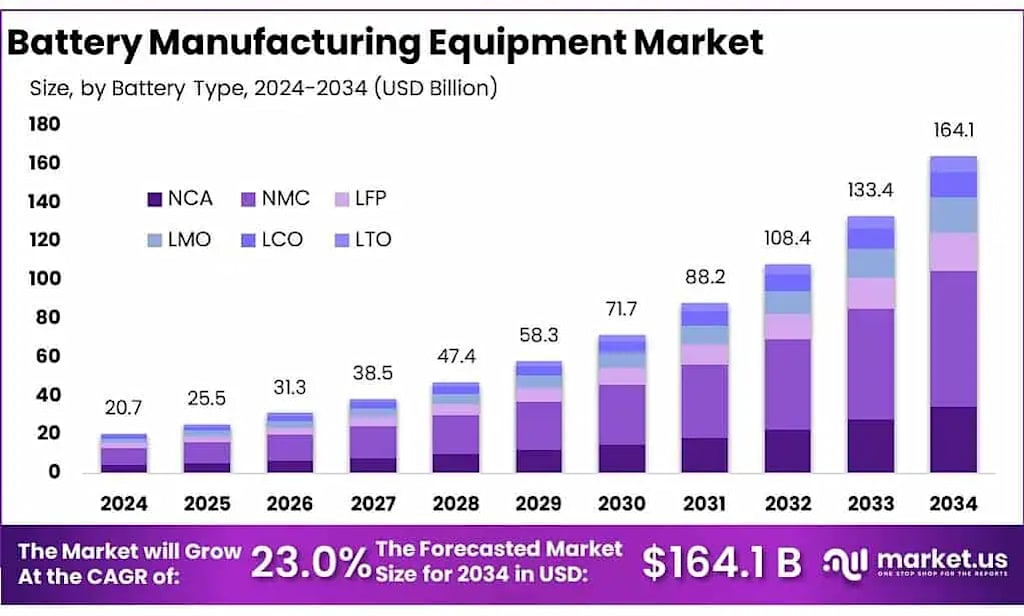
Battery Manufacturing Equipment Market Size USD 164.1 Bn by 2034, from USD 20.7 Bn in 2024 | CAGR of 23.0%

Market Overview
The global battery manufacturing equipment market is projected to grow significantly, reaching USD 164.1 billion by 2034, up from USD 20.7 billion in 2024, at a strong CAGR of 23.0% from 2025 to 2034. In 2024, Asia-Pacific (APAC) led the market with over 43.8% share, generating nearly USD 9 billion in revenue, driven by large-scale battery production expansion across countries like China, South Korea, and Japan.
According to the International Energy Agency (IEA), global electric car sales increased by 25% in 2024 to 17 million units, while annual battery demand crossed 1 TWh for the first time. This milestone is accelerating the construction of new gigafactories, creating strong demand for turnkey equipment solutions. Additionally, battery manufacturing capacity expanded rapidly, reaching 2.5 TWh in 2023, with 780 GWh of new capacity added in a single year.
Key Takeaways
- Battery Manufacturing Equipment Market size is expected to be worth around USD 164.1 Billion by 2034, from USD 20.7 Billion in 2024, growing at a CAGR of 23.0%.
- NMC held a dominant market position, capturing more than a 42.9% share.
- Coating & Drying Machines held a dominant market position, capturing more than a 27.5% share.
- Automotive held a dominant market position, capturing more than a 66.1% share in the Battery Manufacturing Equipment Market.
- Asia-Pacific (APAC) region emerged as the most dominant segment in the Battery Manufacturing Equipment Market, securing a commanding 43.80% regional share USD 9 billion in revenue.
Segmentation Deep Dive
By Battery Type Analysis
In 2024, NMC batteries emerged as the leading segment in the battery manufacturing equipment market, accounting for over 42.9% of the total share. Their dominance was mainly supported by an optimal balance between energy density, performance, and cost efficiency, making them highly suitable for a wide range of battery production applications.
By Machine Type Analysis
The Coating & Drying Machines segment held the largest share of the market in 2024, contributing more than 27.5%. These machines play a crucial role in ensuring uniform electrode coating and effective drying, both of which are essential for battery quality, consistency, and operational reliability.
By Application Analysis
The automotive sector dominated the battery manufacturing equipment market in 2024, capturing over 66.1% share. This strong position was largely driven by the rapid expansion of electric vehicle (EV) and hybrid vehicle production, which requires advanced, high-capacity battery manufacturing systems.
Top Use Cases
High-Volume EV Battery Cell Production: One of the biggest use cases for battery manufacturing equipment is making lithium-ion cells for electric cars. This includes machines for mixing slurry, coating electrodes, drying, calendaring, slitting, stacking or winding, electrolyte filling, sealing, formation, and testing. This use case is the largest because the EV industry needs very large battery volumes, tight quality control, and low defect rates. In 2024, global electric car sales grew by more than 25% and crossed 17 million units, while battery demand moved above 1 TWh, showing why cell production lines are expanding quickly.
Grid-Scale and Stationary Energy Storage Battery Production: Battery manufacturing equipment is also widely used to produce cells and packs for stationary energy storage systems, such as batteries installed with solar and wind projects or for grid balancing. The growth case is strong because battery storage is becoming a core part of power systems. The IEA states that battery storage is expected to deliver 90% of storage growth to 2030, with installed battery storage rising 14-fold to 1,200 GW by 2030 in its scenario.
Capacity Expansion for New Gigafactories and Local Supply Chains: Another major use case is building complete production lines for new gigafactories and regional battery supply chains. Here, battery manufacturing equipment is not just used for output; it is used to create the factory itself, from pilot line setup to commercial ramp-up. The IEA reports that battery manufacturing capacity reached about 2.5 TWh in 2023, and the world added nearly 780 GWh of new capacity in a single year.
Notable Company Developments
In 2024, Manz AG operated in a difficult market environment, with total group revenue expected to range between €170 million and €180 million, reflecting a decline compared with earlier years. As part of this restructuring, Manz AG planned to divest its battery cell production equipment business in early 2025 to improve focus and optimize operations.
During the same period, Nordson Corporation delivered a strong overall performance, reporting annual revenue of USD 2.7 billion in 2024, showing steady growth over previous years.
Conclusion
In conclusion, the battery manufacturing equipment market is entering a strong long-term growth phase, supported by rising electric vehicle adoption, grid-scale storage expansion, and aggressive global factory investments. The IEA reported that global electric car sales exceeded 17 million units in 2024, while annual battery demand crossed 1 TWh for the first time, confirming that battery production has moved into mass-scale industrialization.
About the Creator
Hayden Kulas
I am blogger, digital marketing pro since 5 years and writes for Market.us. Computer Engineer by profession. I love to find new ideas that improve websites' SEO. He enjoys sharing knowledge and information about many topics.
Enjoyed the story? Support the Creator.
Subscribe for free to receive all their stories in your feed.
Comments
There are no comments for this story
Be the first to respond and start the conversation.