
Battery Gigafactory Market: The USD 604 Billion Race to Build the Factories That Power Everything
China controls 75% of global battery production capacity — and every other major economy is spending billions to change that. Here is what the battery gigafactory market looks like right now.

There is a single statistic that explains more about the geopolitics of the next decade than almost any other. China controls over 75% of global lithium-ion battery production capacity. CATL alone — one Chinese company — holds 37% of global lithium-ion battery sales. That concentration means any supply chain disruption in one country creates a global pricing event affecting every electric vehicle manufacturer, every grid storage developer, and every consumer electronics company on the planet simultaneously.
Every major economy outside China has looked at that number and reached the same conclusion: we cannot allow the energy transition to depend on a single country's manufacturing decisions. The result is the largest coordinated industrial investment in clean energy infrastructure in history — and the battery gigafactory market sits at its center.
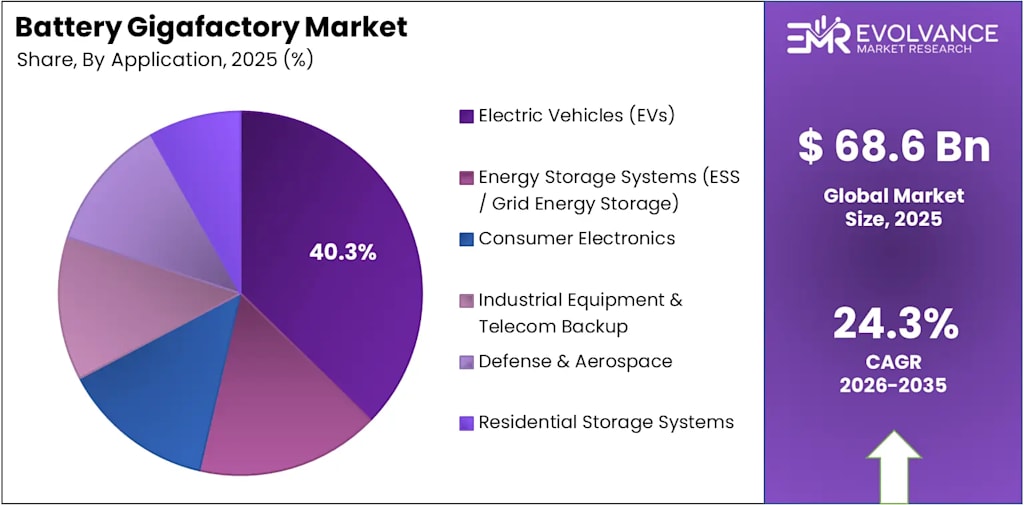
The global battery gigafactory market was valued at USD 68.6 billion in 2025 and is projected to reach USD 604.00 billion by 2035, growing at a CAGR of 24.3%. Global EV battery cell output reached 867.8 GWh in 2024 — a 21.2% year-on-year increase — showing how fast gigafactory build-out is translating into physical production at scale. For investors, policymakers, automotive OEMs, and energy storage developers who need the complete analytical picture — covering battery types, capacity scales, production processes, applications, ownership structures, cell formats, and regional forecasts through 2035 — the full research is available in the battery gigafactory market report from Evolvance Market Research.
Battery Gigafactory Market Size and Growth
Asia Pacific leads all regions with a 56.8% market share valued at USD 38.96 billion in 2025 — a dominance that reflects China's decade-long head start in battery manufacturing investment and the deep supply chain integration between Chinese cell producers, materials processors, and mining operations. Global lithium-ion battery production capacity exceeded 2,500 GWh in 2025, with China controlling more than three quarters of that base.
Want to Know More Please check: Battery Gigafactory Market Sample PDF
The strategic response from the rest of the world is being written in announced investment commitments that dwarf anything previously seen in manufacturing. The US Inflation Reduction Act has triggered over USD 100 billion in announced battery manufacturing investments across North America since its passage. Europe's Net Zero Industry Act and individual member state incentive programs are funding gigafactory construction across Germany, Sweden, Hungary, and the UK. South Korea and Japan are investing in domestic capacity to reduce dependence on Chinese cell supply for their own automotive industries.
The arithmetic of the energy transition makes these investments non-negotiable rather than optional. IEA scenarios require battery production capacity to reach 9,000 GWh annually by 2030 to support projected EV adoption rates. Current global capacity of 2,500 GWh needs to more than triple in five years. The gigafactory building race is not a choice — it is the physical infrastructure requirement of the energy transition.
Battery Gigafactory Market Trends: Scale Is the Competitive Weapon
Large-scale gigafactories — those producing more than 30 GWh annually — lead the capacity segment with a 41.9% share, and the economics explain why. Battery manufacturing has extremely steep learning curves and economies of scale. A factory producing 50 GWh annually achieves cell costs that a 5 GWh facility simply cannot match regardless of how efficiently it is managed. Scale is the primary competitive weapon in this industry — which is why every major player is building as large and as fast as capital and supply chains allow.
Tesla's Nevada Gigafactory — the facility that invented the gigafactory concept in 2016 — demonstrated the manufacturing economics that every subsequent project has tried to replicate. At full capacity it produces more battery cells than the entire global automotive industry manufactured in 2013. The learning curve compression achieved through continuous process optimization at scale has been the primary driver of the 80% reduction in lithium-ion battery costs over the past decade.
Solid-state batteries are the technology transition that every gigafactory operator is watching most carefully. Current lithium-ion chemistry — represented by the wet processing that holds 52.8% of production process share — is a mature technology with well-understood manufacturing processes. Solid-state batteries promise higher energy density, faster charging, and improved safety — but require fundamentally different manufacturing processes that existing gigafactory infrastructure cannot simply be retrofitted to accommodate. The capital allocation decisions being made in 2025 and 2026 around gigafactory technology choice will define competitive positions for the following decade.
Battery Gigafactory Market Segments: EVs Lead but Grid Storage Is Closing
Electric vehicles account for 40.3% of battery gigafactory demand by application — the largest single end-use category and the primary driver behind the gigafactory build-out that has been underway since 2020. Every major automotive OEM has either commissioned its own gigafactory, entered a joint venture with a battery manufacturer, or signed long-term supply agreements that effectively guarantee demand for specific facilities at contracted volumes and pricing.
Grid energy storage is the application segment showing the most dynamic growth trajectory. As renewable energy penetration increases, the need for grid-scale battery storage to manage the intermittency of solar and wind generation becomes structurally critical. Battery storage projects that would have been measured in megawatt-hours five years ago are now being built in gigawatt-hours. The economics of grid storage have improved so dramatically that battery storage is increasingly competing with gas peaker plants on pure cost — without any subsidy support.
Consumer electronics — the original driver of lithium-ion battery demand — represents a smaller but stable base. Industrial equipment and telecom backup applications are growing as electrification extends beyond transportation into industrial power systems. Defense and aerospace applications are emerging as governments invest in electric military vehicles and autonomous systems that require reliable, high-density energy storage.
Battery Gigafactory Market Regional Analysis: Europe Races to Catch Up
Asia Pacific's dominance is structural and durable in the near term — China's integrated supply chain from lithium mining through cell production through vehicle assembly gives it cost advantages that cannot be replicated quickly. CATL's announced gigafactories in Hungary and Germany represent a strategic move to capture European market share while the European battery manufacturing base is still being built.
Europe is investing aggressively. Northvolt — the Swedish battery manufacturer backed by Goldman Sachs and Volkswagen — is building out capacity across Sweden and Germany with ambitions to supply 25% of European battery demand by 2030. ACC, the joint venture between Stellantis, Mercedes-Benz, and TotalEnergies, is constructing gigafactories in France, Germany, and Italy. The EU's strategic autonomy agenda has made domestic battery production a political as well as economic priority.
North America's gigafactory buildout is being driven primarily by IRA incentives that make domestic battery production financially compelling for both OEMs and standalone battery manufacturers. Panasonic's Kansas facility, Samsung SDI's joint venture with Stellantis in Indiana, and LG Energy Solution's multiple US facilities represent Korean battery manufacturers planting deep roots in the American market to capture IRA qualification benefits.
Key Players in the Battery Gigafactory Market
CATL holds a position in battery manufacturing that has no direct parallel — 37% of global sales from a single company represents a market concentration that regulators in Europe and North America are increasingly treating as a strategic vulnerability. Its response has been simultaneous global expansion and technology leadership — the Shenxing battery announced in 2023 charges to 80% in 10 minutes, a specification that changes the consumer EV value proposition more than any vehicle design update.
BYD's vertical integration — manufacturing its own batteries, vehicles, and semiconductor components — gives it structural cost advantages that pure-play battery manufacturers cannot match. Panasonic's deep relationship with Tesla provides volume certainty that anchors its US investment. LG Energy Solution, Samsung SDI, and SK On collectively represent Korean battery manufacturing capability that is being distributed globally through joint ventures with automotive OEMs across North America and Europe.
The race to build the factories that power everything is already underway. The winners will be determined by capital, chemistry, and supply chain depth — in that order.
About the Creator
Suge kun
Research Analyst passionate about data & market insights. I turn complex information into clear, actionable strategies. Detail-driven & results-focused — helping businesses make smarter decisions. — Suge Kun
Enjoyed the story? Support the Creator.
Subscribe for free to receive all their stories in your feed.
Comments
There are no comments for this story
Be the first to respond and start the conversation.