
Battery-as-a-Service BaaS Market Insights: Circular Economy, Battery Reuse & Forecast to 2034
How second-life battery applications, smart asset management, and urban mobility demand are driving expansion across the battery-as-a-service BaaS market.

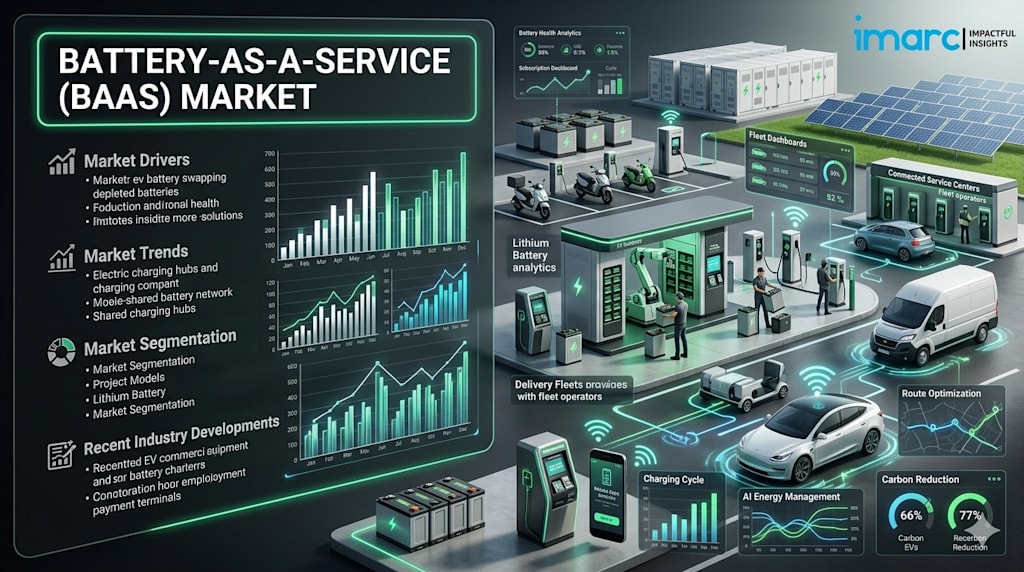
The global Battery-as-a-Service (BaaS) market is witnessing significant growth, driven by rising demand for alternative energy solutions, stringent environmental regulations, and the rapid adoption of electric vehicles (EVs). According to IMARC Group’s latest data, the market was valued at USD 26.9 Million in 2025 and is projected to reach USD 148.3 Million by 2034, reflecting strong growth momentum over the forecast period. Asia Pacific leads adoption, supported by supportive government policies, urban electrification programs, and growing EV penetration, with North America and Europe following closely due to clean energy mandates and fleet electrification initiatives.
Battery-as-a-Service is redefining how businesses and consumers access energy storage. Rather than purchasing batteries outright, customers pay through subscription or lease models, while service providers manage installation, maintenance, performance monitoring, and end-of-life recycling. This model allows users to access high-quality, reliable energy storage solutions without upfront investment, making energy management more flexible and cost-effective.
Evaluate Market Potential Before You Invest – Get the Report Sample
Key Growth Drivers
1. Rising Demand for Alternative Energy Solutions
Grid instability, fluctuating energy prices, and the need to reduce carbon emissions are driving interest in energy storage solutions. BaaS addresses these challenges by offering scalable and professionally managed battery systems. These systems store excess renewable energy from solar and wind installations and release it during peak demand periods, helping businesses and households maintain reliable power supply. Governments worldwide are supporting adoption through subsidies, tax incentives, and emission reduction mandates, making BaaS a strategic solution for sustainable energy management.
2. Lower Total Cost of Ownership
Traditional battery ownership involves high upfront costs, ongoing maintenance, and replacement expenses. BaaS removes this financial burden by spreading costs across predictable subscription payments. Service providers ensure that batteries operate efficiently throughout the contract period, maximizing lifespan and performance. For businesses and fleets, this model reduces capital expenditure while providing a reliable energy solution, making it an attractive alternative to outright battery ownership.
3. Growing Electric Vehicle Adoption
The global EV market is expanding rapidly, with ride-hailing platforms, last-mile delivery companies, and municipal fleets increasingly relying on electric vehicles. Efficient battery management is crucial for these fleets, and BaaS provides a solution by reducing battery-related risks and optimizing usage. By separating battery ownership from the vehicle itself, fleet operators can lower capital costs, improve operational efficiency, and ensure continuous availability of charged batteries.
Market Trends
1. Integration with Renewable Energy Systems
BaaS is increasingly deployed alongside renewable energy projects to balance intermittent power generation with consistent energy delivery. Businesses integrating solar or wind power with BaaS gain a professionally managed energy buffer without the need to own or maintain battery assets directly. This trend is accelerating adoption in commercial, industrial, and residential segments, where reliability and sustainability are key considerations.
2. Technological Advancements in Battery Chemistry and IoT Monitoring
Advances in battery technology are expanding the scope of BaaS. Modern batteries are more energy-dense, lightweight, and long-lasting, making them suitable for a wider range of applications. Additionally, IoT-enabled monitoring systems provide real-time updates on battery status, predictive maintenance alerts, and automated optimization of charge cycles. These features extend battery lifespan, reduce operational costs, and improve overall service quality for subscribers, reinforcing the appeal of subscription-based energy solutions.
3. Premiumization and Enterprise-Grade Services
Demand is increasing for high-quality, enterprise-focused BaaS offerings that combine premium battery storage with service-level agreements, guaranteed uptime, and tailored energy management solutions. Large corporations pursuing net-zero targets are leveraging BaaS as a tool for emissions compliance, energy efficiency, and cost management, positioning battery subscriptions as a strategic solution rather than a simple utility.
Recent Developments
April 2026: Gogoro expanded its battery swapping network into Southeast Asia, prioritizing Indonesia and Vietnam, supporting the growing demand for electric two-wheelers and government clean mobility initiatives.
February 2026: NIO reported surpassing 45 million cumulative battery swaps globally, demonstrating consumer acceptance of battery-vehicle separation models in the EV market.
November 2025: Ample secured a multi-year contract with a U.S. ride-hailing platform to deploy robot-assisted modular battery swap stations across five cities, marking one of the largest commercial BaaS agreements in North America.
August 2025: The European Commission introduced BaaS guidelines under the EU Battery Regulation, requiring providers to disclose carbon footprints and recycled content, accelerating managed battery services as a compliance-friendly alternative to direct ownership.
March 2025: Reliance Industries partnered with a South Korean battery manufacturer to pilot BaaS solutions for commercial fleets in India, supporting the electrification of logistics and last-mile delivery in major urban centers.
October 2024: Shell Recharge collaborated with a European BaaS startup to integrate battery subscription services into its commercial fleet offerings, expanding access to logistics companies in Germany, the Netherlands, and Belgium.
Conclusion
The Battery-as-a-Service (BaaS) market is set for strong and sustained growth as businesses and consumers increasingly seek flexible, cost-effective, and sustainable energy solutions. Rising adoption of EVs, integration with renewable energy systems, technological advancements in batteries and IoT monitoring, and enterprise-focused service models are all driving market expansion.
With supportive policies, global electrification initiatives, and growing awareness of energy sustainability, BaaS is emerging as a strategic solution for efficient energy storage and management. The model not only lowers total cost of ownership but also provides reliable and scalable solutions for a variety of applications across automotive, energy, and industrial sectors.
As technology continues to evolve and adoption expands, BaaS is expected to play a central role in transforming energy access, fleet management, and renewable energy integration, shaping the future of clean energy and electrification worldwide.
Note:
This overview of the Battery-as-a-Service market highlights growth drivers, trends, and recent developments. While it provides a detailed snapshot, additional localized insights and custom analysis may be needed for investment decisions or business strategies. Custom market reports can be prepared on request.
About the Creator
Suhaira Yusuf
I specialize in Consumer Insights, focusing on transforming detailed market data into strategic business solutions that accelerate growth and improve customer engagement.
Enjoyed the story? Support the Creator.
Subscribe for free to receive all their stories in your feed.
Comments
There are no comments for this story
Be the first to respond and start the conversation.