
Baby Car Seat Market Trends: Safety Regulations, Comfort Features & Forecast to 2034
How increasing parental awareness, stringent safety regulations, and demand for advanced protection features are reshaping product development and adoption trends in the baby car seat market

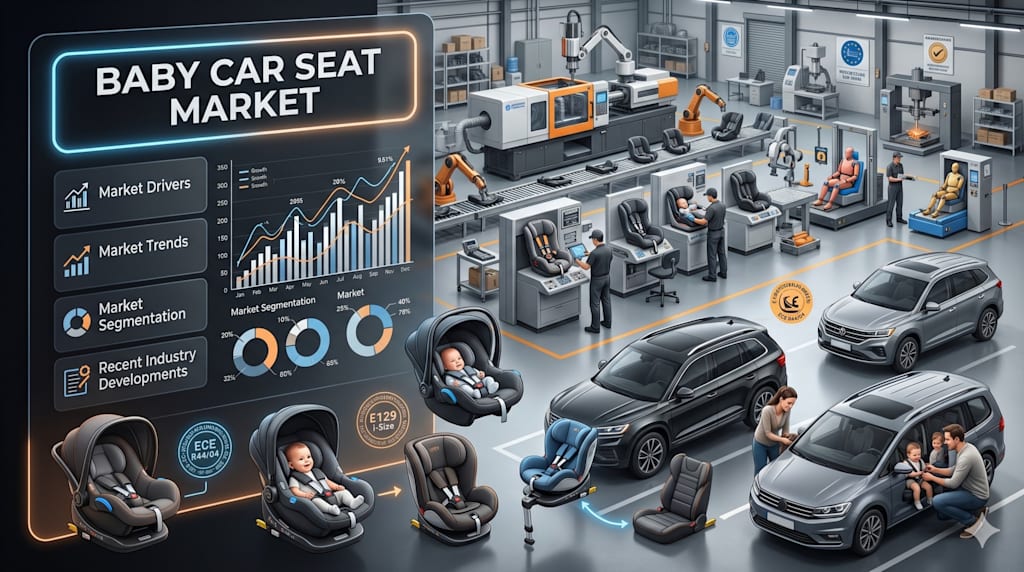
According to IMARC Group's latest research publication, The global baby car seat market size was valued at USD 5.9 Billion in 2025. Looking forward, IMARC Group estimates the market to reach USD 8.3 Billion by 2034, exhibiting a CAGR of 3.66% from 2026-2034.
How AI is Reshaping the Future of Baby Car Seat Market
- Smart Safety Features and Sensor Integration: AI-powered sensors embedded in modern baby car seats are enabling real-time monitoring of installation accuracy, child positioning, and in-cabin temperature conditions. Manufacturers are deploying machine learning systems that alert parents to improper harness use or unsafe seating angles through connected mobile applications. Given that studies indicate 49% of child safety seats are installed or used incorrectly, these intelligent detection systems represent a significant leap in preventing misuse and reducing child passenger fatalities across global markets.
- Predictive Product Development and Consumer Personalization: AI-driven analytics are transforming how baby car seat brands develop and refine their product lines. By processing consumer feedback, safety incident data, and usage behavior at scale, manufacturers can predict which safety features, ergonomic configurations, and material choices resonate most with target demographics. Companies leveraging these tools are shortening product development cycles, improving first-to-market timing, and tailoring seat designs for specific regional regulatory requirements and parental preferences across North America, Europe, and Asia Pacific.
- E-Commerce Optimization and Digital Retail Intelligence: AI algorithms powering e-commerce platforms are reshaping how parents discover, evaluate, and purchase baby car seats. Dynamic recommendation engines analyze browsing behavior, safety certification searches, and price sensitivity to surface the most relevant products for individual buyers. In the United States, eCommerce sales in the segment recorded a 7.2% year-on-year increase, driven in part by AI-enhanced digital retail experiences. Personalized product bundles, automated review aggregation, and intelligent pricing tools are driving higher basket values and stronger brand retention in the online channel.
- Supply Chain Resilience and Demand Forecasting: AI-powered demand forecasting systems are helping baby car seat manufacturers align inventory with fluctuating consumer demand patterns driven by birth rate trends, seasonal buying cycles, and regulatory changes. Machine learning models processing sales history, regional demographic data, and macroeconomic indicators allow brands to reduce overstocking, prevent supply shortages, and maintain consistent product availability across global distribution networks. This capability is especially critical as supermarkets and hypermarkets, which account for approximately 57.85% of distribution channel share, require reliable and predictable supply to sustain prominent shelf positioning.
Baby Car Seat Industry Overview:
Government regulation and rising vehicle ownership are functioning as structural demand engines across every major region of the baby car seat market. In Europe, which holds the largest regional share at 34.2%, mandatory child restraint laws enforced across all member states combined with approximately 10.6 million new car registrations in the EU, representing a 14% increase over the prior period, are directly translating into sustained purchasing requirements for certified child safety seats. Automakers across the region are entering co-development partnerships with baby car seat brands to ensure model compatibility and drive adoption among first-time vehicle buyers. The North American market is similarly shaped by National Highway Traffic Safety Administration mandates requiring age-appropriate restraint systems for all infant and toddler passengers, with hospitals and maternity care centers playing a direct role in educating new parents prior to discharge. In the Middle East and Africa, traffic accidents in the UAE rose 8% to reach 4,748 recorded incidents, prompting governments to tighten child restraint enforcement and invest in road safety awareness campaigns. Across Latin America, where total disposable income is projected to grow by nearly 60% over coming decades, premium baby car seats are steadily transitioning from aspirational purchases to mainstream family expenditures. Asia Pacific is experiencing rapid retail infrastructure expansion, with India alone counting 66,225 supermarkets as of early 2025, a 3.88% increase from the prior period, creating new physical distribution touchpoints that are bringing baby car seat adoption to previously underserved consumer segments.
Baby Car Seat Market Trends and Drivers
The surging preference for convertible and multi-functional baby car seats is one of the primary demand drivers reshaping purchasing behavior across the global market. Parents are increasingly seeking products that transition from rear-facing infant configuration to forward-facing toddler and booster modes, eliminating the need for repeated replacement purchases as the child grows. Infant car seats currently lead with approximately 34.3% of product type share, anchored by hospital discharge protocols that recommend certified restraint systems for newborns from the first journey home. This early adoption behavior creates a strong foundation for long-term brand loyalty, with parents returning to trusted manufacturers as their child advances through developmental stages requiring different seat configurations. Multi-stage convertible designs are gaining particular traction among cost-conscious and space-limited urban families, supported by continuous innovation in harness engineering, side-impact protection systems, and lightweight structural materials that maintain certified safety performance across all seating orientations.
Digital transformation and the explosive growth of e-commerce and direct-to-consumer sales channels are fundamentally reshaping how the baby car seat market reaches its end consumers. Online platforms now offer parents access to comprehensive safety rating comparisons, certification verification, immersive product demonstrations, and peer review ecosystems that were previously only available through in-store specialist consultation. DTC brand strategies are enabling manufacturers to build direct relationships with buyers, gather real-time feedback for product refinement, and offer exclusive online product configurations unavailable through traditional retail formats. Supermarkets and hypermarkets continue to dominate distribution with approximately 57.85% market share, leveraging their physical footprint, bundled promotional offers, and the ability for parents to physically examine seat models before purchase. However, the online channel is growing rapidly as digital literacy rises globally, mobile shopping penetrates new demographics, and subscription-based purchasing models reduce the friction associated with premium product acquisition for budget-sensitive buyers.
Sustainability, premium material innovation, and infrastructure-driven institutional demand are creating additional expansion avenues across the baby car seat market. Eco-conscious parents are increasingly demanding products manufactured from biodegradable fabrics, bio-renewable materials, and modular components designed for disassembly and recycling at the end of the product lifecycle. Manufacturers responding to this shift are securing green certifications, adopting sustainable packaging, and transparently communicating ethical sourcing practices as brand differentiators in a competitive market. Simultaneously, major urban development and hospitality infrastructure projects are generating institutional demand from family-oriented hotels, resort facilities, and rental vehicle operators that require reliable certified child restraint supply. Transportation network improvements in emerging markets are reducing last-mile delivery times and expanding the serviceable geographic footprint for baby car seat distributors, enabling brands to reach secondary cities and rural household segments that were previously inaccessible through conventional retail infrastructure.
Leading Companies Operating in the Global Baby Car Seat Industry:
- Artsana Spa
- Britax Excelsior Ltd.
- Diono LLC
- Dorel Industries Inc.
- Goodbaby International Holdings Ltd.
- Jane Group
- Kiwi Baby
- Newell Brands Inc.
- Nuna International BV
- RECARO Holding GmbH
Baby Car Seat Market Report Segmentation:
By Product Type:
- Infant Car Seats
- Booster Car Seats
- Combination Car Seats
- Convertible Car Seats
Infant car seats lead the product type segment with approximately 34.3% market share, driven by their essential role in newborn safety, mandatory hospital-endorsed adoption protocols, and their rear-facing orientation alignment with global child passenger safety guidelines.
By Distribution Channel:
- Specialty Stores
- Supermarkets and Hypermarkets
- Baby Boutique Stores
- Online Stores
Supermarkets and hypermarkets hold the largest distribution channel share at approximately 57.85%, supported by wide product variety, physical inspection capability, in-store promotional bundling, and extensive geographic reach across urban and suburban markets.
Regional Insights:
- North America (United States, Canada)
- Asia Pacific (China, Japan, India, South Korea, Australia, Indonesia, Others)
- Europe (Germany, France, United Kingdom, Italy, Spain, Russia, Others)
- Latin America (Brazil, Mexico, Others)
- Middle East and Africa
Europe exhibits clear dominance in the baby car seat market with over 34.2% regional share, driven by the region's stringent mandatory child restraint legislation, high consumer awareness, strong premium product preferences, and well-developed specialty retail and hypermarket distribution infrastructure.
Recent News and Developments in Baby Car Seat Market
- February 2025: Graco launched the EasyTurn 360-degree 2-in-1 Convertible Car Seat, its first product featuring a full rotating design for effortless rear-facing to forward-facing transitions. Built under ProtectPlus Engineered safety standards, the seat is designed to accompany children from infancy through toddlerhood within a single certified product.
- January 2025: Evenflo introduced SensorySoothe, an innovative baby car seat technology designed to calm crying infants and reduce parental stress during travel. Integrated into the handle of Evenflo's latest premium car seats, it delivers customizable lights, sounds, and songs controllable via app, voice command, or built-in controls, establishing a new benchmark for sensory comfort innovation in child passenger safety products.
- January 2024: Newell Brands unveiled the Baby Jogger City Turn Convertible Car Seat in Canada, featuring a rotating mechanism that brings the child 10 inches closer to the parent during loading and unloading, combining safety engineering with significant practical convenience for everyday family travel.
Note: If you require specific details, data, or insights that are not currently included in the scope of this report, we are happy to accommodate your request. As part of our customization service, we will gather and provide the additional information you need, tailored to your specific requirements. Please let us know your exact needs, and we will ensure the report is updated accordingly to meet your expectations.
About the Creator
Abhay Rajput
I am working in market research company that provides market and business research intelligence across the globe.
Enjoyed the story? Support the Creator.
Subscribe for free to receive all their stories in your feed.
Comments
There are no comments for this story
Be the first to respond and start the conversation.