
Automotive Switch Market Trends: How Smart Vehicles Are Creating New Growth Opportunities
Rising EV adoption, connected car technologies, and advanced safety systems are reshaping the future of automotive controls.

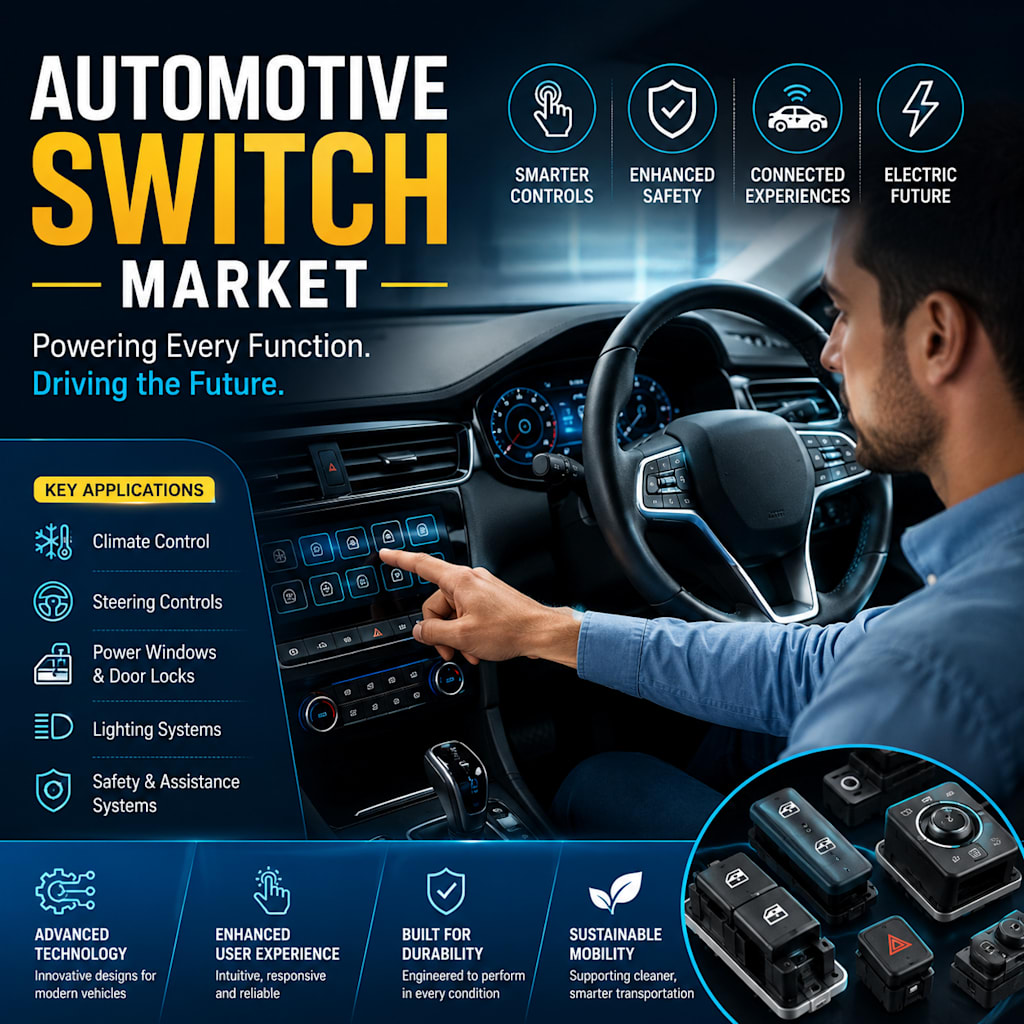
The Little Component That's Changing Everything: Why the Automotive Switch Market Matters More Than Ever
When people think about innovations in the automotive sector, electric vehicles, self-driving technology, massive touchscreens, and sophisticated safety features usually come to mind.
But not many people think about automotive switches.
However, modern cars contain tens, or even hundreds, of switches which are essential to control functions like climate systems, power windows, advanced driver assistance systems, and a multitude of other systems within a car. Essentially, switches serve as the gateway between a driver and the vehicle's technological interior.
With vehicles getting smarter, more connected, and more electrified, automotive switches play a more critical role than ever before, and a component that was once a simple mechanical device has evolved to become an essential part of the driving experience.
A Market Growing With Automotive Technology
The global automotive switch market size is estimated at around 32.1 billion U.S. Dollars in 2025 and will likely reach 46.3 billion U.S. Dollars in 2034.
Even though the annual growth rate of approximately 4% may seem modest, it signifies something very important: Automotive switches are core components that complement every major automotive technology. Regardless of whether it is powered by a gasoline, electric, or alternative energy system, a vehicle must have switches to control operations. As global vehicle production increases, the demand for smart switches will continue to rise.
The Changing Role of the Automotive Switch
Vehicle control used to be simple. You just pressed physical buttons, turned knobs, or flip toggles switches on or off.
But this is not the case with modern vehicles, which now feature:
* Digital instrument clusters
* Touch sensitive controls
* Smart climate controls
* Infotainment platforms
* Voice assistants
* Driver assistance systems
To control these advanced systems, more advanced switches have been developed by automakers to create a fluid user experience. Manufacturers are integrating touch sensitive panels, backlit controls, haptic feedback features and even gesture based control technology to enhance vehicle operation. As the automotive industry transforms, so does the automotive switch.
Electric Vehicle Expansion Creates New Opportunities
The automotive switch market is one that is heavily influenced by the growth of electric vehicles (EVs).
EVs have systems like those shown below which require individual switches for control:
* Charging controls
* Power distribution
* Battery performance monitoring
* Energy usage monitor
* Regenerative breaking controls
Each of these systems requires a switch to control them. Moreover, most EV manufacturers favor a minimalist design in the cabin that would benefit from sophisticated and digital interfaces. This is the driving force behind an increase in demand for highly integrated, advanced switch technology. With the world moving more towards the use of electric vehicles, manufacturers of automotive switches are receiving more opportunities to produce switches designed for this market.
Vehicle Safety Takes Top Priority
Modern cars are all about safety. Customers increasingly expect their vehicles to come equipped with safety features that aid in the prevention of accidents and help drivers operate their cars more comfortably and confidently. Safety systems that are frequently found in modern vehicles include:
* Adaptive cruise control
* Parking assistance
* Lane departure warnings
* Blind spot monitoring
* Emergency braking systems
All of these safety features rely on control interfaces and systems that need to use switches. As manufacturers invest more into the implementation of safety technology, the demand for durable, high quality, user friendly switches is increasing.
The Impact of the Connected Car on Driver Experience
The future is a connected one and the automotive industry is quickly catching up. Cars are beginning to operate more like smartphones, connecting to cloud services, navigation systems, your personal devices and smart home appliances. This has drastically altered consumer expectations of the car's control interface. Consumers want their vehicle to operate as seamlessly as the technology they use every day. To facilitate this, manufacturers of automotive switches are heavily investing in the technology of capacitive touch controls, programmable interfaces, and multi-functional switches.
Climate Control Remains a Large Segment
Although the futuristic aspects of the auto industry often get the spotlight, climate control is still one of the most dominant segments of the auto switch market. The switches which control HVAC (heating, ventilation and air conditioning) systems account for the largest percentage of sales. Drivers and passengers have strict expectations of their car's interior temperature, and expect that they can always control the system. As climate controls evolve, so does the switch. Many modern cars today have:
* Multi- zone control of the climate systems
* Automatic climate control adjustments
* Energy saving settings for the AC and heating system
* Air quality monitoring
All these new features will boost the demand for switches and their related technology.
Asia Pacific dominates the market
The Asia Pacific region currently dominates the global market for auto switches, thanks to strong automotive manufacturing industries and increasing vehicle ownership. Countries like China, Japan, India and South Korea, along with other nations within the region are responsible for the production and demand for over half of the world's auto switches. Several factors contribute to the region's market dominance including a well developed automotive infrastructure, increasing personal disposable incomes and an appetite for new technology in markets such as China.
The competition has spurred incredible innovation
Automotive switch markets are very competitive, causing brands to invest billions in research and development to improve switches. The most critical factors that are driving the innovation for these switches are enhancing durability and tactile feedback, enabling greater customization and the use of illuminations, increasing the switches' ability to withstand environmental hazards and integration with new technology to improve user experience. Manufacturers are also working closer than ever with automakers to design custom switch systems to fit various vehicle models and brands. This level of innovation and collaboration helps to increase demand for the product, ultimately advancing the entire automotive industry.
What's next?
As autonomy in vehicles progresses and vehicle interiors evolve to become areas of comfort and entertainment rather than traditional controls and driver responsibilities, there are numerous innovative ways that automotive switches can be integrated. Fully customizable controls that are controlled by gestures, voice and artificial intelligence (AI) based touch panels are just some of the possibilities. While physical switches may still have a place, their role will change and evolve in line with the changing automotive industry. The switches of the future will be used not just to switch a function on and off, but to create a fully immersive interaction between people and their vehicle.
In Conclusion
Automotive switches may not grab as much attention as electric batteries, self driving systems, or infotainment interfaces but these little components are among the most important parts of any car. They act as the direct link between drivers and the technologies found within their vehicles to provide both an interactive and enjoyable driving experience, along with increased vehicle safety and comfort. In a future that is clearly becoming more electrified, more connected, and more autonomous, demand for smart automotive switches is set to escalate even further. While the market operates behind the scenes, its role in the future of automobiles is too significant to ignore.
As vehicles become smarter, more connected, and increasingly autonomous, even the smallest components are being reimagined. Automotive switches may operate behind the scenes, but their evolution offers a fascinating glimpse into the future of mobility.
About the Creator
Robert
Senior Market Researcher at IMARC Group, specializing in global market analysis, industry trends, and data-driven insights across diverse sectors.
Enjoyed the story? Support the Creator.
Subscribe for free to receive all their stories in your feed.
Comments
There are no comments for this story
Be the first to respond and start the conversation.