
Australia Vegan Food Market Is Moving From Niche to Mainstream
Valued at US$ 377.13 million in 2024 and projected to reach US$ 857.04 million by 2033, Australia’s vegan food market is gaining momentum through health-driven demand, sustainability concerns, and rapid product innovation.

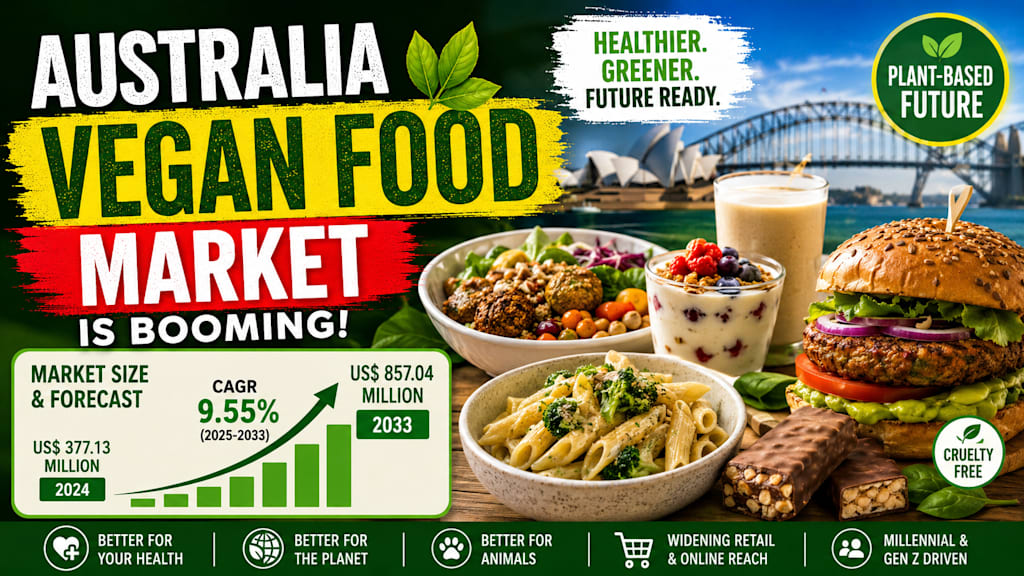
Australia’s vegan food market is no longer a quiet corner of the grocery aisle. It is becoming a visible part of everyday consumer behavior, supported by a stronger appetite for plant-based eating, a wider retail presence, and a growing belief that food choices should align with health, ethics, and sustainability. According to the market brief, the sector is expected to rise from US$ 377.13 million in 2024 to US$ 857.04 million by 2033, advancing at a CAGR of 9.55% between 2025 and 2033. The report also points to millennial and Gen Z shoppers, animal welfare concerns, environmental sustainability, rising health awareness, lactose intolerance, and strong retail and online distribution as key demand drivers.
What is happening in Australia is part of a broader change in how people think about food. Vegan food, as defined in the report, excludes meat, dairy, eggs, and honey and relies instead on ingredients such as fruits, vegetables, grains, legumes, nuts, and seeds. That shift has helped expand the category far beyond a small group of committed vegans. Today, flexitarians, health-conscious families, environmentally aware buyers, and consumers who are simply trying to reduce animal-based foods are all contributing to the rise in plant-based purchasing.
The strongest force behind this growth is health consciousness. The report says around 6.5 million Australians are reducing their meat intake, and 79% of them consume plant-based meals at least once a week. That is a meaningful signal for the food industry because it shows vegan and plant-based foods are no longer tied only to ideology. They are being adopted as practical, everyday choices. The same brief also notes that plant-based meat alternatives in Australia have grown five times since 2015, a sign that consumers are increasingly open to trying meat-free substitutes that still fit familiar meal occasions.
Environmental awareness is another major accelerant. Australian consumers, especially younger ones, are paying more attention to the environmental impact of their meals. Plant-based foods are often viewed as lower-impact alternatives because they generally use fewer resources and create fewer emissions than animal-based foods. Brands are responding by emphasizing sustainability in their packaging, sourcing, and messaging. This is one reason vegan food has become more than a trend: it is now part of a larger lifestyle conversation about carbon footprint, responsible consumption, and cleaner food systems.
Ethical concerns also continue to shape demand. The report highlights animal welfare as a meaningful driver, noting that public reactions to cruelty-related footage from slaughterhouses have increased interest in cruelty-free food options. For many consumers, vegan products are appealing not only because they are plant-based, but because they represent a food choice that feels more consistent with personal values. That emotional connection matters, because it often turns first-time trial into repeat purchase.
The market is also being supported by retail availability and product innovation. Supermarkets, hypermarkets, convenience stores, specialty outlets, and online channels are making vegan products easier to find. At the same time, companies are investing in better taste, improved texture, cleaner labels, and more familiar formats such as sausages, mince, plant milk, yogurt, and cheese alternatives. The report’s segmentation shows how broad the category has become: product types include dairy alternatives, meat substitutes, and others; source inputs include almond, soy, oats, wheat, and other plant bases; and distribution runs across supermarkets and hypermarkets, convenience stores, specialty stores, online stores, and more.
Still, the category is not without friction. Price remains one of the biggest barriers. Plant-based foods often cost more than conventional animal-based items because of ingredient costs, smaller production scale, and logistics. Taste and texture are also important hurdles, especially for consumers who are curious but cautious. If a vegan burger, sausage, or dairy alternative feels too far removed from the conventional product it is replacing, repeat sales can suffer. That means the market’s next stage of growth will depend not just on ethical appeal, but on convenience, price parity, and better sensory performance.
The company landscape reflects that same mix of opportunity and competition. The report identifies Beyond Meat Inc., Danone S.A., The Archer Daniels Midland Company, Tofutti Brands Inc., Vitasoy Australia Products Pty Ltd., SunOpta, and Daiya Foods, Inc. among the key players being tracked. That roster shows how the market spans global brands, dairy-alternative specialists, ingredient suppliers, and local market participants. It also suggests that future gains will likely come from both product leadership and distribution strength.
10 recent company developments shaping the vegan food space
Beyond Meat introduced its Beyond IV platform in February 2024, presenting its fourth-generation plant-based meat platform as a major step forward in taste and nutrition.
Beyond Meat launched its Beyond Sun Sausage line at Whole Foods in November 2024, expanding distribution for a new plant-based sausage product that quickly gained traction in natural grocery retail.
Beyond Meat debuted Beyond Immerse Protein Drink in January 2026, moving beyond meat analogues and into plant-based protein beverages.
Danone opened its new Daniel Carasso Research and Innovation Center, with a dedicated focus on innovation in fresh dairy and plant-based products.
Danone also introduced Dairy & Plants Blend baby formula, a product positioned as the first of its kind specifically designed for a vegetarian diet and built with more than half of its required protein derived from soy.
Danone’s Alpro brand announced a major investment to make its oat drink from 100% British oats, reinforcing the shift toward localized sourcing and supply-chain storytelling in plant-based beverages.
SunOpta announced a US$ 26 million expansion of its California facility in July 2024, aimed at increasing oat milk production by 60% and supporting stronger plant-based beverage output.
Daiya launched dairy-free cream cheese packets for foodservice operators in May 2025, targeting convenience and portion control for restaurants and foodservice channels.
Daiya also introduced a new line of dry powdered mac & cheese in March 2024, expanding its dairy-free portfolio with a more familiar comfort-food format.
In Australia, Vitasoy introduced a new oat yogurt line made with Australian-grown oats, strengthening the local plant-based dairy alternative story and leaning into domestic sourcing.
Two additional Australia-specific developments from the market brief also deserve attention. In November 2024, Harvest B established Australia’s first plant-based meat ingredient production facility in Penrith, New South Wales, helping reduce reliance on imported plant proteins. In September 2024, vEEF launched carbon-neutral plant-based meat products at Woolworths, including beef mince and sausages, with price positioning close to animal meat and packaging designed to use less plastic. These moves show how local players are trying to solve the industry’s two biggest questions: affordability and scale.
That last point matters. For all the talk about values and lifestyle, the vegan category will only truly scale if it becomes easy to buy, easy to cook, and easy to justify on price. Australia’s market is moving in that direction. More products are showing up in mainstream retailers. More brands are investing in local production. More buyers are trying plant-based foods without needing to identify as vegan. And more companies are designing products that compete directly with the taste, convenience, and cost of traditional protein and dairy options.
The result is a market that feels like it has crossed an important line. It is no longer dependent on a small, niche audience. Instead, it is being shaped by a broader consumer shift toward flexitarian eating, cleaner labels, and practical sustainability. Dairy alternatives and meat substitutes are likely to remain the core categories, but the real story is bigger than categories. It is about how food culture is changing in Australia, one plant-based choice at a time.
Final Thoughts
The Australia vegan food market is entering a more mature phase. Growth is still being powered by health, sustainability, and ethics, but the next wave will depend on execution: better taste, better value, stronger local manufacturing, and smarter retail placement. With a projected value of US$ 857.04 million by 2033, the opportunity is significant, but so is the competitive pressure. Brands that can combine purpose with performance are the ones most likely to win in the years ahead.
About the Creator
Enjoyed the story? Support the Creator.
Subscribe for free to receive all their stories in your feed.
Comments
There are no comments for this story
Be the first to respond and start the conversation.