
Australia Goat Milk Market: Why This Niche Dairy Category Is Quietly Building Strong Momentum
With rising demand for low-lactose nutrition, infant formula innovation, and premium dairy alternatives, Australia’s goat milk industry is moving from niche shelves toward broader consumer relevance. The market is projected to grow from US$ 231.99 million in 2024 to US$ 342.1 million by 2033, at a CAGR of 4.41% between 2025 and 2033.

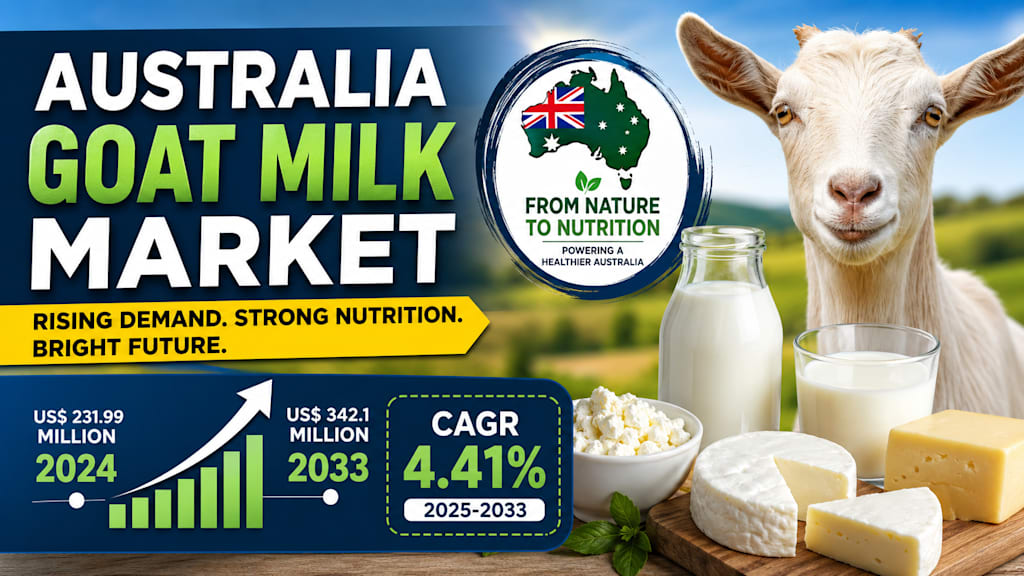
Australia’s goat milk market is entering a more confident growth phase, shaped by changing consumer preferences, nutrition-led buying habits, and the widening presence of specialty dairy products. Once seen as a narrow alternative for a small group of health-focused buyers, goat milk is now finding a stronger identity in the broader dairy conversation. It is benefiting from the rise of low-lactose diets, the search for more digestible dairy options, and the steady premiumization of food and beverage purchases across the country. According to the market brief, Australia’s goat milk market is expected to rise from US$ 231.99 million in 2024 to US$ 342.1 million by 2033, reflecting a CAGR of 4.41% from 2025 to 2033.
What makes this story important is that the growth is not being driven by just one factor. It is a combination of health awareness, changing family nutrition choices, stronger product variety, and wider distribution through specialty stores and online channels. The market is also being supported by the growing interest in value-added dairy formats such as goat milk powder, cheese, flavored milk, and infant formula. In other words, this is no longer a single-product story. It is becoming a broader category story.
The strongest advantage for goat milk in Australia is its health positioning. The market brief highlights its richness in calcium, iron, potassium, and other nutrients, along with its digestive benefits and suitability for people looking for low-lactose options. It is also being associated with better tolerance compared with conventional cow milk, which gives it a practical edge for consumers who want dairy but are cautious about digestion or sensitivity. That message is especially relevant in a market where people are increasingly reading labels, comparing ingredients, and paying attention to how food fits into everyday wellness routines.
This is one of the reasons the product has grown beyond a wellness niche. Goat milk now sits at the intersection of nutrition, convenience, and premium food culture. Consumers who once treated it as an occasional purchase are starting to see it as a functional household product. That shift matters because dairy categories often grow when consumers stop seeing them as “specialty only” and start seeing them as part of a regular shopping basket. Australia’s goat milk market is still in that transition, but the direction is clearly positive.
A major growth engine in the category is infant formula. The file indicates that goat milk-based infant formula is gaining popularity because of its digestibility and lower allergic potential, especially among parents seeking a gentler formula choice for babies with mild sensitivity or lactose-related discomfort. That is a powerful segment because infant nutrition is a trust-driven market. Once parents become confident in a product category, they often show repeat demand. Goat milk formula also benefits from a broader perception of being closer to natural nutrition, which helps it stand out in a highly scrutinized category.
Another important growth area is value-added products. The market brief mentions flavored milk, reduced sugar and reduced fat variants, cheese, yogurt, milk powder, and personal care applications such as soaps, creams, and lotions. This diversification is important because it reduces reliance on one product format. Goat milk cheese, for example, opens the category to consumers who may not buy liquid milk often but are willing to buy gourmet or functional dairy products. Goat milk powder, meanwhile, expands shelf life and improves convenience, making the category more adaptable to household and commercial needs.
The distribution picture is also improving. The report points to hypermarkets and supermarkets, convenience stores, specialty stores, medical and pharmacy stores, and online channels as key routes to market. That is significant because goat milk has historically depended on narrower retail access. The more it appears in mainstream retail and digital commerce, the easier it becomes for consumers to discover it, compare brands, and repurchase it. Specialty stores may still play a key role in trust-building, but online and pharmacy channels can help accelerate category awareness and trial.
Still, the market is not without pressure points. Competition remains intense from both cow milk and plant-based alternatives. Cow milk has scale, familiarity, and pricing advantages. Plant-based products have strong appeal among younger consumers, flexitarians, vegans, and sustainability-conscious buyers. Goat milk sits in a difficult middle position: it has stronger nutrition credentials than many plant-based options, but it often lacks the price advantage of standard dairy and the lifestyle branding of plant-based competitors. That means the category has to win on trust, digestion, and premium nutrition rather than on price alone.
Environmental challenges also matter. Australia’s climate variability can affect feed quality, herd health, and milk output. Drought, heat stress, and rainfall inconsistency can all disrupt production and raise costs. For goat dairy farmers, this creates a practical challenge: maintaining consistent supply in a market where consumers and retailers still expect reliability. Climate resilience, herd management, and better supply planning will be essential for long-term growth. A category may have healthy demand, but if supply is unstable, scale becomes harder to sustain.
From a consumer perspective, goat milk’s biggest long-term opportunity is education. Many shoppers still need a clearer reason to switch, and that reason cannot just be “it is different.” It has to be “it fits my needs better.” The market brief shows that nutrition awareness, digestive comfort, and health-conscious consumption are central to the category’s momentum. That means the strongest brands will be the ones that explain benefits clearly, use packaging to simplify the value proposition, and build trust through consistency and quality.
The segmentation of the market also reveals where the industry can grow next. Milk remains the core format, but cheese and milk powder can deliver stronger margin opportunities and broader use cases. Organized players will likely continue to gain share as the category matures, because organized distribution offers better branding, packaging, and shelf visibility. At the same time, specialty stores and online platforms can help premium brands tell a more complete story around origin, purity, and health value.
Looking at the competitive landscape, the report identifies companies such as Ausnutria Dairy Corporation Ltd., AVH Dairy Trade B.V., Goat Partners International, Granarolo S.p.A., Meyenberg, Redwood Hill Farm & Creamery, and St Helen’s Farm. These names suggest a market that is still international in flavor, with brands bringing different strengths in dairy expertise, product diversity, and specialty positioning. For Australia, the competitive challenge is not only to stock imported or established brands, but also to build local recognition and consumer loyalty around Australian-sourced or Australia-optimized goat milk products.
Here is how the next phase of the market is likely to unfold. First, premium positioning will remain central, especially in health food and specialty channels. Second, infant formula will continue to be one of the most strategically important growth segments. Third, product diversification will matter more than ever, because companies that rely on one format will be more vulnerable to pricing pressure. Fourth, digital visibility and e-commerce discovery will increasingly shape consumer adoption. Finally, supply stability and climate-adaptive farming practices will determine how quickly the market can scale without disruption.
10 recent company developments and market moves to watch
More brands are widening their product lines beyond plain milk into cheese, powder, yogurt, and value-added dairy.
Infant formula remains a major innovation focus, especially for digestibility-led positioning.
Reduced-sugar and reduced-fat formats are becoming more important as consumers watch nutrition labels.
Specialty health food retail is helping brands build credibility before they expand into mainstream channels.
Online distribution is gaining importance for discovery, comparison, and repeat buying.
Personal care uses such as soaps and creams are giving goat milk a second life outside the dairy aisle.
Premium branding is becoming stronger as companies frame goat milk as a natural, high-quality dairy choice.
Organized market players are likely to gain more visibility as packaging, compliance, and shelf presence improve.
Companies with strong international dairy expertise are influencing product standards and category expectations.
Brands that communicate digestibility and low-lactose value clearly are better positioned to convert first-time buyers into repeat customers.
The broader message is simple: Australia’s goat milk market is no longer just a niche dairy story. It is becoming a wellness, infant nutrition, and premium food category with real commercial depth. The forecast to 2033 points to steady rather than explosive growth, but that kind of growth can be even more valuable because it is built on durable consumer needs rather than short-lived trends. As health awareness rises and product availability improves, goat milk looks increasingly likely to hold a stronger place in Australia’s evolving dairy landscape.
Final Thoughts
Australia’s goat milk market has reached an important turning point. Demand is being supported by health-conscious shoppers, lactose-sensitive consumers, parents exploring infant formula options, and premium buyers looking for something beyond conventional dairy. The market still faces strong competition and climate-related supply risks, but its fundamentals are encouraging. With better retail access, stronger product innovation, and clearer consumer education, goat milk can move from a niche choice to a more established part of Australia’s dairy future.
About the Creator
Enjoyed the story? Support the Creator.
Subscribe for free to receive all their stories in your feed.
Comments
There are no comments for this story
Be the first to respond and start the conversation.