
Augmented Reality Gaming Market Surges as Mobile Technology Redefines Interactive Entertainment
Smartphone adoption, immersive gaming experiences, and AR innovation are expected to push the augmented reality gaming market beyond US$ 102 Billion by 2034

The global gaming industry is evolving rapidly, and augmented reality gaming is emerging as one of its most exciting growth segments. By blending virtual elements with real-world environments, augmented reality (AR) gaming is changing how people experience entertainment, social interaction, and digital storytelling.
What once seemed like experimental technology has now become a mainstream gaming trend powered by smartphones, wearable devices, high-speed internet, and increasingly advanced AR software platforms.
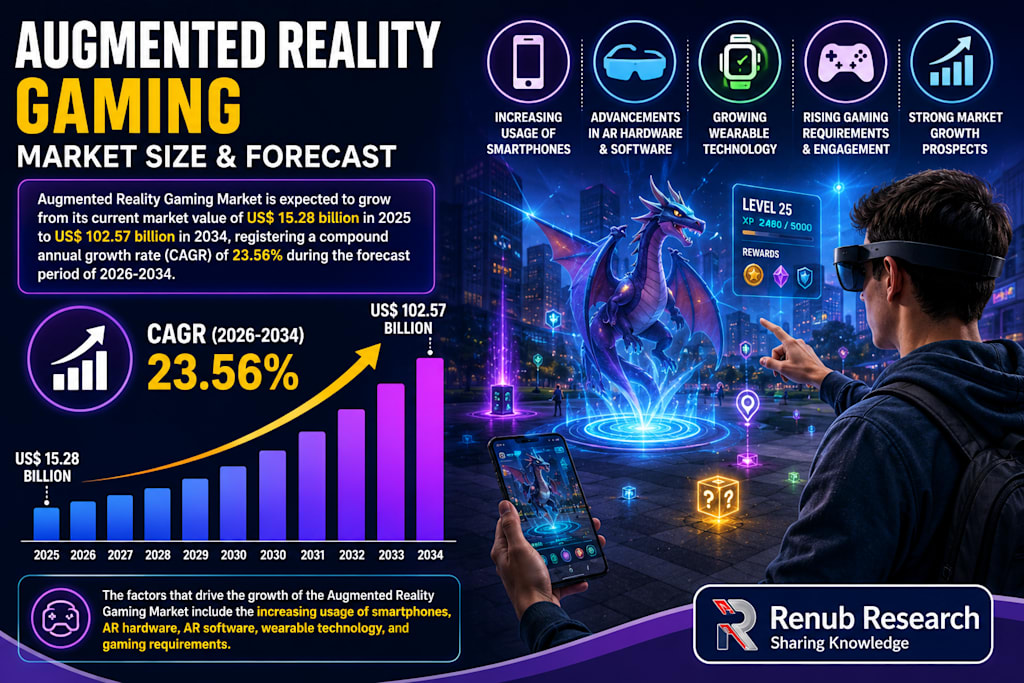
According to the Renub Research market brief provided, the global augmented reality gaming market is projected to grow from US$ 15.28 Billion in 2025 to US$ 102.57 Billion by 2034, expanding at an impressive compound annual growth rate (CAGR) of 23.56% from 2026 to 2034.
This remarkable growth reflects rising demand for immersive entertainment, continuous improvements in mobile hardware, and the increasing popularity of socially interactive gaming experiences across global markets.
Augmented reality gaming is reshaping digital entertainment
Augmented reality gaming allows digital characters, objects, and visual effects to appear within the real environment using devices such as smartphones, tablets, AR glasses, and wearable technologies. Unlike virtual reality, which fully immerses users in a completely digital environment, AR gaming enhances the real world while allowing players to remain aware of their physical surroundings.
This hybrid experience is one of the key reasons AR gaming has gained popularity so quickly.
Gamers can interact with virtual content while moving through real-world locations, creating a unique combination of digital immersion and physical engagement. This has made AR gaming especially attractive for location-based gameplay, social interaction, outdoor gaming activities, and interactive storytelling experiences.
As technology becomes more sophisticated and accessible, AR gaming is evolving from a niche category into a major force within the global gaming industry.
Smartphones are driving mass adoption
One of the biggest reasons behind the rapid expansion of the AR gaming market is the global growth of smartphone usage.
Modern smartphones now include high-resolution cameras, advanced processors, GPS systems, motion sensors, and AI-powered capabilities that support seamless augmented reality experiences. This allows millions of users to access AR gaming without purchasing expensive specialized equipment.
The Renub Research brief notes that there are currently more than 3.2 billion active mobile gamers globally, with that number expected to rise even further. This enormous user base provides a powerful foundation for AR gaming growth.
The combination of mobile accessibility and widespread internet connectivity has made AR gaming one of the most scalable forms of interactive entertainment.
Developers are increasingly optimizing AR games specifically for smartphones because mobile platforms allow faster adoption, broader geographic reach, and lower barriers to entry.
5G and cloud computing are enhancing the experience
Technological advancements beyond smartphones are also playing a major role in AR gaming growth.
The expansion of 5G networks is improving mobile internet speed, reducing latency, and enabling smoother real-time interactions within AR environments. Faster connectivity is particularly important for multiplayer experiences, location-based gaming, and cloud-powered AR applications.
Cloud computing is another important factor. AR games often require large amounts of processing power for spatial mapping, object recognition, rendering, and real-time interaction. Cloud infrastructure helps offload some of these tasks, improving performance while reducing hardware limitations on mobile devices.
This technological combination allows developers to build more visually rich and interactive gaming environments that feel increasingly realistic and responsive.
As network infrastructure improves globally, AR gaming experiences are expected to become more sophisticated and immersive.
Wearable AR devices are opening new possibilities
Although smartphones currently dominate the market, wearable AR devices are gradually expanding the industry’s future potential.
Smart glasses, head-mounted displays, and AR gaming wearables are creating entirely new forms of interactive entertainment. These devices provide more immersive experiences by integrating digital content directly into a player’s field of vision.
The report highlights the January 2026 launch of ASUS Republic of Gamers’ ROG XREAL R1 gaming glasses featuring a 240Hz micro-OLED display designed specifically for gaming applications.
Innovations like these suggest that AR gaming hardware is moving toward more advanced, high-performance systems capable of delivering deeper immersion and richer gameplay experiences.
As hardware becomes lighter, more comfortable, and more affordable, wearable AR gaming could become a much larger segment of the industry over the next decade.
Social interaction is becoming central to gaming
One of the defining characteristics of augmented reality gaming is its social and interactive nature.
Unlike traditional mobile games that are often isolated experiences, AR gaming encourages players to interact with their surroundings and with other users in real-world environments. This creates highly engaging social experiences that are difficult to replicate through conventional gaming formats.
Location-based gameplay, real-time collaboration, and community interaction have become major attractions within AR gaming ecosystems.
The report notes that growing consumer demand for immersive and socially interactive experiences is one of the market’s strongest growth drivers. Gamification of physical activities and public events is also increasing interest in AR entertainment globally.
Brands and entertainment companies are also increasingly using AR experiences for marketing, promotions, and fan engagement, further strengthening public interest in the technology.
Investments in immersive entertainment are accelerating
The broader immersive entertainment industry is attracting major investment activity.
Technology companies, gaming studios, and venture capital firms are increasingly supporting AR and VR gaming startups due to strong long-term growth expectations.
The report highlights a February 2024 investment by Alphabet’s venture capital division GV into StatusPro, a VR sports startup, alongside support from other investors and sports personalities including LeBron James.
Although VR and AR represent different technologies, both sectors benefit from growing consumer demand for immersive digital experiences.
These investments suggest that major technology and entertainment companies view immersive gaming as a critical part of the future digital economy.
Hardware limitations still affect user experience
Despite strong growth potential, the AR gaming market still faces important technical challenges.
One of the biggest issues involves hardware limitations on consumer devices. Not all smartphones are capable of supporting advanced AR applications smoothly. Processing limitations, overheating, battery drain, and device compatibility problems can negatively affect the gaming experience.
AR wearables also face challenges related to comfort, usability, and long-term usage fatigue.
For the industry to achieve broader adoption, hardware manufacturers will need to continue improving battery efficiency, processing power, ergonomics, and affordability.
As device performance improves over time, many of these limitations are expected to become less severe.
Privacy and safety concerns remain important
Privacy and safety concerns are another major challenge for the AR gaming industry.
Many AR games rely heavily on GPS tracking, camera access, environmental mapping, and location-based services. This creates concerns around data privacy, personal security, and user safety.
There are also concerns about distraction-related accidents in public spaces while players engage with AR environments.
Developers increasingly need to balance immersive gameplay with responsible design practices, stronger data protection measures, and safer interaction systems.
Regulatory attention surrounding child protection, digital privacy, and location-based technologies may also become more important as the market expands further.
Software is becoming the foundation of AR gaming
The software segment remains one of the most important components of the AR gaming industry.
AR gaming software includes game engines, development platforms, content creation tools, and middleware systems that support real-time rendering, spatial mapping, and interactive gameplay.
Continuous improvements in software are allowing developers to integrate artificial intelligence, cloud analytics, and personalization features into gaming environments.
Cross-platform compatibility is also improving, allowing AR games to operate across smartphones, tablets, wearables, and other connected devices.
Live content updates, downloadable expansions, and in-game monetization systems are further strengthening revenue opportunities for developers and publishers.
As AR experiences become more advanced, scalable software platforms will remain critical to industry growth.
Mobile AR gaming dominates the market
Among all device categories, mobile AR gaming currently represents the largest and fastest-growing segment.
Smartphones offer accessibility, portability, and massive global reach, making them ideal platforms for mainstream AR adoption.
The freemium business model used by many mobile games also supports rapid user acquisition. App stores allow developers to distribute AR games globally while generating revenue through advertising, subscriptions, and in-app purchases.
Advances in mobile graphics, battery life, and processing capabilities continue improving the overall user experience.
Because of these factors, mobile devices are expected to remain the primary growth engine for the AR gaming market in the near future.
Adventure and puzzle games are gaining popularity
Different AR game genres are evolving rapidly as developers experiment with immersive gameplay mechanics.
Adventure games are becoming increasingly popular because they combine storytelling, exploration, location-based interaction, and social engagement. Players can interact with virtual missions and characters layered onto real-world environments, creating highly immersive experiences.
Puzzle games are also performing strongly because AR adds a physical dimension to problem-solving and cognitive gameplay. These games appeal not only to traditional gamers but also to educational users and families seeking interactive learning experiences.
As developers continue exploring new forms of interactive entertainment, genre diversity within AR gaming is expected to expand significantly.
Regional markets are growing at different speeds
The United States remains one of the world’s most advanced AR gaming markets due to strong smartphone penetration, widespread internet access, and a highly developed gaming ecosystem.
The report notes that eWorld Companies acquired 21 Moves Gaming Studios in January 2024 to strengthen its position in AR, VR, and multimedia gaming development.
The United Kingdom market benefits from a strong digital entertainment culture and high engagement with mobile gaming. AR applications in tourism, museums, and education are also contributing to broader market growth.
India represents one of the fastest-growing AR gaming opportunities globally because of its young population, affordable smartphones, and expanding mobile internet access. Nazara Technologies’ move into VR and immersive multiplayer gaming highlights the country’s growing interest in advanced gaming experiences.
Saudi Arabia is also emerging as a promising market due to strong digital transformation initiatives, growing smartphone penetration, and increasing investment in entertainment infrastructure.
The future of gaming will become increasingly immersive
The augmented reality gaming market is growing because players increasingly want entertainment experiences that feel interactive, social, and connected to the real world.
As AR hardware improves and software ecosystems mature, the line between digital and physical entertainment will continue to blur.
Future growth will likely involve deeper integration between AR, AI, cloud computing, wearable devices, and location-based technologies.
Gaming experiences are expected to become more personalized, immersive, and socially connected than ever before.
Final Thoughts
The global augmented reality gaming market is entering a powerful growth phase driven by smartphone adoption, immersive entertainment demand, and rapid technological innovation.
With the market projected to expand from US$ 15.28 Billion in 2025 to US$ 102.57 Billion by 2034, AR gaming is becoming one of the fastest-growing segments within the global entertainment industry.
Although hardware limitations, privacy concerns, and technical challenges remain, ongoing advancements in mobile technology and AR platforms are expected to keep driving the market forward.
About the Creator
Enjoyed the story? Support the Creator.
Subscribe for free to receive all their stories in your feed.
Comments
There are no comments for this story
Be the first to respond and start the conversation.