
Atomic Clocks Are Everywhere. Nobody Told You That
From GPS satellites to 5G towers, atomic timing is the hidden infrastructure keeping the modern world synchronised.

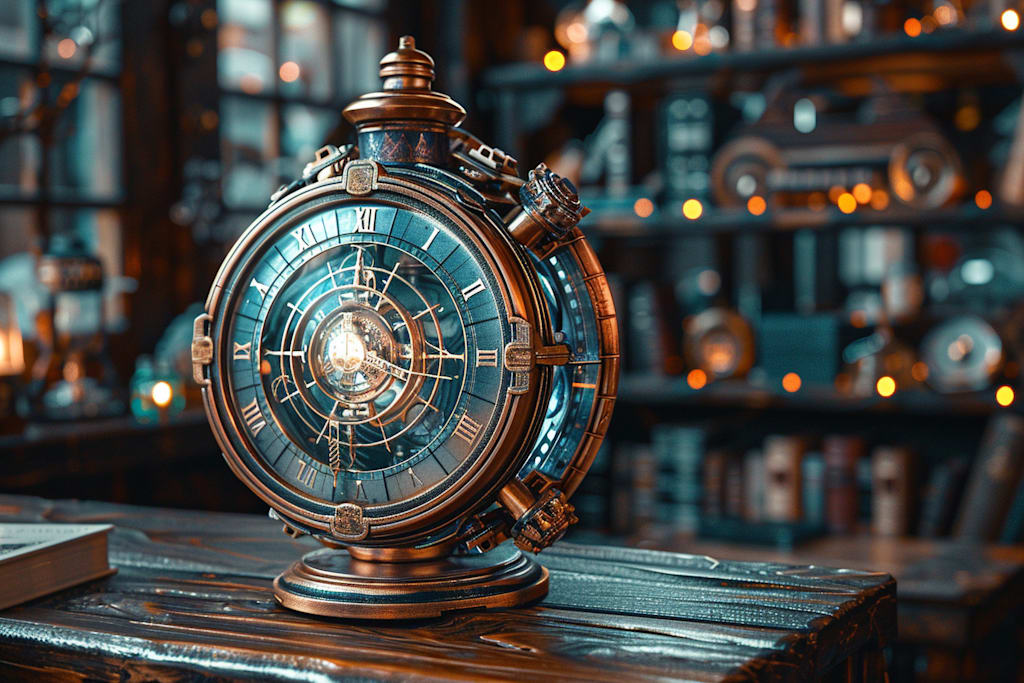
Atomic Clocks Are Everywhere. Nobody Told You That.
The banking system processed your last transaction in a window smaller than a millisecond. Not because the computers are fast — they are — but because every node in that network is synchronized to within nanoseconds by an atomic clock signal it never stops receiving. Pull that signal, and high-frequency trading platforms, mobile payment networks, and interbank settlement systems don't slow down. They break.
Most people picture atomic clocks as something NASA keeps in a clean room. The reality is stranger and more pervasive. The Atomic Clock Market was valued at USD 630.3 million in 2025 and is on track to reach USD 1,204.8 million by 2035. That growth doesn't come from physics labs. It comes from 5G towers, GPS satellites, and financial infrastructure that most people use every day without knowing what keeps it accurate.
A detailed breakdown of the segments driving that number is available in this atomic clock market size and share analysis from Market.us.
The GPS Myth Worth Correcting
Ask someone how GPS works and they'll say satellites. That's true but incomplete. GPS is fundamentally a timing network. Each satellite broadcasts a precise timestamp. Your phone measures how long each signal takes to arrive, runs the math across four or more satellites, and produces a location. The position is a byproduct of the timing.
A one-microsecond drift in a satellite's onboard clock translates to 300 meters of positional error on the ground. One microsecond. That's why the U.S. Air Force doesn't use cheaper oscillators aboard GPS satellites. Cesium and rubidium atomic clocks aren't a premium — they're the minimum viable component for the system to work at all.
The defense implications compound this. Precision-guided munitions depend on GPS. Battlefield communications depend on timing synchronization. Electronic warfare depends on frequency accuracy that only atomic standards can reliably provide. Defense and aerospace have dominated the end-user segment of this market for years, and nothing about that is changing soon.
5G Created a Market Nobody Predicted
Here's what the carriers don't advertise: millimeter-wave 5G is an atomic clock problem as much as it is a radio engineering problem. Small cells placed every few hundred meters need nanosecond-level synchronization to avoid collisions between adjacent signals. Without it, the network generates its own interference and performance collapses.
This quietly turned telecom infrastructure into one of the more important demand drivers for rubidium oscillators and chip-scale atomic clocks. Not the dramatic kind of demand — no single contract is worth much — but the steady, compounding kind that scales with every new tower, every new market, every new country rolling out coverage. The Atomic Clock Market research from Market.us identifies chip-scale and rubidium products as the fastest-growing segments specifically because of this telecom tailwind extending through 2035.
Rubidium clocks fit telecom deployment in ways cesium primary standards simply don't. Smaller, cheaper, accurate enough for synchronization requirements, and manufacturable at volumes that match infrastructure rollout timelines. They're not the most precise clocks humans have built. They're the right clocks for the job.
The Australian Startup Trying to Change the Ceiling
In April 2025, a company called QuantX Labs in Australia announced funding of AUD 3.7 million from the federal Moon to Mars program to launch a component of its TEMPO optical atomic clock aboard a SpaceX mission. It's worth pausing on what that sentence means.
Optical atomic clocks — the kind built around ytterbium or strontium atoms rather than cesium — lose one second every 15 billion years. Cesium fountain clocks, considered the gold standard for decades, lose one second every 300 million years. The optical generation isn't an improvement on the existing technology. It's a different category entirely. If QuantX and others can prove these clocks survive the thermal cycling, vacuum conditions, and radiation of low Earth orbit, GPS accuracy improves by orders of magnitude. Deep-space navigation — where current systems accumulate enormous timing errors over vast distances — becomes genuinely tractable.
That's a decade away at minimum. But it's a decade that several well-funded teams are actively working toward.
What Makes This Market Unusually Hard to Enter
Atomic clock procurement is not like buying servers. The installed base of cesium and rubidium devices in satellite constellations, defense networks, and telecom infrastructure has been qualified, tested, and certified over years. Sometimes decades. Swapping in a new timing module isn't a procurement decision — in a satellite context, it requires replacing the satellite.
Incumbents like Microchip Technology, Oscilloquartz, and Orolia benefit from this in ways that don't show up in standard competitive analysis. Their moat isn't brand or switching cost in the conventional sense. It's certification history. Buyers can't take a risk on an unproven vendor when the failure mode is a GPS satellite losing positional accuracy or a defense communication network losing sync during an operation.
New entrants find footholds at the component design level — winning a design-in on a next-generation platform before it launches, not displacing existing infrastructure. As commercial space economics continue to compress launch costs and qualification cycles, those footholds will multiply. But for now, the incumbents have a durability in this market that most technology companies would envy.
About the Creator
Enjoyed the story? Support the Creator.
Subscribe for free to receive all their stories in your feed.
Comments
There are no comments for this story
Be the first to respond and start the conversation.