
ATM Market Set for Steady Growth as Banking Access, Financial Inclusion, and Smart Technologies Reshape Global Cash Infrastructure
From Traditional Cash Dispensers to Intelligent Banking Hubs: Why the Global ATM Industry Continues to Evolve

Although digital payments continue to dominate headlines worldwide, automated teller machines (ATMs) remain a critical part of the global financial ecosystem. Millions of people still rely on ATMs every day to access cash, deposit funds, transfer money, and conduct banking transactions without entering a physical bank branch.
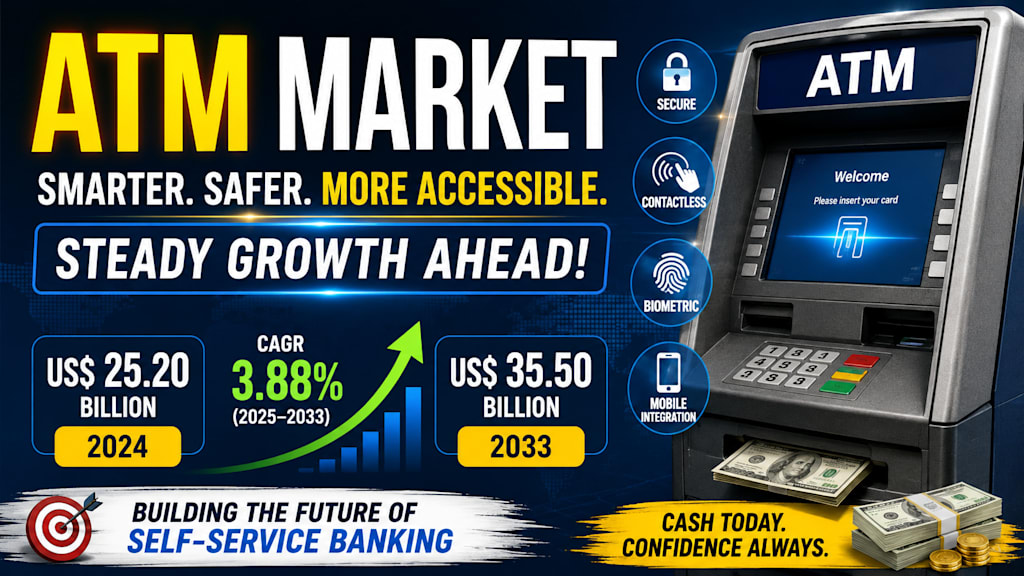
According to Renub Research, the global ATM market is projected to grow from US$ 25.20 billion in 2024 to US$ 35.50 billion by 2033, expanding at a CAGR of 3.88% during 2025–2033. This growth highlights the enduring importance of ATM infrastructure despite the rapid rise of digital and mobile banking. The market is being supported by increasing financial inclusion efforts, technological advancements, expanding banking networks, and the continued demand for convenient cash access across both developed and emerging economies.
Understanding the Role of ATMs in Modern Banking
ATMs have transformed the way consumers interact with financial institutions. What once served primarily as cash withdrawal machines have evolved into multifunctional banking terminals capable of handling deposits, fund transfers, balance inquiries, bill payments, and even biometric authentication.
These self-service banking kiosks operate around the clock, allowing customers to access essential banking services at their convenience. Located in shopping centers, transportation hubs, hospitals, retail stores, airports, and business districts, ATMs help financial institutions extend their reach while reducing operational burdens on physical branches.
As customer expectations shift toward convenience and instant access, ATMs continue to serve as a bridge between traditional banking and modern digital finance.
Market Forecast Signals Long-Term Industry Stability
The ATM industry is not experiencing explosive growth, but it is demonstrating resilience and stability. A projected increase from US$ 25.20 billion in 2024 to US$ 35.50 billion by 2033 reflects steady demand across global markets.
Unlike some financial technologies that quickly become obsolete, ATMs remain deeply integrated into national banking systems. Many governments and financial institutions continue investing in ATM infrastructure because large segments of the population still depend on cash transactions.
Emerging markets, particularly across Asia, Africa, and Latin America, are expected to contribute significantly to future growth as banking access expands into underserved regions.
Financial Inclusion Remains a Powerful Growth Driver
One of the strongest drivers of ATM deployment worldwide is the push toward financial inclusion.
Governments and banking institutions increasingly recognize the importance of providing accessible financial services to rural and underserved communities. In many regions, physical bank branches remain limited, making ATMs a practical and cost-effective solution for expanding banking access.
Through strategic ATM placement, financial institutions can provide essential services to populations that may otherwise face barriers to traditional banking. This approach supports economic participation, encourages savings, and promotes greater financial literacy.
As more individuals enter the formal banking system, ATM demand is expected to remain strong, particularly in developing economies.
Convenience Continues to Influence Consumer Behavior
Convenience remains one of the biggest reasons consumers continue using ATMs.
Unlike traditional bank branches with limited operating hours, ATMs provide uninterrupted access to cash and financial services twenty-four hours a day. This flexibility is especially important for individuals with demanding work schedules or those living in locations where banking facilities are scarce.
Urbanization trends are also contributing to ATM usage. As cities expand and populations become more mobile, consumers increasingly value quick access to cash and self-service banking options.
Even in highly digital economies, many consumers appreciate having immediate access to physical currency for transportation, local commerce, emergencies, and small-value transactions.
Technological Innovation Is Redefining ATM Experiences
The modern ATM bears little resemblance to its earlier versions.
Technology has significantly enhanced ATM functionality, security, and customer experience. Today's machines incorporate advanced features such as:
Touchscreen interfaces
Biometric authentication
Real-time cash deposit capabilities
Contactless transaction support
Mobile banking integration
QR-code-based withdrawals
Enhanced fraud detection systems
These innovations are making ATMs more efficient and user-friendly while reducing security risks.
Biometric technologies, including fingerprint recognition and facial authentication, are becoming increasingly important as banks seek stronger identity verification methods. These systems help reduce fraud while delivering faster and more secure transactions.
Meanwhile, contactless payment technology allows users to interact with ATMs using smartphones and digital wallets, reducing reliance on physical cards.
ATM-as-a-Service Gains Industry Momentum
A notable trend reshaping the ATM landscape is the emergence of ATM-as-a-Service (ATMaaS).
Rather than managing ATM networks internally, financial institutions are increasingly partnering with specialized providers that handle deployment, maintenance, software updates, cash management, and transaction processing.
This model allows banks and credit unions to reduce operational complexity while maintaining high service standards.
ATMaaS solutions also accelerate the adoption of new technologies, enabling institutions to upgrade customer experiences without making substantial infrastructure investments.
As cost efficiency becomes a priority across the banking sector, ATMaaS is expected to gain wider adoption globally.
Emerging Markets Offer Significant Opportunities
Developing economies present some of the most promising opportunities for ATM expansion.
Countries across Asia-Pacific, Africa, and Latin America continue investing heavily in banking infrastructure. Rising incomes, expanding middle-class populations, and government-led financial inclusion initiatives are increasing demand for banking access.
In many of these regions, cash remains a dominant payment method despite growing digital payment adoption.
The combination of increasing bank account ownership and continued cash usage creates favorable conditions for ATM deployment.
Furthermore, independent ATM operators and white-label ATM providers are helping extend banking services into remote locations where traditional branches may not be economically viable.
The Rise of White Label and Brown Label ATM Models
Alternative ATM ownership models are becoming increasingly important within the industry.
White-label ATMs are operated by non-bank entities and provide banking services on behalf of multiple financial institutions. These machines are particularly valuable in areas where banking infrastructure remains limited.
Brown-label ATMs involve shared operational responsibilities between banks and service providers, helping reduce costs while maintaining customer service standards.
Both models support wider financial accessibility and are gaining popularity in emerging markets where rapid expansion is required.
Security Challenges Continue to Shape Industry Strategies
Security remains one of the most critical concerns facing ATM operators worldwide.
Criminals continue developing sophisticated methods to target ATM networks through card skimming, malware attacks, cash theft, and identity fraud.
In response, ATM manufacturers and financial institutions are investing heavily in:
Encryption technologies
Biometric verification
AI-driven fraud monitoring
Secure communication protocols
Real-time transaction analytics
These investments are helping strengthen trust in ATM services while protecting both customers and financial institutions from evolving threats.
Digital Payments Create Both Challenges and Opportunities
The increasing popularity of digital payments presents a complex challenge for the ATM industry.
Mobile wallets, instant payment systems, and contactless transactions have reduced dependence on cash in many markets. As a result, ATM transaction volumes may decline in certain regions.
However, digital transformation is not necessarily reducing ATM relevance.
Instead, many ATM providers are adapting by integrating digital capabilities into their services. Cardless withdrawals, mobile authentication, and seamless banking app integration are helping ATMs remain relevant in an increasingly cashless environment.
Rather than competing with digital banking, modern ATMs are becoming an extension of it.
Regional Outlook: United States Leads ATM Innovation
The United States remains one of the world's largest ATM markets.
With hundreds of thousands of ATMs operating nationwide, the country continues investing in advanced technologies, including contactless services, mobile integration, and enhanced security systems.
Retail partnerships between ATM providers and major commercial chains are further expanding consumer access to banking services. These collaborations ensure that cash remains readily available even as digital payment adoption increases.
The U.S. market is expected to maintain steady growth through ongoing innovation and infrastructure modernization.
India Emerges as a High-Growth ATM Market
India's ATM sector is experiencing significant expansion driven by financial inclusion initiatives, rural banking development, and increasing demand for cash access.
The country's extensive banking transformation efforts continue to support ATM deployment across both urban and rural regions.
White-label ATM operators are playing a particularly important role in extending banking services to underserved communities.
Government programs promoting financial inclusion, combined with rising digital banking adoption, are creating a hybrid financial environment where both cash and digital services coexist.
This balance positions India as one of the most promising ATM markets globally.
United Kingdom and UAE Showcase Industry Evolution
The United Kingdom illustrates how ATM networks can adapt to changing consumer preferences.
While digital payments continue to grow, many communities still depend on cash access. Innovative ATM concepts and multi-bank service models are helping preserve accessibility while improving efficiency.
Meanwhile, the United Arab Emirates demonstrates how advanced technology can enhance ATM functionality. The country has embraced digital transformation initiatives, leading to wider adoption of biometric authentication, NFC-enabled transactions, and cardless banking solutions.
These examples highlight how regional strategies differ while supporting overall market growth.
Competitive Landscape Remains Highly Dynamic
Competition within the ATM market continues to intensify as manufacturers, software providers, and service companies compete to deliver more secure and efficient solutions.
Leading industry participants focus on innovation, strategic partnerships, software modernization, and customer experience enhancements.
Key players include:
Diebold Nixdorf Incorporated
NCR Corporation
HESS Cash Systems GmbH
Hitachi Channel Solutions Corp.
Fujitsu
GRG Banking
Source Technologies
Hyosung TNS Inc.
These companies continue investing in next-generation ATM technologies that align with evolving consumer expectations and regulatory requirements.
10 Recent Developments Shaping the ATM Industry
NCR Corporation expanded ATM service availability through major retail partnerships.
ATM-as-a-Service offerings gained traction among banks and credit unions.
Contactless ATM transactions became increasingly common worldwide.
Biometric authentication solutions expanded across banking networks.
Mobile banking integration improved cardless withdrawal experiences.
White-label ATM deployments accelerated in emerging markets.
AI-powered fraud detection systems enhanced ATM security.
Cloud-based ATM management platforms improved operational efficiency.
Financial inclusion initiatives increased ATM penetration in rural areas.
Smart ATM technologies enabled advanced deposit and self-service capabilities.
Final Thoughts
The ATM industry continues proving its resilience in an increasingly digital financial world. While payment technologies evolve rapidly, cash remains an essential component of economic activity across many regions.
The future ATM is no longer simply a machine that dispenses money. It is becoming a sophisticated self-service banking platform that integrates digital technologies, biometric security, mobile connectivity, and intelligent customer experiences.
With the global ATM market expected to reach US$ 35.50 billion by 2033, industry stakeholders have significant opportunities to innovate, expand access, and strengthen financial inclusion worldwide. The institutions that successfully combine convenience, security, and technological advancement will be best positioned to thrive in the next phase of ATM market evolution.
About the Creator
Enjoyed the story? Support the Creator.
Subscribe for free to receive all their stories in your feed.
Comments
There are no comments for this story
Be the first to respond and start the conversation.