
ATM Managed Services Market Set to Reach US$ 12.29 Billion by 2033 as Banks Accelerate Outsourcing and Digital Transformation
Financial Institutions Turn to Managed ATM Solutions to Reduce Costs, Improve Security, and Enhance Customer Experience

Despite the rapid growth of digital banking, mobile payments, and contactless transactions, automated teller machines (ATMs) continue to play a critical role in the global financial ecosystem. Millions of consumers still rely on ATMs for cash withdrawals, balance inquiries, deposits, and other banking services. However, managing large ATM networks has become increasingly complex and costly for banks and financial institutions.
As a result, organizations are increasingly outsourcing ATM operations to specialized service providers, creating strong momentum in the ATM Managed Services Market.
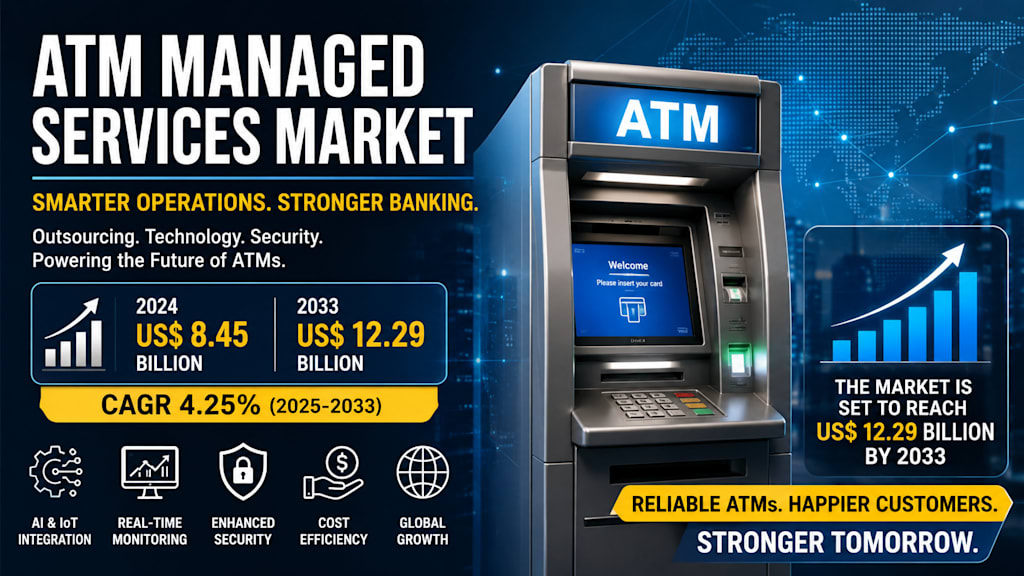
According to Renub Research, the global ATM Managed Services Market is projected to grow from US$ 8.45 Billion in 2024 to US$ 12.29 Billion by 2033, expanding at a CAGR of 4.25% during the forecast period from 2025 to 2033.
The market is benefiting from rising demand for operational efficiency, growing ATM deployments, advancements in artificial intelligence (AI), enhanced security requirements, and increasing pressure on banks to focus on their core business functions rather than infrastructure management.
Understanding ATM Managed Services
ATM managed services refer to outsourced solutions that handle the operation, maintenance, monitoring, replenishment, and security of ATM networks. These services enable banks and financial institutions to improve ATM performance while reducing operational costs.
Managed service providers typically offer a comprehensive range of services, including:
ATM monitoring
Cash replenishment
Currency management
Incident management
Network management
Security management
Predictive maintenance
Regulatory compliance support
Rather than investing heavily in internal ATM management teams, banks can rely on specialized providers that possess the technology, expertise, and resources required to maintain high ATM uptime and customer satisfaction.
Why Banks Are Increasingly Outsourcing ATM Operations
The banking industry is experiencing unprecedented transformation. Customers expect seamless digital experiences while still requiring reliable access to cash when needed.
Managing thousands of ATM locations internally requires significant investments in personnel, software, hardware, logistics, and cybersecurity. Outsourcing these functions allows banks to improve efficiency while reducing operational burdens.
Financial institutions are increasingly partnering with managed service providers to ensure:
Reduced operational expenses
Improved ATM availability
Faster issue resolution
Better customer experiences
Enhanced security measures
Greater regulatory compliance
This strategic shift is helping banks allocate resources toward innovation, digital banking platforms, and customer-centric initiatives.
Digital Banking Growth Is Creating New Opportunities
The rise of digital banking has not eliminated the need for ATMs. Instead, it has transformed their role.
Today's consumers expect ATMs to function as self-service banking centers capable of handling multiple transactions beyond cash withdrawals. Modern ATMs now support deposits, bill payments, cardless transactions, QR-based services, and account management functions.
As ATM functionality expands, maintenance requirements become more sophisticated. Financial institutions require specialized expertise to manage software updates, connectivity issues, cybersecurity threats, and hardware performance.
This growing complexity is creating significant opportunities for ATM managed service providers worldwide.
Artificial Intelligence Is Transforming ATM Management
One of the most significant trends shaping the ATM managed services market is the integration of artificial intelligence and machine learning technologies.
AI-powered monitoring systems enable service providers to detect problems before they affect customers.
These advanced systems can:
Predict equipment failures
Identify suspicious activity
Optimize cash replenishment schedules
Improve ATM uptime
Reduce maintenance costs
Enhance customer service quality
Predictive maintenance is particularly valuable because it minimizes downtime and prevents costly disruptions.
Instead of waiting for machines to fail, service providers can proactively address issues, ensuring uninterrupted banking services for customers.
Internet of Things Enhances ATM Efficiency
The integration of Internet of Things (IoT) technology is further improving ATM management capabilities.
IoT-enabled sensors continuously monitor:
Hardware performance
Network connectivity
Internal temperatures
Security conditions
Transaction patterns
Real-time monitoring allows providers to identify operational anomalies instantly and take corrective action before service interruptions occur.
This technological advancement is helping banks achieve higher efficiency while reducing operational risks.
Expanding ATM Networks Fuel Market Growth
One of the strongest drivers supporting market expansion is the continued growth of ATM networks worldwide.
Many developing economies are actively promoting financial inclusion by expanding banking access to rural and underserved populations.
As a result, financial institutions are deploying ATMs across:
Rural communities
Semi-urban locations
Transportation hubs
Shopping centers
Educational institutions
Corporate workplaces
While expanding ATM coverage improves financial accessibility, it also increases management complexity.
Managed service providers play a crucial role in ensuring these geographically dispersed ATM networks operate efficiently and securely.
Growing Security Concerns Increase Demand for Managed Services
ATM-related fraud remains a significant concern for financial institutions globally.
Criminals continue to employ sophisticated techniques such as:
Card skimming
Cash trapping
Malware attacks
Network intrusions
Identity theft
To combat these threats, banks are investing heavily in advanced security solutions.
Managed service providers help institutions strengthen security through:
Real-time threat monitoring
AI-powered fraud detection
EMV compliance
Encryption technologies
Continuous surveillance
Security audits
The growing need for robust ATM security is expected to remain a key growth catalyst throughout the forecast period.
Government Initiatives Support Market Expansion
Governments across the world are encouraging the modernization of banking infrastructure.
Several countries have introduced regulations requiring the transition from magnetic stripe cards to EMV chip-enabled cards to reduce fraud risks.
In addition, many governments are promoting:
Digital financial inclusion
Secure banking ecosystems
Cash accessibility programs
Banking infrastructure modernization
These initiatives create favorable conditions for ATM managed service adoption.
Financial institutions increasingly rely on external providers to ensure compliance with evolving regulations while maintaining efficient ATM operations.
The Challenge of Maintaining High ATM Uptime
Although growth opportunities are substantial, the industry faces several operational challenges.
One of the most critical challenges is maintaining high ATM availability.
Consumers expect ATMs to be available around the clock. Even brief outages can negatively affect customer satisfaction and damage a bank's reputation.
Service providers must establish:
Real-time monitoring systems
Rapid-response maintenance teams
Strong service-level agreements (SLAs)
Remote diagnostic capabilities
Maintaining high uptime across thousands of machines requires significant expertise and operational discipline.
Cash Management Remains a Complex Task
Efficient cash management represents another major challenge for ATM managed service providers.
Accurate cash forecasting is essential to prevent:
Cash shortages
Excess idle cash
Increased operational costs
Customer dissatisfaction
Providers must analyze transaction patterns, seasonal demand fluctuations, and regional cash usage trends.
Managing cash logistics becomes even more complicated in remote locations where transportation infrastructure may be limited.
Despite these challenges, advancements in predictive analytics are helping providers optimize cash replenishment strategies and improve operational efficiency.
North America Leads Market Development
North America remains one of the most mature ATM managed services markets globally.
Banks throughout the United States and Canada increasingly outsource ATM operations to improve efficiency and reduce expenses.
The region benefits from:
Advanced banking infrastructure
Strong technology adoption
High ATM penetration
Sophisticated cybersecurity frameworks
AI-powered predictive maintenance and real-time monitoring solutions are becoming standard offerings among service providers.
The United States continues to represent a major revenue-generating market due to the extensive ATM networks operated by financial institutions nationwide.
Europe Continues Steady Growth
Europe is witnessing consistent growth in ATM managed services adoption.
Countries such as Germany, the United Kingdom, France, and Italy are increasingly investing in managed solutions to improve ATM performance and security.
German financial institutions, in particular, are leveraging AI and IoT technologies to enhance ATM operations while ensuring compliance with strict regulatory standards.
As banking institutions seek greater efficiency, outsourcing trends are expected to strengthen across the European market.
Asia-Pacific Emerges as a High-Growth Region
Asia-Pacific is expected to deliver some of the strongest growth opportunities during the forecast period.
Rapid urbanization, expanding banking infrastructure, and financial inclusion initiatives are driving ATM deployment across the region.
Countries such as:
China
India
Indonesia
Thailand
Malaysia
are witnessing increasing demand for managed ATM services.
China's large banking network and strong focus on technological innovation have accelerated adoption of AI-enabled ATM management solutions.
Similarly, India's growing banking penetration and government-led financial inclusion programs continue to support market expansion.
Middle East and Africa Show Promising Potential
The Middle East and Africa region is gradually becoming an important market for ATM managed services.
Countries such as Saudi Arabia and the United Arab Emirates are investing heavily in banking modernization initiatives.
Rising demand for secure financial services, increasing ATM installations, and expanding digital banking ecosystems are creating favorable conditions for managed service providers.
Financial institutions across the region are increasingly outsourcing ATM operations to improve efficiency and service quality.
Competitive Landscape
The ATM managed services market remains highly competitive, with global technology providers and specialized service companies competing to expand their market presence.
Leading companies focus on:
Technology innovation
Strategic partnerships
Geographic expansion
Security enhancements
AI integration
Service portfolio diversification
Major industry participants include:
NCR Atleos
Diebold Nixdorf, Inc.
Euronet Worldwide, Inc.
Fiserv, Inc.
AGS Transact Technologies Ltd.
Brink's Incorporated
Hitachi, Ltd.
CMS Info Systems Limited
These organizations continue investing in advanced technologies to improve ATM reliability, security, and customer experiences.
10 Recent Developments in the ATM Managed Services Industry
1. NCR Atleos Expanded ATM-as-a-Service Solutions
The company strengthened its ATM outsourcing portfolio by offering more comprehensive ATM-as-a-Service models for financial institutions.
2. Diebold Nixdorf Enhanced AI-Based Monitoring
Diebold Nixdorf introduced advanced predictive maintenance capabilities designed to reduce downtime and improve ATM performance.
3. Euronet Worldwide Expanded Global ATM Operations
The company continued growing its independent ATM network and managed services footprint across multiple international markets.
4. Fiserv Increased Focus on Digital Banking Integration
Fiserv enhanced integration capabilities between ATM networks and digital banking ecosystems.
5. AGS Transact Technologies Expanded Managed Services Portfolio
The company strengthened its ATM outsourcing offerings across key banking customers in Asia.
6. Brink's Enhanced Cash Management Solutions
Brink's expanded intelligent cash logistics capabilities to improve ATM replenishment efficiency.
7. Hitachi Advanced Smart ATM Technologies
Hitachi continued investing in automation and self-service banking technologies.
8. CMS Info Systems Expanded Banking Infrastructure Services
The company increased its presence in ATM management and cash logistics operations.
9. Industry-Wide Adoption of IoT Monitoring Accelerated
Service providers increasingly adopted IoT-enabled sensors for real-time ATM monitoring.
10. AI-Powered Fraud Detection Became a Key Investment Area
Leading providers increased investments in machine learning systems designed to detect suspicious ATM activity in real time.
Final Thoughts
The ATM Managed Services Market is entering a new phase of growth driven by technological innovation, operational efficiency requirements, and the evolving needs of financial institutions.
Although digital banking continues to expand rapidly, ATMs remain an essential component of the global banking ecosystem. Financial institutions increasingly recognize that outsourcing ATM management allows them to focus on innovation while ensuring reliable, secure, and cost-effective service delivery.
With the market projected to grow from US$ 8.45 Billion in 2024 to US$ 12.29 Billion by 2033, ATM managed services are expected to play an increasingly important role in shaping the future of banking infrastructure worldwide. As AI, IoT, predictive analytics, and advanced security solutions continue to evolve, managed service providers will remain at the center of modern ATM network operations.
About the Creator
Enjoyed the story? Support the Creator.
Subscribe for free to receive all their stories in your feed.
Comments
There are no comments for this story
Be the first to respond and start the conversation.