
Assortment and Space Optimization (ASO) Market: Data-Driven Retail Is Reshaping Profitability and Customer Experience
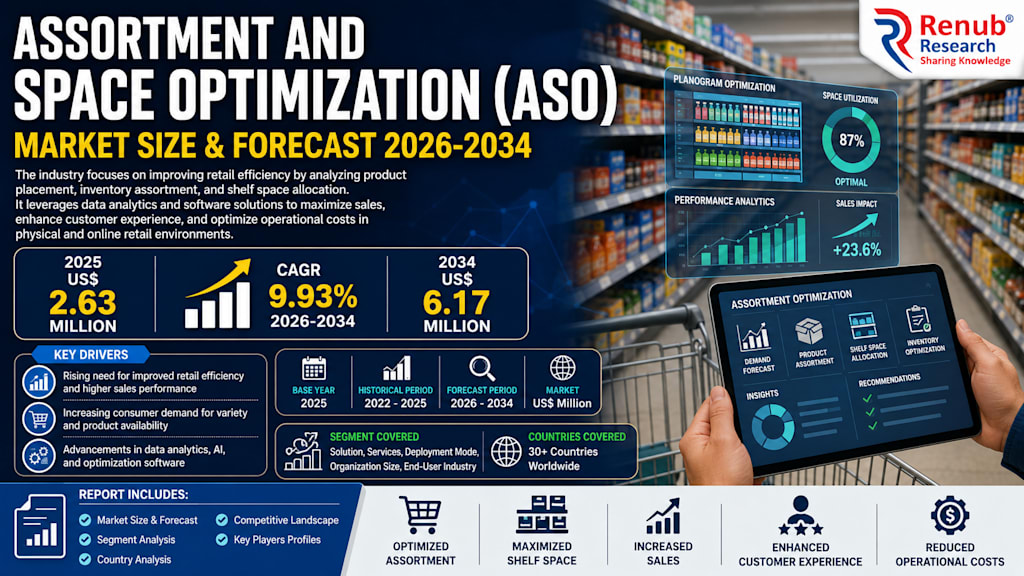
Projected to grow from US$ 2.63 million in 2025 to US$ 6.17 million by 2034, the ASO market is becoming a critical engine for retail efficiency, powered by AI, analytics, and omnichannel strategies.

The Rise of Smarter Retail: Why ASO Matters More Than Ever
Retail is no longer just about stocking shelves—it’s about precision. Every product placed, every square foot used, and every digital listing displayed can directly influence revenue. This is where Assortment and Space Optimization (ASO) steps in as a game-changing solution.
According to the provided market insights, the ASO market is expected to expand from US$ 2.63 million in 2025 to US$ 6.17 million by 2034, registering a strong CAGR of 9.93% from 2026 to 2034.
This growth reflects a fundamental shift in how retailers operate. Instead of relying on intuition, modern retail is increasingly driven by data, analytics, and technology. ASO solutions enable businesses to decide what products to stock, where to place them, and how to present them—both in physical stores and online platforms.
In a competitive retail environment where margins are tight and consumer expectations are rising, ASO is no longer optional. It is becoming essential.
Industry Overview: The Science Behind Shelf Success
The ASO industry focuses on optimizing product assortment, inventory management, and space allocation using advanced technologies such as artificial intelligence (AI), machine learning, and predictive analytics.
In traditional retail stores, ASO determines how shelves are arranged, which products are displayed at eye level, and how promotional space is used. These decisions directly affect customer behavior and purchase patterns. A well-optimized store layout can significantly increase sales per square foot.
In e-commerce, ASO operates in a digital environment. It ensures that products appear in the right positions on websites and apps, improving discoverability and conversion rates. Digital shelf optimization, personalized recommendations, and real-time inventory visibility are all part of ASO’s capabilities.
The integration of point-of-sale data, loyalty programs, and customer insights allows retailers to forecast demand more accurately. This reduces stockouts, minimizes overstock situations, and improves overall operational efficiency.
As product assortments grow more complex and consumer preferences evolve rapidly, ASO provides the analytical foundation needed to make smarter, faster decisions.
Data-Driven Decision Making Is the Core Growth Driver
One of the most significant drivers of the ASO market is the growing reliance on data-driven decision-making. Retailers today manage thousands of SKUs across multiple channels, making manual planning increasingly ineffective.
ASO tools analyze vast amounts of data, including sales history, customer behavior, pricing trends, and inventory levels. This enables retailers to determine the optimal product mix for each store or platform.
For example, a product that performs well in one location may not perform as well in another due to differences in demographics or shopping behavior. ASO solutions can identify these patterns and recommend localized assortments that maximize sales.
Real-time analytics also allow retailers to adapt quickly to changing conditions. Seasonal trends, promotional campaigns, and unexpected demand shifts can all be managed more effectively with ASO tools.
As competition intensifies, retailers that embrace data-driven strategies gain a significant advantage in terms of efficiency, profitability, and customer satisfaction.
Omnichannel Retail Is Expanding the Need for ASO
The rise of omnichannel retail has added a new layer of complexity to assortment and space management. Retailers are no longer operating in a single channel—they must coordinate across physical stores, e-commerce platforms, mobile apps, and even social commerce.
ASO solutions help ensure consistency across these channels. They enable retailers to synchronize inventory, optimize product placement, and deliver a seamless customer experience.
For instance, click-and-collect services require precise inventory management to ensure that products ordered online are available in-store. Subscription models and personalized recommendations also depend on accurate assortment planning.
In e-commerce, ASO improves product visibility by optimizing search rankings, recommendations, and digital shelf placement. This directly impacts conversion rates and customer engagement.
As omnichannel strategies continue to evolve, the importance of ASO will only increase.
Maximizing Space: A Critical Profitability Lever
Retail space is expensive, especially in urban areas and high-traffic locations. Every inch of shelf space must generate value. ASO tools help retailers identify high-performing products and allocate space accordingly.
By analyzing sales data and customer behavior, ASO solutions can recommend which products to prioritize and which to remove. This ensures that only the most profitable items occupy valuable space.
In addition, ASO supports effective promotional planning. Seasonal displays, cross-selling opportunities, and targeted promotions can all be optimized to increase sales.
In the digital world, space optimization translates into screen space. Products that appear higher in search results or on homepage banners are more likely to be purchased. ASO ensures that these positions are used strategically.
Ultimately, maximizing space utilization is not just about efficiency—it’s about driving revenue and improving the customer experience.
Challenges: Data Complexity and Execution Barriers
Despite its advantages, the ASO market faces several challenges that can limit adoption and effectiveness.
One of the biggest challenges is data complexity. ASO relies on large volumes of data from multiple sources, including sales systems, inventory databases, and customer insights. Ensuring that this data is accurate, consistent, and up-to-date is a significant task.
Poor data quality can lead to incorrect recommendations, which can negatively impact sales and inventory management. Retailers must invest in data governance and integration to fully benefit from ASO solutions.
Another challenge is balancing standardization with localization. While standardized assortments simplify operations, they may not meet local customer needs. On the other hand, highly localized assortments can increase complexity and operational costs.
Change management is also a key issue. Many retailers are accustomed to traditional decision-making methods and may resist adopting data-driven approaches. Successful ASO implementation requires alignment across teams and a willingness to embrace new technologies.
Regional Insights: Growth Across Global Retail Markets
The United States remains a leading market for ASO, driven by advanced retail infrastructure and the widespread adoption of analytics and AI technologies. Retailers across grocery, apparel, and specialty sectors are leveraging ASO to improve efficiency and profitability.
The United Kingdom is also experiencing steady growth, particularly in urban retail environments where space constraints are significant. UK retailers are focusing on optimizing smaller store formats and improving customer experience through data-driven merchandising.
India represents a rapidly emerging market for ASO. As organized retail expands and consumer expectations rise, retailers are increasingly adopting ASO solutions to manage complex assortments and limited space. Cloud-based platforms are particularly लोकप्रिय due to their scalability and cost-effectiveness.
Saudi Arabia is gaining momentum as part of broader retail modernization efforts under Vision 2030. Investments in organized retail and shopping infrastructure are driving demand for advanced optimization tools.
Recent Developments Highlight Innovation
Recent developments in the ASO market demonstrate the growing importance of technology and innovation.
In February 2024, Brevo launched its Customer Data Platform (CDP) and mobile push capabilities following strategic acquisitions, showcasing the integration of customer data into retail optimization strategies.
Zoho Corporation introduced Zakya, a point-of-sale system designed to streamline retail operations and provide centralized management.
In January 2024, Lenovo showcased AI-powered retail solutions at the Big Retail Show in New York City, emphasizing the role of advanced technologies in creating smarter and more secure retail environments.
These developments highlight how ASO is evolving beyond simple shelf management into a comprehensive, technology-driven ecosystem.
Market Segmentation: A Diverse and Expanding Landscape
The ASO market is segmented by components, deployment types, enterprise size, and geography.
Solutions and services form the core components, with solutions focusing on software platforms and services providing implementation, consulting, and support.
Cloud-based deployment is gaining popularity due to its flexibility, scalability, and lower upfront costs. On-premises solutions remain relevant for large enterprises with specific security or integration requirements.
Both large enterprises and small-to-medium-sized businesses are adopting ASO, although the scale and complexity of implementation may vary.
Industries such as grocery, fashion, electronics, and FMCG are among the primary adopters, reflecting the broad applicability of ASO across retail sectors.
The Future of ASO: Smarter, Faster, More Personalized
The future of the ASO market is closely tied to advancements in technology. AI, machine learning, and real-time analytics will continue to enhance the accuracy and effectiveness of optimization strategies.
Personalization will become increasingly important. Retailers will use ASO to tailor assortments and recommendations to individual customers, improving engagement and loyalty.
Sustainability is another emerging focus. By reducing overstock and waste, ASO contributes to more efficient and environmentally friendly retail operations.
As competition intensifies and consumer expectations continue to rise, ASO will play a central role in shaping the future of retail.
Final Thoughts
The Assortment and Space Optimization (ASO) market is transforming how retailers think about products, space, and strategy. With projected growth from US$ 2.63 million in 2025 to US$ 6.17 million by 2034, it is clear that data-driven retail is here to stay.
In a world where every decision counts, ASO provides the tools needed to make smarter choices. It turns data into insights, insights into actions, and actions into measurable results.
About the Creator
Enjoyed the story? Support the Creator.
Subscribe for free to receive all their stories in your feed.
Comments
There are no comments for this story
Be the first to respond and start the conversation.